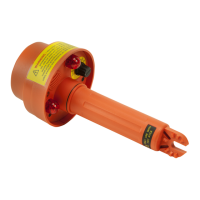
The Klein Tools HVNCVT2 is a broad-range high-voltage non-contact tester designed for verifying the live or de-energized status of conductors and other exposed electrical equipment. This instrument provides warnings against dangerous voltage across several different ranges without requiring direct contact with the energized conductor. It is intended for use by trained personnel only, always in conjunction with hot sticks and rubber gloves that meet industry standards.
Function Description:
The primary function of the HVNCVT2 is to detect the presence of AC voltage in a non-contact manner. It is capable of identifying live or de-energized conditions in various electrical systems, including overhead lines and cables. The tester features a sensitivity selector that allows users to choose from multiple voltage ranges, ensuring appropriate detection for different applications. It provides both visual (red LEDs) and audible (beeping sound) warnings when voltage is detected. The device also includes a self-test function to confirm battery sufficiency, system integrity, and active mode before use. Additionally, it can be used for finding faults in some flexible cables by detecting changes in the electric field along the cable.
Important Technical Specifications:
- Operating Temperature: 14° to 122°F (-10° to 50°C) at 85% relative humidity.
- Storage Temperature: -4° to 140°F (-20° to 60°C) at 85% relative humidity.
- Dimensions:
- Tester: 10" x 4.25" x 4.25" (254 x 108 x 108 mm)
- Case: 13.5" x 8.75" x 4.75" (343 x 222 x 121 mm)
- Weight: 1.32 lbs. (600 g).
- Power Source: Three 1.5V "C" cell batteries.
- Voltage Ranges (Sensitivity Selector): OFF, TEST, 240V, 4.2kV, 15kV, 25kV, 35kV, 69kV, 115kV, 230kV.
- Maximum Voltage Rating: Never test voltage more than 230kV AC RMS.
- Safety Ratings: Double Insulated.
- Compliance: Designed to be used in accordance with OSHA Sub-parts R & V and company work rules, including Minimum Approach Distances (MAD) specified in OSHA Tables R-6 and R-7.
Usage Features:
- Non-Contact Detection: Detects AC voltage without physical contact, reducing the risk of electrical shock.
- Broad Voltage Range: Offers multiple sensitivity settings from 240V up to 230kV, making it versatile for various high-voltage applications.
- Visual and Audible Indicators: Equipped with three red voltage indicator LEDs and a buzzer to provide clear warnings of detected voltage.
- Self-Test Function: A "TEST" setting on the sensitivity selector allows users to perform a self-test, confirming battery life and proper operation before use. This test should result in a steady red light from all three LEDs and a steady high-pitched sound.
- Secondary Test (240V AC): A secondary test can be performed at the 240V setting by placing the dome near a low voltage live conductor or rubbing it against clothing to generate static. This should produce a blinking red light and a beeping sound.
- Hot Stick Connection: Designed for exclusive use with hot sticks, connecting securely at the hot stick connection point. This ensures safe operation at a distance from energized equipment.
- Sensitivity Selector: A rotary switch allows users to select the appropriate voltage range. It is recommended to start with a lower test setting than the actual working voltage and gradually increase it until voltage is detected.
- Fault Finding: Can be used to locate faults in flexible cables by moving the detector along the cable and observing changes in the warning signals (beeping/blinking).
- Safety Precautions: Emphasizes the importance of following approved work safety practices, clearances, and using appropriate Personal Protective Equipment (PPE) such as rubber gloves and arc-rated clothing. Users are warned against grounding themselves, operating in explosive atmospheres, or exposing the tester to rain/moisture. It is crucial to verify that phase conductors are separated by at least 15" (381 mm) when testing 3-phase feeder cables to avoid self-cancellation of the electric field. The tester should not be relied upon for shielded wire or cable with concentric neutrals, or in areas with mixed high voltages where it may become unreliable.
Maintenance Features:
- Battery Replacement:
- Unscrew the tester handle (battery compartment) from the tester head.
- Remove the three old batteries.
- Replace with three new 1.5V "C" type batteries, ensuring the negative (-) end is down into the handle first, and the positive (+) end is upwards towards the head.
- Screw the handle and head back together, making sure the black rubber O-ring is in place and not damaged.
- Cleaning: The tester should be kept clean and dry. Wipe with a clean, dry, lint-free cloth. Do not use abrasive cleaners or solvents.
- Storage: For periods of non-use longer than 60 days, remove the batteries and store them separately from the tester to prevent potential damage.
- Disposal/Recycling: The equipment and its accessories should not be placed in regular trash but disposed of properly in accordance with local regulations. Information on proper disposal can be found at www.epa.gov or www.erecycle.org.

 Need help?
 General

 To Next Page