HELPFUL HINTS
• Do not operate TEAS close to a fan or point of high air motion. Wind will dissipate the
heat from the test area, causing poor readings.
• Hold the Hot Probe in contact with the test metal for only about 2 seconds & read the
display. Lift probe off test metal for two seconds allowing probe temperature to stabilize.
Repeat this cycle. Rushed testing without pauses may result in reading drift.
• Be sure the test metal and hot tip of the probe remains clean.
• If tip becomes marred or misshaped, unscrew and replace.
• Confirm that the tip is completely screwed tightly into the probe shaft. Loose tips could
give weak readings. Use of a hand-held crimping tool (Part No. TE-3000 F) is
recommended for proper torque without scratching tip.
•
PREVENTATIVE MAINTENANCE & CALIBRATION
• The Thermoelectric Alloy Sorter Model TE-3000-HD is supplied with an Initial Certificate of
Calibration. Koslow Scientific Co. recommends yearly calibration services known as a
“field” Certificate of Calibration (Service No. TE-3000-C). This certificate contains before
and after calibration data and the expected manufactures criteria. Aspects of the document
are N. I. S. T. traceable.
• Maintain kit by storing in a cool, dark place.
• Annual calibration cycles can be logged on the last page of this instruction manual.
Maintenance items are the responsibility of the customer/user. Failure to observe these
recommendations may adversely affect the operation of the equipment.
SIGNAL JACKS
The TE-3000-HD is supplied with one black and one red female banana jack on the top of the
instrument. These terminals can be used to interface with automation equipment, PLC’s
(Programmable Logic Controls) and data logging equipment. The output signal is an analog DC
millivolt signal.
DAILY QUALIFICATION STANDARD
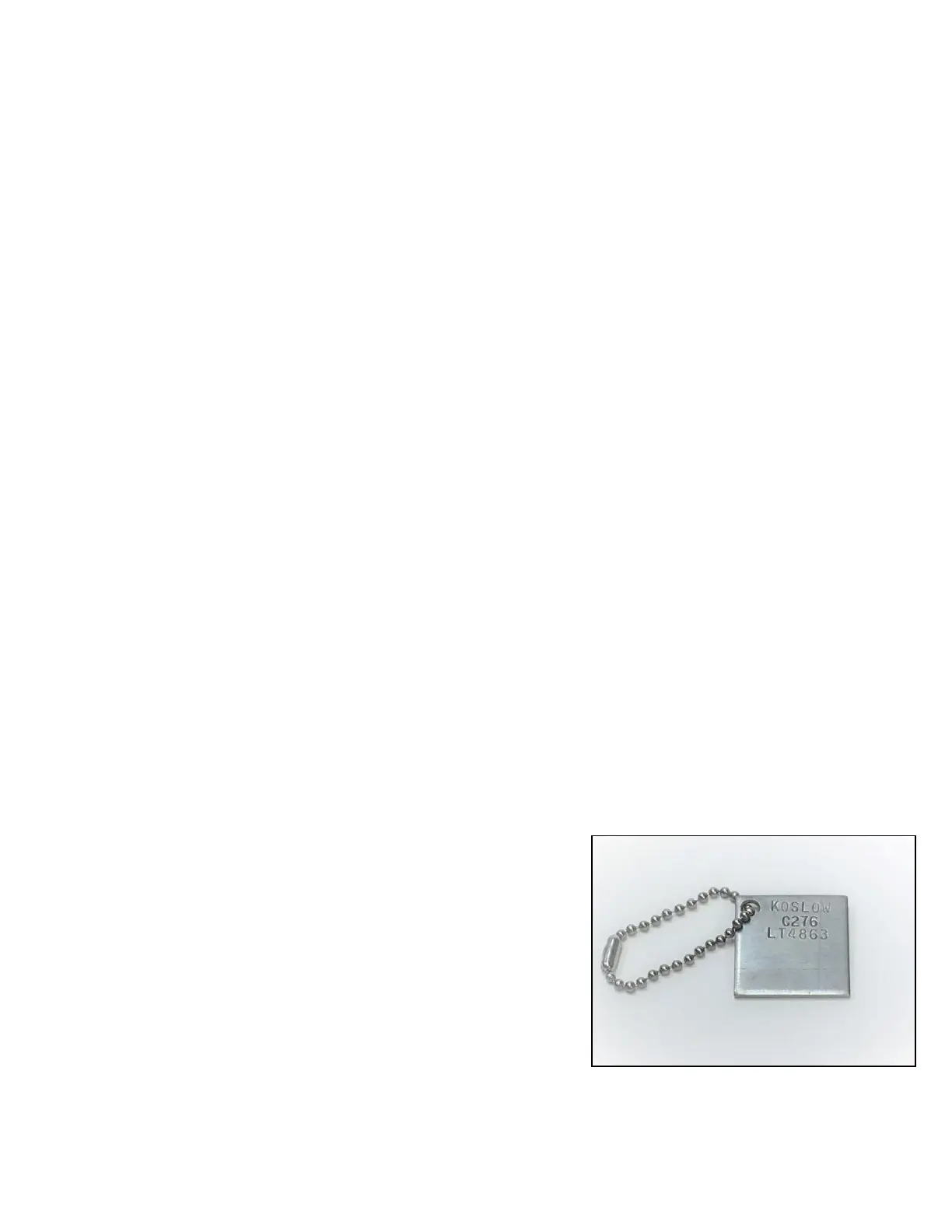
The kit includes a Daily Qualification Standard, (DQS) a
1-inch square plate of a nickel alloy. The DQS is
attached to the side of the machine with a small chain.
The DQS is principally used to confirm repeatability. It
acts as a calibration registration point for all the other
readings.


 To Next Page
 Loading...