Form #: SIDOM.4 Page | 15 Revised: 03/19
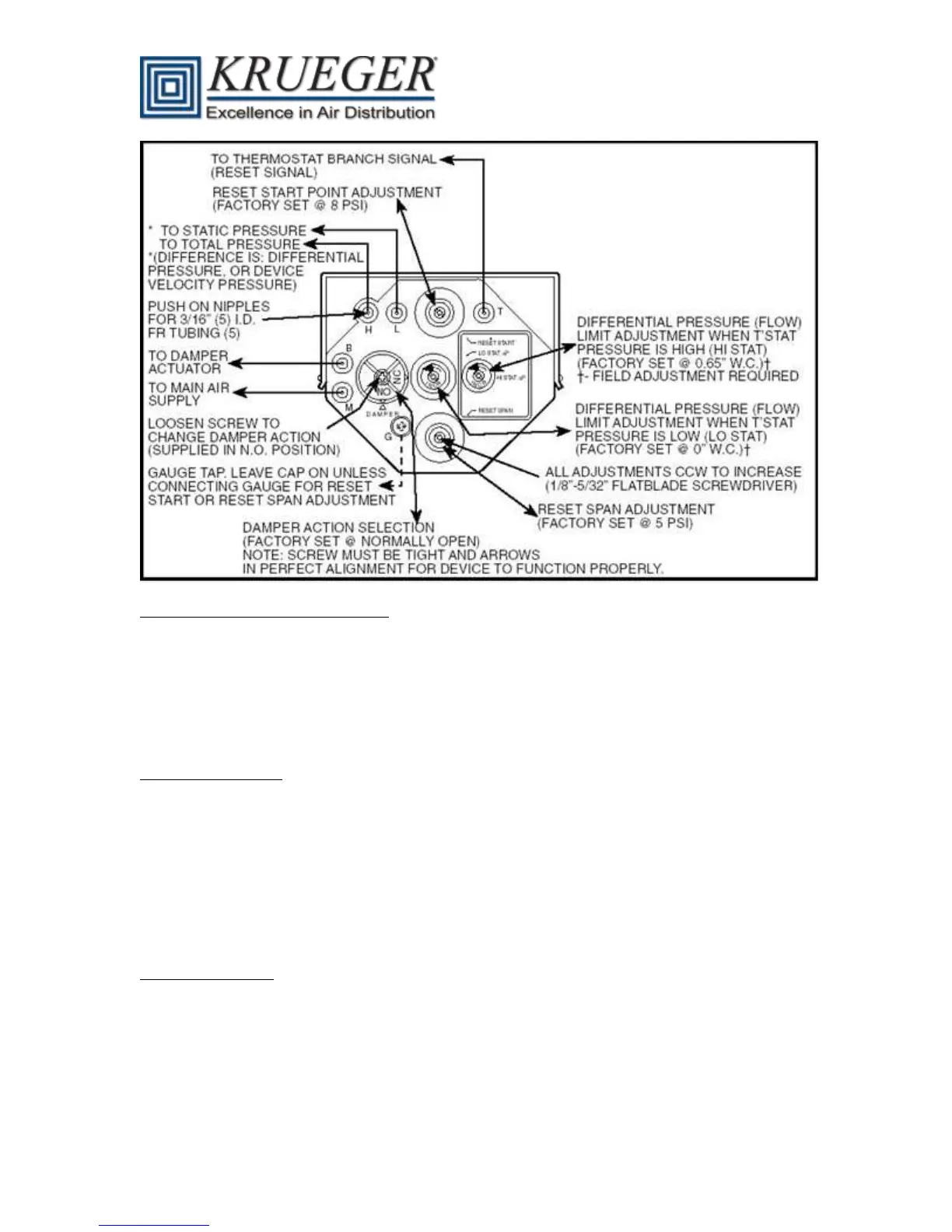
Figure 8 – CSC 3011
Adjusting Minimums and Maximums
When adjusting the minimum and maximum airflow settings, the output responds slowly to
changes in the set point. Wait for the flow rate to stabilize after making an adjustment
(usually 20 to 30 seconds) before making further adjustments. Also, if the damper position
is completely closed or open when starting this step, turn the adjustment one full turn then
wait 20 to 30 seconds for a change in the flow reading of the Magnehelic gauge. If no change
occurs after this time, repeat until the flow rate changes.
LO STAT ∆P Setting is the desired airflow limit when the thermostat pressure is less than, or equal
to, the reset start point.
For DA Cooling or RA Heating (See Table 2 on pg. 12): Adjust LO STAT ∆P to the
desired minimum airflow by turning knob CLOCKWISE with 0 psig (or a pressure less
than the reset start point) at port “T”. The LO STAT ∆P must be set first. The LO STAT
∆P will affect the HI STAT ∆P setting.
For RA Cooling or DA Heating (See Table 2 on pg. 12): Adjust LO STAT ∆P to the
desired maximum airflow by turning knob COUNTER CLOCKWISE with 0 psig (or a
pressure less than the reset start point) at port “T”. The LO STAT ∆P must be set first.
The LO STAT ∆P will affect the HI STAT ∆P setting.
HI STAT ∆P Setting is the desired airflow limit when the thermostat pressure is greater than, or equal
to, the reset stop-point. The reset stop-point is the reset span pressure added to the reset start point
pressure.
For DA Cooling or RA Heating (See Table 2 on pg. 12): Adjust HI STAT ∆P to the desired
maximum airflow by turning knob COUNTER CLOCKWISE with 20 psig (or a pressure
greater than the reset stop point) at port “T”. The HI STAT ∆P must be set last. The HI STAT
∆P setting will be affected by the LO STAT ∆P setting.


 To Next Page