EasyManua.ls Logo

KTM 250 SX-F 2018 - User Manual

KTM 250 SX-F 2018
120 pages
Print Icon
To Next Page IconTo Next Page
Loading...
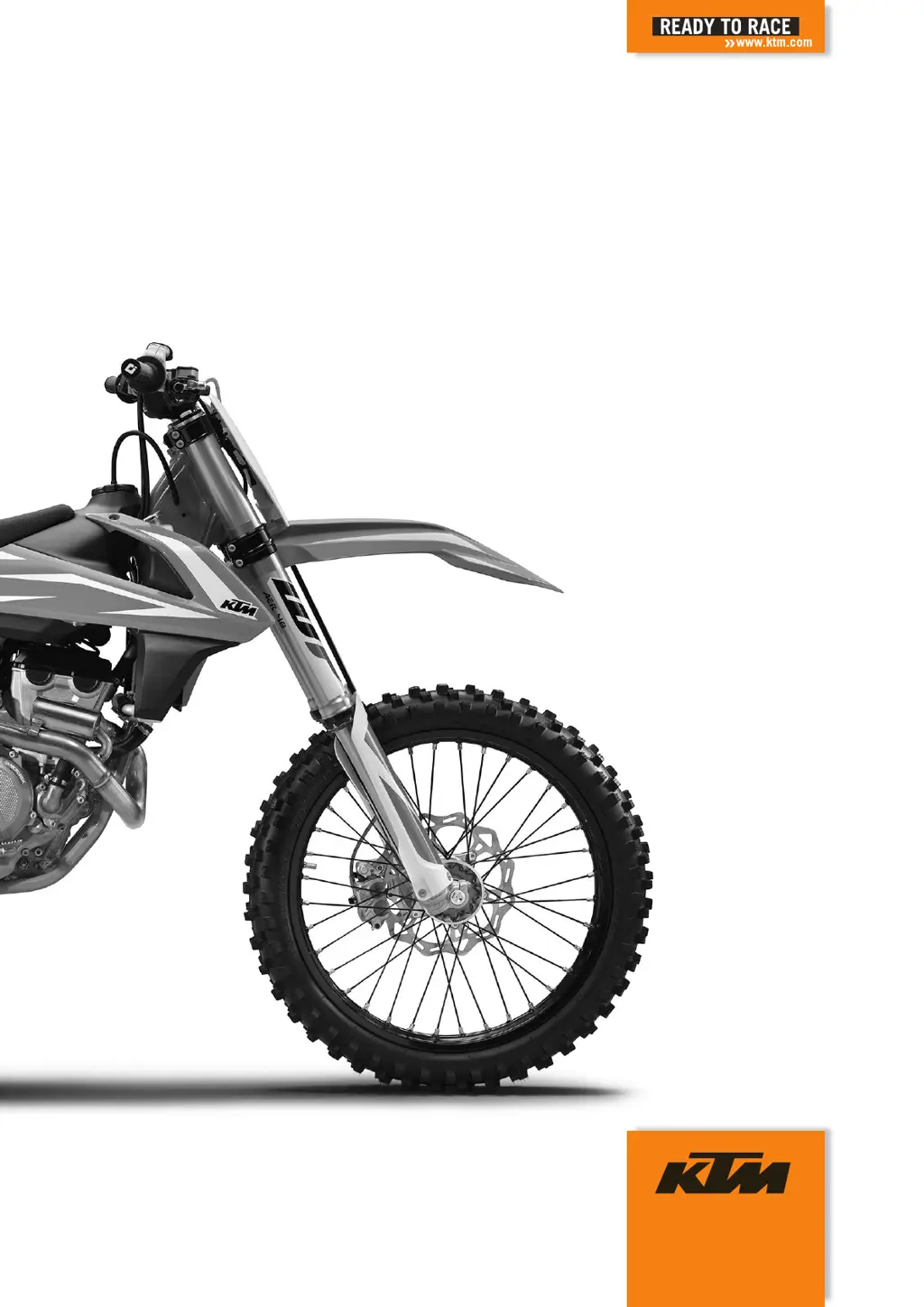
OWNER'S MANUAL 2018
250 SX-F
250 XCF
Art. no. 3213638en

Table of Contents

Questions and Answers

  • B
    Bethany FernandezAug 2, 2025
    What to do if my KTM Motorcycle engine does not turn when pressing the electric starter?
    • O
      omorganAug 2, 2025
      If your KTM Motorcycle engine doesn't turn when you press the electric starter button, consider the following possibilities: * It could be an operating error; ensure you follow the correct start procedure. * The battery might be discharged; try recharging it, and check the charging voltage, open-circuit current, and the stator winding of the alternator. * The main fuse could be blown; replace the main fuse. * The starter relay might be defective; check the starter relay. * The starter motor itself could be defective; in this case, check the starter motor.
  • J
    Jose AyersAug 8, 2025
    Why does my KTM 250 SX-F 2018 Motorcycle engine overheat?
    • W
      William JohnstonAug 8, 2025
      Your KTM Motorcycle engine may overheat due to these reasons: * There might be too little coolant in the cooling system; check the cooling system for leakage and ensure the coolant level is correct. * There could be too little air stream; switch off the engine when standing. * The radiator fins might be very dirty; clean the radiator fins. * There might be foam formation in the cooling system; drain and refill the coolant. * A bent radiator hose could be the cause; replace the radiator hose.
  • S
    Stacy PetersonAug 13, 2025
    Why KTM 250 SX-F 2018 engine has too little power?
    • M
      Mallory WilliamsAug 13, 2025
      If your KTM Motorcycle engine has too little power, here are potential causes: * The air filter might be very dirty; clean the air filter and air filter box. * The fuel filter could be very dirty; replace the fuel filter. * There may be a defect in the fuel injection system; read out the fault memory using the KTM diagnostics tool. * The exhaust system might be leaky or deformed, or there could be too little glass fiber yarn filling in the main silencer; check the exhaust system for damage and replace the glass fiber yarn filling of the main silencer. * The valve clearance could be too little; adjust the valve clearance.
  • V
    vargasericAug 18, 2025
    Why does my KTM 250 SX-F 2018 have high oil consumption?
    • C
      coopermichaelAug 18, 2025
      High oil consumption in your KTM Motorcycle can be attributed to: * A bent engine vent hose; ensure the vent hose is routed without bends, and replace it if necessary. * An engine oil level that is too high; check the engine oil level. * Engine oil that is too thin (low viscosity); change the engine oil and oil filter, and clean the oil screen. * A worn piston or cylinder; measure the piston/cylinder mounting clearance.
  • S
    Stephanie HernandezAug 22, 2025
    What to do if malfunction indicator lamp lights up or flashes on my KTM 250 SX-F 2018?
    • J
      Jessica TaylorAug 23, 2025
      If the malfunction indicator lamp lights up or flashes on your KTM Motorcycle, it indicates a defect in the fuel injection system. Check the cabling for damage and the electrical plug-in connections for corrosion and damage. Then, read out the fault memory using the KTM diagnostics tool.
  • P
    peggy01Oct 28, 2025
    Why does my KTM 250 SX-F 2018 engine turn but not start?
    • L
      Louis ThomasOct 28, 2025
      Your KTM Motorcycle engine might turn but fail to start due to several reasons: * The plug-in connection of the fuel line may not be connected; ensure it is properly connected. * The fuel screen in the fuel hose connection could be clogged; in this case, you should replace the fuel screen. * The idle speed might not be set correctly; adjust the idle speed accordingly. * The spark plug could be oily or wet; clean and dry it, or replace it if necessary. * The electrode distance (plug gap) of the spark plug might be too wide; adjust the plug gap to the recommended guideline of 0.8 mm (0.031 in). * There could be a short circuit cable in the wiring harness frayed, or the kill switch may be defective; check the wiring harness visually and the electrical system. * There might be a...

Summary

Safety Advice

Use Definition - Intended Use

Defines intended use and describes potential dangers from misuse.

Misuse and Safety Advice

Covers misuse, general safety instructions, and risk symbols.

Degrees of Risk and Symbols

Explains the different degrees of risk and associated symbols.

Tampering Warning

Warns against tampering with noise control systems and related legal prohibitions.

Safety Advice (Continued)

Safe Operation

Provides guidance on operating the vehicle safely and under correct conditions.

Protective Clothing

Emphasizes the importance of wearing appropriate protective clothing.

Controls

Clutch, Hand Brake, and Throttle Grip

Details the operation and adjustment of clutch, hand brake, and throttle grip.

Kill Switch and Electric Starter Button

Explains the function of the kill switch and electric starter button.

Controls (Continued)

Combination Switch and Indicator Lamps

Explains the combination switch functions and indicator lamps.

Handlebar Controls and Fuel Cap Closing

Covers throttle grip, electric starter, and closing the fuel filler cap.

Combination Switch Operation

Explains the combination switch mapping and its effect on engine characteristics.

Preparing for Use

Initial Setup and Safety Advice

Essential checks and safety guidelines before the first ride.

Preparing for Use (Continued)

First Use Safety and Riding Advice

Safety warnings and advice for initial operation and riding.

Riding Instructions

Pre-Ride Checks and Starting Procedures

Essential checks before operating the vehicle and basic starting steps.

Riding Instructions (Continued)

Starting Engine and Control Systems

Covers starting the engine, launch control, and traction control operation.

Traction Control and Starting Off

Instructions for activating traction control and starting off.

Launch Control and Traction Control Operation

Details on activating and using launch and traction control systems.

Shifting, Riding, and Braking Techniques

Guidance on gear shifting, riding, and applying brakes effectively.

Service Schedule

Required Work Intervals

Details required maintenance tasks at different operating hour intervals.

Service Schedule (Continued)

Required Work Intervals (Continued)

Continues detailing required maintenance tasks at different operating hour intervals.

Tuning the Chassis

Front Suspension (AER 48) Adjustments

Covers air suspension, compression, and rebound damping adjustments for the fork.

Tuning the Chassis (Continued)

Shock Absorber Adjustments - Low-Speed Compression

Adjusting low-speed compression damping on the rear shock absorber.

Shock Absorber Adjustments - Rebound Damping

Adjusting rebound damping on the rear shock absorber.

Adjusting the Spring Pretension of the Shock Absorber

Steps for adjusting the spring preload on the rear shock absorber.

Adjusting the fork air pressure

Procedure for adjusting the air pressure in the front fork suspension.

Adjusting the compression damping of the fork

Adjusting the hydraulic compression damping on the front fork.

Shock Absorber Adjustments - High-Speed Compression

Adjusting high-speed compression damping on the rear shock absorber.

Adjusting the rebound damping of the fork

Adjusting the hydraulic rebound damping on the front fork.

Service Work on the Chassis

Service Work on the Chassis (Continued)

Adjusting the chain tension

Steps for adjusting the chain tension using adjusting screws and nuts.

Brake System

Checking the free travel of the hand brake lever

Procedure for checking and setting the free travel of the front brake lever.

Brake System (Continued)

Checking the front brake fluid level

Procedure for checking the front brake fluid level.

Changing the front brake linings

Steps for changing the front brake linings, including caliper and piston procedures.

Checking the free travel of foot brake lever

Procedure for checking and setting the free travel of the rear brake lever.

Checking the rear brake fluid level

Procedure for checking the rear brake fluid level.

Rear Brake Lining Change Procedure

Continues steps for changing rear brake linings, including piston and fluid addition.

Adding front brake fluid

Instructions for adding front brake fluid and related warnings.

Changing the rear brake linings

Steps for changing the rear brake linings, including caliper and piston procedures.

Wheels, Tires

Wheels, Tires (Continued)

Electrical System

Electrical System (Continued)

Cooling System

Checking Antifreeze and Coolant Level

Procedure for checking antifreeze protection and coolant level in the radiator.

Cooling System (Continued)

Checking the Coolant Level

Procedure for checking the coolant level in the radiator.

Refilling Coolant

Procedure for refilling the coolant into the cooling system and checking level.

Tuning the Engine

Tuning the Engine (Continued)

Service Work on the Engine

Service Work on the Engine (Continued)

Checking the engine oil level

Procedure for checking the engine oil level when cold or warm.

Changing the engine oil and oil filter, cleaning the oil screen

Detailed steps for changing engine oil, filter, and cleaning the oil screen.

Engine Oil and Filter Replacement

Continues steps for replacing engine oil filter and adding engine oil.

Adding engine oil

Procedure for adding engine oil, including types and recommendations.

Troubleshooting

Engine Starting Issues

Addresses common problems like engine not turning or not starting.

Troubleshooting (Continued)

Engine Performance and Consumption Issues

Covers issues like engine not speeding up, high oil consumption, or engine dying.

Technical Data - Engine

Technical Data - Engine (Continued)

Technical Data - Capacities and Chassis

Technical Data - Chassis (Continued)

Technical Data - Fork and Shock Absorber

Fork Specifications (SX-F EU, SX-F US, XC-F US)

Details fork settings like compression, rebound damping, and air pressure.

Shock Absorber Specifications (SX-F EU)

Details shock absorber settings like compression and rebound damping.

Technical Data - Shock Absorber (Continued)

Shock Absorber Specifications (SX-F US, XC-F US)

Details shock absorber settings for SX-F US and XC-F US models.

Technical Data - Chassis Tightening Torques

KTM 250 SX-F 2018 Specifications

General IconGeneral
Displacement249.9 cm³
Bore x Stroke78 mm x 52.3 mm
Compression Ratio14.4:1
StarterElectric starter
Transmission5-speed
Fuel SystemKeihin EFI, throttle body 44 mm
IgnitionKeihin EMS
Rear SuspensionWP shock absorber with linkage
Front Wheel1.60 x 21"
Rear Wheel2.15 x 19"
Ground Clearance370 mm
Seat Height960 mm
Engine TypeSingle Cylinder, 4-Stroke Engine
Final Drive5/8 x 1/4"
FrameCentral double-cradle type 25CrMo4 steel
Front SuspensionWP USD AER 48
Front BrakeDisc brake 260 mm
Rear BrakeDisc brake 220 mm
Fuel Tank Capacity7 l

Related product manuals