Scanning System
The product warranty does not cover the damages to the scanning system caused by
improper use of the scanning system or by incorrect programming. Therefore it is essential
to understand how the scanning works and where are the limits of it. In this manual we will
explain only the basics of it but it is the responsibility of every user to educate themselves so
they can avoid damage being caused to the scanning system and costly repairs.
How to establish correct Scan-rate and maximal number of points in an effect
Each effect (picture) contains a different number of graphical points which defines the actual shape
of the effect. The more points an effect contains, the lower the maximum scan rate will be in relation
to the scanning angle.
As an example we'll work with the star effect shown below and with the parameters of the
ScannerMAX 506 Compact:
Let's say the star effect is made of 300 graphical points (including non-visible blanking points) and
we know that the maximal scan-rate of this scanning system is 35kpps @ 8 degrees (= 35.000
points per second at 8 degrees projection angle). We also know that we display the star 35 times
per second which is a default frame rate of the control software we are using.
So we need to display 300 points 35 times per second = 10.500 pps. This means that we could
display 3 of these stars within one single laser effect and that it would be quite close to the scanner
limit (3 x 10.500 = 31.500pps). This however applies ONLY if the scanning angle is not more
than 8 degrees on both axis! If we start to increase the size of the projection (scanning angle) it is
necessary to either lower the number of points within the effect or drop down the scan-rate in the
control software (FPS) to a safe level which may result in flicker.
Page 5Page 5
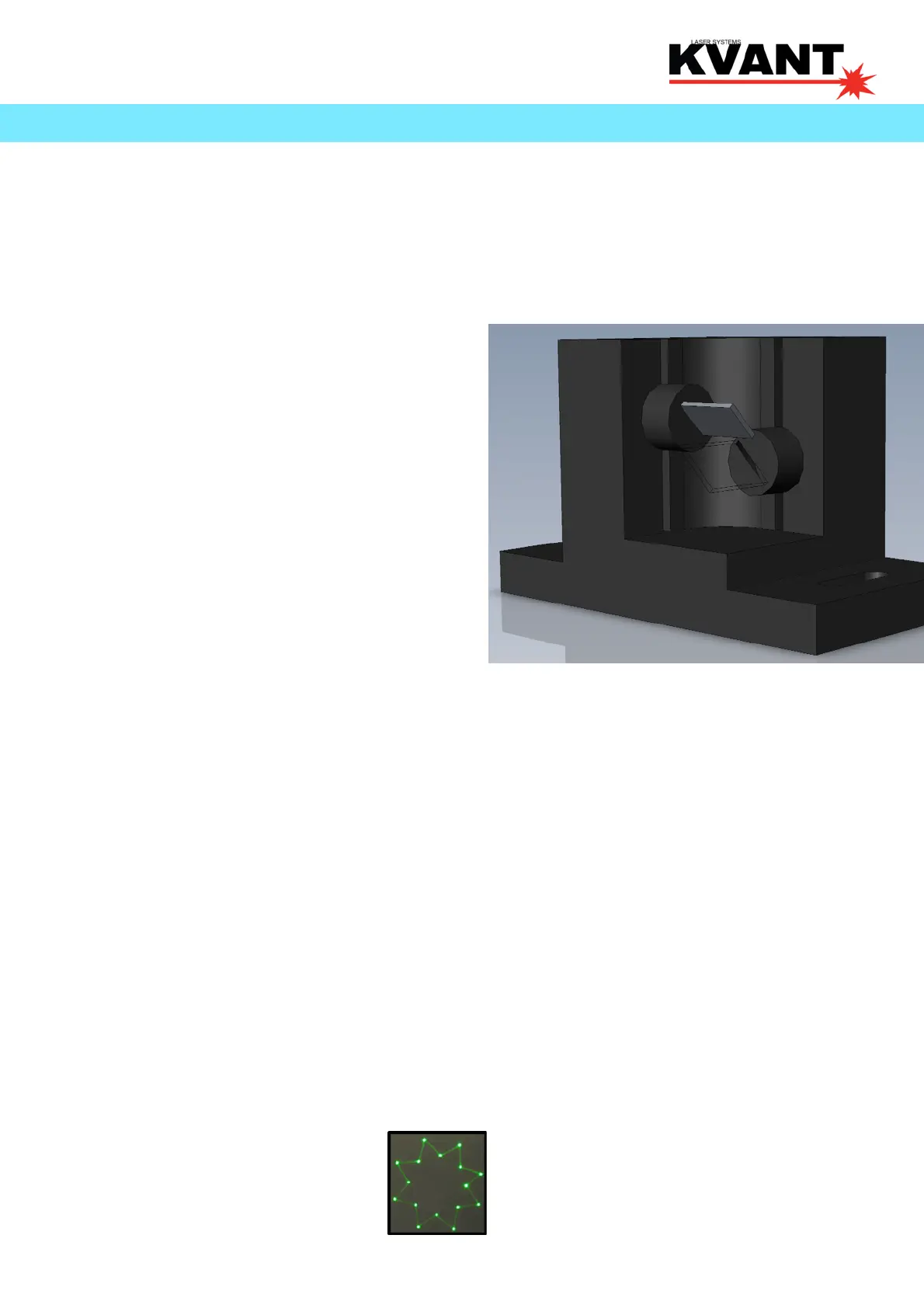
A laser beam comes from a laser module and hits
the two moving mirrors of the scanning system.
These mirrors are mounted on the scanner shafts
and are moved by the scanner rotors, one on X
and one on Y axis.
An effect such as tunnel (circle) is displayed by a
repetitive mechanical movement of the scanners.
For each scanning system and effect, there's a
maximal scan rate that is defined by mechanical
load, scanner mirror size and weight, complexity
of displayed picture and size of the projection (an
angle under the laser beam is being projected). A
different scanning systems have different scan-
rate limits. It is absolutely essential to operate the
scanning system at scan-rates within its maximal
limit at all times to prevent it from overload
damage.


 To Next Page
 Loading...