3
compressors.
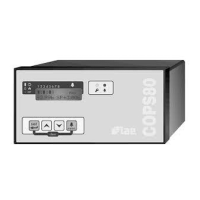
2.5 By pressing and keeping key [6] pressed, the stored alarms are displayed in area [9]; it's
possible to scroll this memory backwards and forwards by means of keys [6]+[5] or cancel
the displayed location with keys [6]+[4].
2.6 LED [2] illuminates when at least one of the compressors achieves the programmed run hours
for the warning to come up.
2.7 LED [3] blinks when an internal or external alarm is detected.
3 PROGRAMMING
The COPS 80 is a controller able to perform complex control functions to the best, it must therefore
be able to recognize the plant connected to it without any doubt. To this purpose, before the first
system start-up, it is mandatory to program the configuration parameters carefully in order to obtain
a perfect adaptation of the COPS 80 control algorithms to the specific plant.
As such parameters have a different influence on the whole function, access to the various settings
has been divided into 4 levels. This partition aims to allow access to authorised service technicians
only, avoiding in this way dangerous configuration mistakes.
The partition of the parameters, their identification code and the programmable range appear on Table
A.
CAUTION: beware that reprogramming some of the parameters implies a total re-configuration of
the COPS operating mode, we therefore recommend to put the controller on stand-by in the event
that you have to change parameter values of level higher than 1.
3.1 You have got access to programming by keeping key [4] pressed for 2 sec. Now, the display
asks for the pass code; set your own code by means of keys [4]+[5]. If the code is 0 or
invalid, you have access to level #0 parameters only.
3.2 Through keys [5], achieve the desired parameter, press then [4]+[5] to set the value. All
parameters except the pass code are stored in non-volatile memory and resumed on following
power-ups.
Exit from programming occurs automatically after 15 sec. of no operation on the keyboard or
immediately, by simultaneously pressing both keys [5].
3.3 Parameter function:
1. pass code, allows access to the various programming levels.
2. stand-by, enables (NO) or switches off (YES) the control and alarm functions.
3. (language), allows to display all inscriptions in the favourite language.
4. LCD contrast, suitably adjusts the contrast on display according to viewing angle,
ambient light etc.
5. main SET, provides the reference suction pressure, becoming the dead zone mid value.
6. alternative SET, if enabled and switched on, replaces the main SET temporarily.
7. dead zone, adds a pressure gap, above and below the current set, such as to
maintain the output status unchanged as long as pressure remains within this band.
8. relative High Pressure alarm delay, if the suction pressure remains higher than
the upper dead zone for at least this time, a relative high pressure alarm takes place.
9. compressor cut-in delay, the suction pressure must be higher than the upper dead
zone for this time before the next compressor cuts in.
10. compressor stop delay, the suction pressure must be lower than the lower dead
zone for this time before the next compressor stops.
11. minimum compressor stop, provides the minimum time that must elapse between
compressor stop and its next cut-in.
12. maximum compressor run, when compressor rotation is enabled this parameter, if
greater than 0, establishes the time after which considering the possibility of swapping
two compressors.
13. stage cut-in delay, the suction pressure must be higher than the upper dead zone for
this time before the next stage cuts in.
14. stage stop delay, the suction pressure must be lower than the lower dead zone for
this time before the next stage stops.
15. warming-up, puts a delay between COPS power-up and output on switching in order
to allow that the compressor crankcases warm up through their electrical heaters.
16. down scaling limitation, imposes the minimum number of outputs that must remain
on even during an alarm period with quick down scaling function.
17. peripheral number, gives the COPS an address in the event that, through the serial
port, the controller must be linked to a data transmission network.
18. number of compressors, provides the number of outputs that are connected to
compressors. The maximum programmable value depends on parameter 19.
19. number of stages/compressor, provides the number of stages for each compressor
(equal for all). The maximum programmable value depends on parameter 18.
20. compressor rotation, if enabled (YES), applies the optimised management algorithm
to minimize the Starts/Stops per hour of each compressor. Differently (NO) the outputs
will be switched on and off with fixed sequence, from 1 to 8.
21. refrigerant, allows Pressure
"Temperature conversion according to the refrigerant
media used.
22. probe offset, adds a constant correction to the value measured by the pressure
transmitter to obtain the value to be processed by the COPS (display, control etc.).
23. minimum probe current input, programmed according to the 0...20/4...20 mA
transmitter used.


 To Next Page
 Loading...