Need help?
Do you have a question about the LaTrax TETON and is the answer not in the manual?
Carefully read and follow all instructions to prevent damage to your model.
Follow all instructions and precautions for safe operation of your model.
Register your product online within 10 days of your purchase.
Contact customer support for questions about your model or its operation.
Explains the FCC compliance for the digital device.
Explains the Industry Canada compliance for the digital apparatus.
Details RF exposure limits for the equipment in an uncontrolled environment.
Provides specifications for the TQ Radio System.
Provides specifications for the Traxxas iD Battery Connector.
Warns about fire hazard and special handling procedures for LiPo batteries.
Details crucial safety points for using LiPo batteries, including discharge thresholds.
Provides general safety guidelines for charging and handling all battery types.
Lists the equipment included with your model.
Lists additional recommended items not included with the model.
Identifies the front suspension arm.
Identifies the steering servo.
Identifies the main chassis of the model.
Identifies the motor.
Identifies the electronic speed control.
Instructions for installing batteries into the transmitter.
Guidance on selecting appropriate batteries for the transmitter.
Step-by-step guide to charging the model's battery pack.
Instructions for installing the battery pack into the model.
Defines terms related to the radio and power systems.
Essential rules for operating the 2.4GHz radio system.
Identifies and explains the controls on the transmitter.
Guide on how to operate the radio system for the model.
Procedure for testing the radio system's range.
Adjustments for steering trim and channel reversing.
Steps to bind the transmitter and receiver.
Explanation of the failsafe function.
Explains the meaning of transmitter LED indicators.
Explains the meaning of receiver LED indicators.
How to select different operating profiles for the ESC.
How to operate the Electronic Speed Control.
Information on Low-Voltage Detection settings.
Explains ESC LED codes and protection features.
Important precautions to keep in mind before driving.
Factors affecting the model's run time.
Advice on how to extend the model's running time.
Adjusting shock positions for suspension tuning.
Guidelines for operating the model in wet conditions.
Maintenance procedures after wet operation.
Checklist for inspecting the model for wear and damage.
Routine maintenance tasks for the model.
Guidelines for storing the model and batteries.
Technical specifications for the ESC.
Technical specifications for the motor.
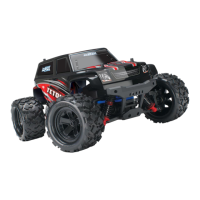
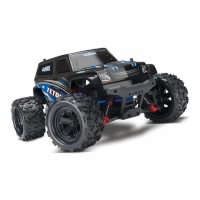
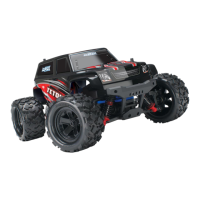
The LaTrax Teton is a 1/18-scale 4X4 adventure vehicle designed for off-road performance and driving fun. It features 4-wheel independent suspension, oil-filled shocks, and an efficient 4WD drivetrain, all engineered to withstand rigorous use. The model is also waterproof, allowing for operation in wet conditions.
The LaTrax Teton is a radio-controlled (R/C) vehicle that provides an exciting driving experience, particularly in off-road environments. Its primary function is to offer recreational driving with precise control over steering and throttle. The model is equipped with a 2.4GHz radio system, which allows multiple models to be operated simultaneously without frequency conflicts. This system ensures reliable communication between the hand-held transmitter and the vehicle's receiver. The electronic speed control (ESC) manages the motor's power output, providing proportional throttle control for both forward and reverse, as well as braking. The vehicle's suspension system, with its adjustable shocks, is designed to absorb impacts and maintain stability over varied terrain. The 4WD system ensures traction and power delivery to all four wheels, enhancing its off-road capabilities.
To begin using the LaTrax Teton, the transmitter requires four AA batteries, which are installed in its base. The included NiMH charger is used to charge the vehicle's 7.2V 6-cell NiMH battery pack. The charging process is straightforward: plug the charger into a wall outlet, and then connect the battery. The charger's LED indicates the charging status, turning red when charging and green when complete. It's crucial to use only the included NiMH charger for NiMH batteries and never attempt to charge LiPo batteries with it.
Once the batteries are ready, the vehicle's battery pack is installed into the battery compartment, secured by a hold-down and body clip. Before connecting the battery to the ESC, the radio system needs to be turned on. The transmitter should always be turned on first and off last to prevent accidental runaways. The 2.4GHz radio system is factory-programmed, but users can check and adjust settings like steering trim to ensure the wheels are pointing straight when the steering wheel is centered. The ESC has an EZ-Set button for easy operation. Pressing and releasing it turns the ESC on, indicated by a solid red LED (default setting for NiMH batteries).
The ESC offers three driving profiles:
Changing profiles involves a specific sequence of pressing and holding the EZ-Set button, observing LED blinks, and releasing the button at the desired blink count. The ESC also includes a Low-Voltage Detection feature, which is disabled by default for NiMH batteries to prevent poor performance. If activated (indicated by a green LED), it should be disabled for NiMH use by holding the EZ-Set button until the LED turns red after three motor beeps.
Before each driving session, a range test of the radio system is recommended to ensure proper operation. This involves walking away from the model with the transmitter to the farthest intended operating distance and verifying that the model responds correctly. When driving, it's important to maintain a safety margin around the model to prevent collisions, as radio interference can cause momentary losses of control. The model's high speed means it can cover significant distances quickly, so positioning oneself in the middle of the running area can help maintain visibility and control.
The Teton is designed for wet conditions, but it's not submersible. After running in wet environments, additional care is required. This includes rinsing off dirt, blowing off excess water with compressed air, removing wheels, spraying bearings and fasteners with water-displacing oil, and lubricating the drivetrain. The receiver box should also be checked for trapped moisture.
Regular maintenance is crucial for the longevity and optimal performance of the LaTrax Teton. After each run, the vehicle should be inspected for any obvious damage or wear, such as cracked or bent parts, binding in the wheels or steering, and proper shock absorber function. Wiring should be checked for fraying or loose connections, and the mounting of the receiver, servo, and speed control should be secure. Wheel hex bolts and other screws should be checked for tightness. The radio system's operation, particularly battery condition, should also be verified.
Periodic maintenance includes:
For optimal run time, using batteries with the highest mAh rating is recommended, along with a high-quality peak-detecting charger. Maintaining the speed control cool and ensuring the drivetrain is free of dirt or damaged parts also contributes to longer run times. If the tires spin on the rims, they can be glued for better performance using CA glue, ensuring safety glasses are worn during this process. The model's adjustable shock mounting positions allow for tuning the suspension to suit different driving styles and surfaces, with lower shock positions recommended for harder surfaces.
 General
| Product type | Car |
|---|---|
| Frequency band | 2.4 GHz |
| Battery technology | Nickel-Metal Hydride (NiMH) |
| Number of battery cells | 6 |

 To Next Page