This document is a user's manual for Lennox VRF (Variable Refrigerant Flow) indoor units, providing essential information on their function, installation, operation, maintenance, and troubleshooting. The manual covers a range of indoor unit types, including various cassette models, ducted units, and wall-mounted units, each designed for specific applications within a VRF system.
Function Description:
Lennox VRF indoor units are components of a larger VRF HVAC system, designed to provide heating and cooling to indoor spaces. They work by circulating refrigerant to absorb or release heat, thereby conditioning the air. The units are controlled by either wired or wireless remote controllers, allowing users to set temperature, fan speed, and operating modes. The manual emphasizes the importance of proper installation and service by licensed professionals to ensure safe and efficient operation.
Important Technical Specifications (Implied from the manual):
While specific technical specifications like BTU ratings or power consumption are not explicitly listed in this user manual, the document categorizes units by their design and application, implying different capacities and airflow characteristics.
- V22B Compact 360° Cassette and V33B 360° Cassette: These are ceiling-mounted units designed to discharge air from one, two, three, or four sides, providing comprehensive air distribution. The V22B is described as "Compact," suggesting it might have a smaller footprint or lower capacity than the V33B.
- VOWA One-Way Cassette: A ceiling-mounted unit that discharges air in one direction, suitable for specific room layouts.
- VOSB Outside Air Unit: This unit is designed to condition outside air before introducing it into the indoor space, implying features for fresh air ventilation and potentially higher static pressure capabilities.
- VVCB Air Handler: A larger ducted unit, likely with higher capacity, designed for more extensive air distribution through ductwork. It features a blower compartment, coil compartment, and condensate drain.
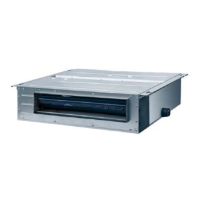
- VMDB Medium-Static Concealed Duct Unit: A ducted unit designed for medium static pressure applications, meaning it can handle a moderate amount of ductwork resistance. It is concealed within the ceiling or wall.
- VWMB Wall-Mounted Non-Ducted Unit: A visible unit mounted on a wall, suitable for single-zone applications without ductwork.
- VHIB High-Static Concealed Duct Units: Ducted units designed for high static pressure applications, capable of handling extensive and complex ductwork systems.
- VCFB Ceiling- or Floor-Mounted Non-Ducted Unit: A versatile unit that can be installed either on the ceiling or floor, providing non-ducted heating and cooling.
Usage Features:
- Control: System operation is managed via wired or wireless remote controllers. Users can adjust temperature, fan speed, and operating modes (e.g., COOL, HEAT, FAN ONLY, DRY).
- Louver Adjustments: Louvers are adjustable (via controller, not manually) to direct airflow. For heating, louvers are directed downward; for cooling, they are directed outward. Some units offer an "Auto-swing" function for automatic louver movement.
- Error Codes: Indoor units are equipped with LED indicators or digital displays to show error codes, aiding in troubleshooting. The manual provides tables listing fault codes and their descriptions for both LED and digital displays.
- Safety Warnings: The manual includes prominent "WARNING" and "CAUTION" sections covering electrical shock, fire, explosion hazards, and general safety practices. It stresses that installation and service must be performed by licensed HVAC professionals.
- Troubleshooting: A dedicated section helps users identify common issues and their possible solutions before calling for service. This includes scenarios like the unit not starting, not cooling/heating properly, fan speed issues, and remote control problems.
Maintenance Features:
- Filter Cleaning/Replacement: Air filters are crucial for system efficiency and air quality. The manual instructs users to check filters monthly, clean them (using a vacuum cleaner or water), or replace them if necessary. Specific instructions are provided for accessing filters in different unit types (e.g., VOWA, V22B/V33B, VVCB, VMDB/VHIB).
- General Cleaning: Users are advised to wipe the indoor unit and remote control with a clean, dry cloth. Chemical cleaners, paint thinners, or abrasive products are explicitly prohibited to prevent damage to plastic surfaces.
- Condensate Drain: Ensuring the condensate drain is properly routed is highlighted as an important maintenance point.
- Preparing for Idle Periods: Instructions are given for preparing the unit for long periods of inactivity, including running the fan-only mode, cleaning filters, wiping cabinets, disconnecting power, and removing remote control batteries.
- Returning to Operation: Steps for reactivating the unit after an idle period are provided, including cleaning filters, wiping panels, inserting batteries, and reconnecting power.
The manual serves as a comprehensive guide for owners and technicians, emphasizing safety, proper operation, and routine maintenance to ensure the longevity and efficient performance of Lennox VRF indoor units.

 Need help?
 General

 To Next Page
