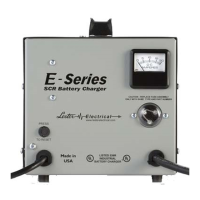
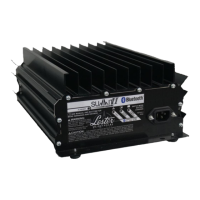
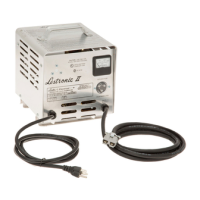
www.lesterelectrical.com 3 00870E
• The DC output plug, receptacle or cords are cut,
worn, or have any exposed wires.
• The DC output plug, cords, charger, or receptacle
are damaged.
Using this charger with any of the above
symptoms could result in a fire, property
damage, or personal injury.
Have your distributor, dealer or other qualified
service agent repair or replace worn or damaged
parts immediately. Repairs should not be
attempted by people who are not qualified.
2. Connect the DC output plug to the battery
receptacle by grasping the plug body or handle
and pushing the plug straight into the receptacle.
The charger will start automatically in three to
five (3-5) seconds.
WARNING: DO NOT DISCONNECT THE DC
OUTPUT CORD FROM THE BATTERY
RECEPTACLE WHEN THE CHARGER IS ON.
THE RESULTING ARCING AND BURNING OF
THE PLUG AND RECEPTACLE COULD CAUSE
THE BATTERIES TO EXPLODE. IF THE
CHARGER MUST BE STOPPED, FIRST
DISCONNECT THE AC POWER SUPPLY CORD
FROM ITS OUTLET, THEN DISCONNECT THE
CHARGER DC OUTPUT PLUG FROM THE
BATTERY RECEPTACLE.
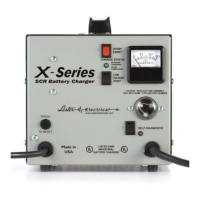
3. Monitor the ammeter for the correct charge rate.
The initial charge rate will vary from 20 to 29
amps, depending upon the condition of the
batteries and how much the batteries have been
discharged.
Slight variations in the initial charge rate may
also result from AC input line voltages which are
higher or lower than 115 volts. Higher line
voltages increase the initial charge rate while
lower line voltages reduce the charge rate.
If the batteries are heavily discharged and the
AC input line voltage is higher than 115 volts,
the initial charge rate may exceed 30 amps and
the ammeter needle will be pegged at 30 amps.
Under normal conditions, the charge rate will
taper to less than 30 amps within 30 minutes. If
the ammeter still reads 30 amps after 30
minutes, turn the charger off by disconnecting
the power supply cord from its outlet. Refer to
the Troubleshooting Guide in this manual for
additional information.
CAUTION: TO PREVENT OVERHEATING
DAMAGE TO THE CHARGER, DO NOT ALLOW
THE CHARGER TO OPERATE FOR MORE THAN
30 MINUTES WITH THE AMMETER READING 30
AMPS.
During charge, the battery voltage increases
gradually, which causes the charge rate to
decrease. Good battery cells should each rise
to approximately 2.5 volts DC, which will allow
the charge rate to taper to less than 8 amps.
Since each cell accepts charge at a slightly
different rate, normal charging with the ammeter
reading in the 4 to 10 amps area for the last few
hours of charge is important to achieve
equalization of all battery cells every time the
batteries are charged.
The charger turns off automatically when the
batteries are fully charged. The required charge
time varies with battery size and depth of
discharge. Allow sufficient time, as listed in the
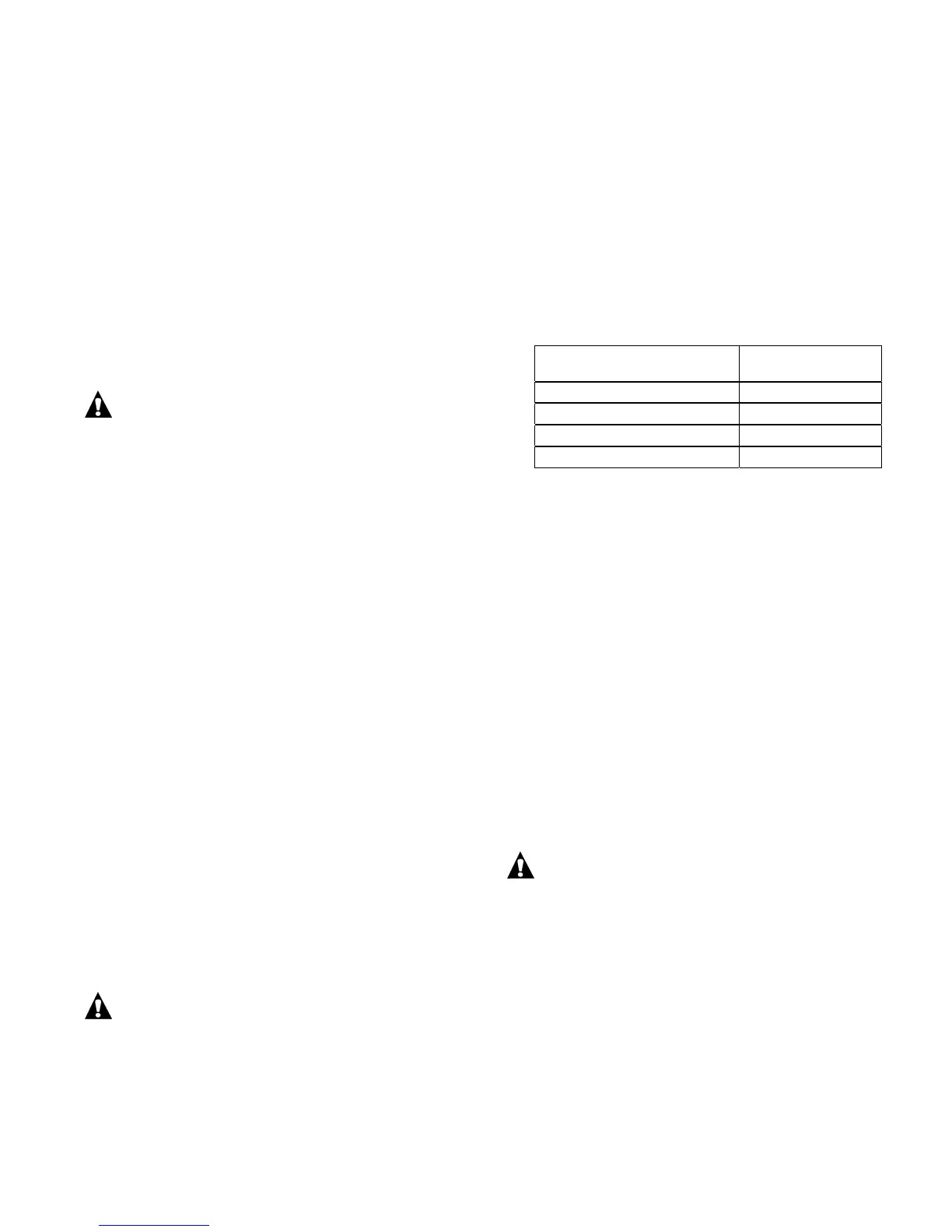
following chart, for normal charging.
Battery Capacity
(Ampere Hours @ 20 Hr. Rate)
(Hours)
180 9
190 10
220 11
230 12
The normal charge times listed above are for
batteries which have been discharged to 80% of
their rated capacity. As much as 4
ADDITIONAL HOURS may be required to
properly charge batteries under the following
conditions:
• Heavily discharged batteries (more than 80%
discharged)
• Charging new batteries (batteries with less
than 50 discharge/charge cycles)
• Charging cold batteries (ambient temperatures
below 65°F)
When charging new or cold batteries, a higher
than normal finish charge voltage can be
expected. This results in a low finish charge
rate (4-6 amps), and additional time is required
to achieve equalization of all battery cells. Refer
to a qualified service agent if the charger does
not turn off within the specified time.
WARNING: DO NOT LEAVE THE CHARGER
UNATTENDED FOR MORE THAN TWO DAYS IN
A ROW. SEVERE OVERCHARGING AND
POSSIBLE DAMAGE TO THE BATTERIES WILL
RESULT IF THE CHARGER SHOULD FAIL TO
TURN OFF.
As batteries age, individual cells may weaken
resulting in a lower than normal finish charge
voltage. As the finish charge voltage decreases,
the charge rate will not taper into the 5-10 amps
area on the ammeter. The electronic timer will,
however, still determine when the batteries have
reached full charge and turn the charger off.
Even though they are properly charged, older
batteries will gradually lose capacity, and should


 To Next Page
 Loading...