6
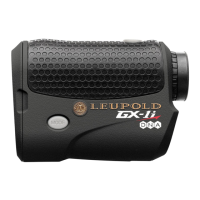
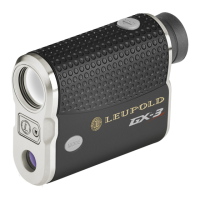
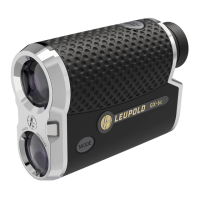
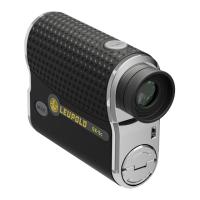
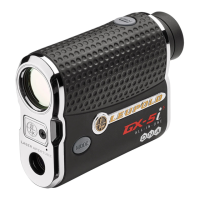
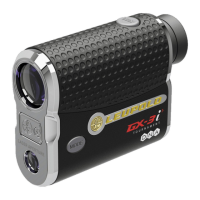
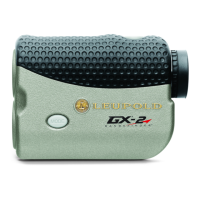
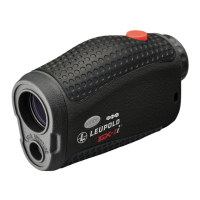
The Leupold GX series of rangefinders emit a series of invisible, infrared energy pulses that
are reflected off the selected target back to the optical unit. State-of-the-art circuitry and
precision computing circuits are used to calculate the distance instantaneously by measur-
ing the time it takes for each pulse to travel from the GX rangefinder to the object and back.
Surface texture, color, size, and shape of the target all affect reflectivity, which in turn
affects the maximum range of the instrument. As a rule of thumb, brightly colored targets
are much more reflective than darker targets, with black being the least reflective color.
A shiny surface is more reflective than a dull surface. Smaller targets are more difficult
to range than larger targets. Light conditions, haze, fog, rain, and other environmental
conditions can all affect ranging performance. Any factor which degrades air clarity will
reduce the maximum effective range. Bright light shining directly on the lenses reduces the
effectiveness, producing shorter maximum ranges than those possible on darker (overcast)
days. The steadier the GX unit is held, the greater the maximum distance.
HOW IT WORKS


 To Next Page
 Loading...