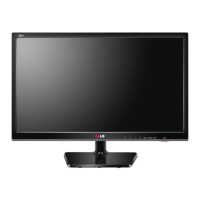
Need help?
Do you have a question about the LG 24MT48DF and is the answer not in the manual?
Key safety instructions and warnings for servicing the TV.
Essential precautions for handling and servicing the TV chassis.
Troubleshooting flowchart for units that do not power on.
Steps to check RF cable and related ICs for video issues.
Verifies if the input signal format is supported.
Reinforces safety precautions for parts identified with a symbol.
This document serves as a comprehensive service manual for LG LED TVs, specifically covering models 24MT48DF, 24MT48DW, 24MT48VF, 24MT48VW, and 24MT48DG, all built on the LD60A chassis. It is intended for use by trained service personnel and provides detailed instructions for the maintenance, adjustment, and troubleshooting of these devices.
The LG LED TVs covered by this manual are designed to provide high-quality visual and audio entertainment. They support a variety of broadcasting systems, including analogue TV (PAL-B/G/D/K/I, SECAM-B/G/D/K/I, SECAM L/L') and digital TV (DVB-T/T2, DVB-C, DVB-S/S2), making them versatile for different regional standards. The TVs are equipped with multiple input interfaces, including RF, Composite, Component (CVBS), HDMI, D-Sub, Scart, USB, Audio In, and Headphone Out, allowing for connection to a wide range of external devices such as PCs, gaming consoles, and media players.
The core functionality of these TVs includes displaying video content from various sources, processing audio signals, and providing user control over settings and features. The internal architecture, as detailed in the block diagram, involves a main MSTAR M1A+ processor that manages video and audio processing, memory access (NAND Flash, Serial Flash, System EEPROM), and communication with peripheral components. The TVs are designed to operate within a standard power voltage range of 100 V - 240 V~ at 50/60 Hz.
These LG LED TVs offer a user-friendly experience with several key features. The ability to receive both analogue and digital broadcasts ensures compatibility with diverse signal types. The multiple input options allow users to connect various devices, enhancing the TV's utility as a central entertainment hub. HDMI inputs support both PC and DTV formats, accommodating different resolutions and refresh rates.
The TVs incorporate features for image quality adjustment, such as White Balance calibration, which can be performed through a service remote control or an auto-control interface using a Color Analyzer. This allows for precise tuning of color temperature (Cool, Medium, Warm) and luminance to achieve optimal display characteristics.
For software management, the TVs support USB download for firmware updates, simplifying the process of keeping the device up-to-date with the latest features and bug fixes. This method automatically detects update files from a USB stick and initiates the update process.
The TVs also include diagnostic and testing features accessible through a service mode. These allow for checking display and sound, verifying input and signal items (TV, AV, Component, HDMI, RGB, PC Audio In, Headphone Out, USB), and performing specific tests like DPM (Display Power Management) and PIP (Picture-in-Picture). The PIP function allows users to view two different sources simultaneously, such as a TV broadcast and an external device input.
The service manual provides extensive guidance for maintaining and repairing the LG LED TVs, emphasizing safety precautions throughout. Key maintenance features and procedures include:
Safety Precautions: Detailed instructions are provided to ensure technician safety, including the use of an isolation transformer, proper handling of fuses and resistors, and maintaining safe distances from high-voltage/high-temperature parts. It also outlines procedures for AC leakage current checks (cold and hot) to prevent shock hazards after servicing.
Servicing Precautions: Specific guidelines for handling electrostatically sensitive (ES) devices are given, such as grounding oneself, placing assemblies on conductive surfaces, and using grounded-tip soldering irons and anti-static solder removal devices. Soldering guidelines for various components (IC, transistors, diodes, fuses, resistors) are also provided, emphasizing quick work to avoid overheating circuit board foil.
Circuit Board Foil Repair: Techniques for repairing damaged copper patterns on circuit boards are described, including using jumper wires for IC and other connections, ensuring proper insulation, and maintaining original component spacing.
Adjustment Instruction:
Model Name & Serial Number Download: Instructions for writing the model name and serial number to the TV's memory using a service remote and USB-to-RS232 signal cable, and verifying the information in the Diagnostics menu.
MAC Address & CI+ Key Download: A comprehensive guide for downloading MAC addresses and CI+ (Common Interface Plus) keys, involving specific software ("Serial.exe"), port connections, and verification steps.
Troubleshooting: Flowcharts are provided for common issues such as "No Power," "No Screen on" (for different screen sizes), "No Video - Digital TV," and "No Video - HDMI." These flowcharts guide technicians through a systematic process of checking voltage levels, replacing components (e.g., ICs, cables, adapters), and repairing main boards.
The manual emphasizes the importance of replacing special safety parts with recommended components to prevent hazards and advises against modifying the original design without manufacturer permission. It serves as a critical resource for ensuring the safe and effective servicing of these LG LED TV models.
 General
| 3D | No |
|---|---|
| HD type | WXGA |
| Color gamut | 72 % |
| Pixel pitch | 0.38175 x 0.38175 mm |
| Screen shape | Flat |
| Response time | 14 ms |
| Display surface | Matt |
| Display diagonal | 23.6 \ |
| Display resolution | 1366 x 768 pixels |
| Native aspect ratio | 16:9 |
| Vertical scan range | 56 - 75 Hz |
| Horizontal scan range | 30 - 83 kHz |
| Contrast ratio (typical) | 3000:1 |
| Display number of colors | 16.78 million colors |
| Display brightness (typical) | 250 cd/m² |
| Supported graphics resolutions | 1366 x 768 |
| TV tuner integrated | Yes |
| Height adjustment | - |
| Panel mounting interface | 75 x 75 mm |
| Certification | FCC-B, UL, EPA |
| Product color | Black |
| Cables included | AC |
| Headphone connectivity | 3.5 mm |
| Power consumption (off) | 0.4 W |
| Power consumption (standby) | 2 W |
| Power consumption (typical) | 28 W |
 Weight and Dimensions
| Depth (with stand) | 146.3 mm |
|---|---|
| Height (with stand) | 387.3 mm |
| Weight (with stand) | 3400 g |
| Depth (without stand) | 53.1 mm |
| Width (without stand) | 556 mm |
| Height (without stand) | 345.2 mm |
| Weight (without stand) | 3200 g |

 To Next Page