
 To Next Page

M
Michael GrantAug 17, 2025
What to do if there is no sound on my LG 32LK311?
- SstevenmyersAug 17, 2025
If your LG LCD TV has no sound, verify the input source first. If that doesn't work, try changing the source input.

What to do if there is no sound on my LG 32LK311?
If your LG LCD TV has no sound, verify the input source first. If that doesn't work, try changing the source input.
What to do if there is no raster on my LG 32LK311 display unit?
If there is no raster on the display unit, check the panel link cable, inverter connector, and LVDS cable. You may need to change the panel link cable, inverter connector, or LVDS cable. Also, check the output of IC802 and consider changing IC802.
What to do if there is no raster on HDMI signal on my LG 32LK311 LCD TV?
If there is no raster on the HDMI signal, check the input source cable and jack. Also, check the input/output of JK101 and IC800. Change the defective part if necessary.
What to do if there is no raster on PC signal on my LG LCD TV?
If there is no raster on the PC signal, check the input source cable and jack. Also, check the input/output of J202 and IC201. Verify the RGB EDID data and check the input/output of IC800. Change the defective part if necessary.
What to do if there is no signal on TV(RF) signal on my LG 32LK311 LCD TV?
If there is no signal on the TV(RF) signal, check the input/output of JK102 and IC800. Change the defective part if necessary.
What to do if there is no raster on AV signal on my LG LCD TV?
If there is no raster on the AV (Video, S-Video) signal, check the input/output of JK102 and IC800. Change the defective part if necessary.
What to do if there is no raster on COMPONENT signal on my LG 32LK311?
If your LG LCD TV displays no raster on COMPONENT signal, check the input source cable and jack.
How to fix no signal on LG 32LK311 LCD TV(RF) signal?
If there is no signal on your LG LCD TV(RF) signal, inspect the input/output. Resolder JK102, or if it's defective, replace it.
How to troubleshoot fail on LG 32LK311?
If your LG LCD TV fails, check 24V, 12V, and 3.5V. Also, check for shorts in the Main B/D or Power B/D, or consider changing the Power B/D.
What to do if Fail On Display Unit on LG 32LK311 LCD TV?
If your LG LCD Display Unit fails, check the panel link cable. If necessary, change the panel link cable or module.
Critical warnings and general guidance for safe product servicing.
Detailed methods for checking AC leakage current to prevent shock hazards.
Best practices for component handling, static discharge, and cleaning.
Step-by-step instructions for replacing ICs, transistors, diodes, fuses, and resistors.
Methods for repairing damaged copper foil on circuit boards using jumper wires.
Details on application range, operating conditions, test methods, and electrical data.
Technical data for component, RGB, and HDMI video inputs.
Procedures for downloading Mstar software and setting up adjustment tools.
Steps for using memory sticks and managing EDID data for display compatibility.
Guidance on ADC calibration and checking the software version.
Instructions for both automatic and manual white balance adjustments.
Visual guides for diagnosing common hardware issues.
Specific steps for resolving no raster or signal issues across various inputs.
Diagnostic steps for no sound or no signal problems.
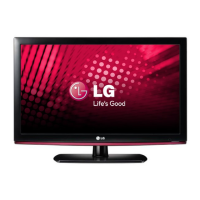
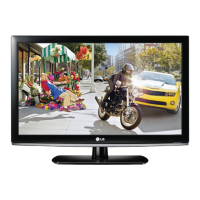
This document serves as a service manual for an LG LCD TV, specifically models 32LK310, 32LK310-MA, 32LK311, and 32LK311-MB, all based on the LP91J chassis. It provides comprehensive information for technicians on how to service, adjust, and troubleshoot the device, ensuring safe and effective repairs.
The primary function of this device is to display video and audio content from various sources, acting as a central entertainment hub. It supports a range of input types, including analog broadcasting systems (NTSC, PAL-M, PAL-N), component video, RGB (PC), and HDMI, allowing for connection to diverse external devices such as DVD players, game consoles, personal computers, and set-top boxes. The TV also features USB input for playing multimedia files (Divx, MP3, JPEG), expanding its utility beyond traditional broadcasting. Audio output is managed through internal speakers, and it includes audio output jacks for external sound systems. The device is designed for use in North/Latin America, Europe/Africa, and Asia/Oceania, with specific regional settings and broadcasting standards supported.
In terms of usage features, the TV offers a user-friendly interface for navigating channels, adjusting picture and sound settings, and selecting input sources. The remote control is the primary means of interaction, enabling users to power on/off, change channels, adjust volume, and access various menus. The TV's ability to handle multiple video resolutions, from standard definition (SDTV) to high definition (HDTV) and various PC resolutions (VGA, SVGA, XGA, WXGA, SXGA, WUXGA), ensures compatibility with a wide array of content and devices, providing a versatile viewing experience. The HDMI inputs support both PC and DTV signals, making it suitable for both computer monitor use and home theater setups. The inclusion of RS-232C functionality suggests potential for commercial control or integration into more complex AV systems.
Maintenance features are extensively detailed within the service manual, focusing on safety, component replacement, and calibration procedures. Safety precautions are paramount, with specific warnings about using an isolation transformer during servicing, replacing fuses with specified types, maintaining proper spacing for high-wattage resistors, and performing AC leakage current checks before returning the receiver to the customer. The manual emphasizes the importance of using original manufacturer-specified parts for safety-related components, identified by a special symbol in the schematic diagrams and exploded views, to prevent hazards like shock or fire.
Component replacement procedures are outlined for various parts, including ICs, discrete transistors, power output transistors, diodes, fuses, and resistors. These procedures detail steps for safe removal and installation, often involving desoldering, careful handling to prevent damage, and proper soldering techniques. For instance, IC replacement involves straightening leads, desoldering, and then carefully inserting and soldering the new component. Special attention is given to electrostatically sensitive (ES) devices, with guidelines on grounding oneself, handling components on conductive surfaces, and using grounded-tip soldering irons to prevent static discharge damage.
Circuit board foil repair techniques are also described, addressing situations where excessive heat might have damaged the copper foil. This includes procedures for installing jumper wires at IC connections and other points on the circuit board, ensuring proper electrical continuity and insulation.
Adjustment instructions cover critical aspects of the TV's performance, such as software download, EDID (Extended Display Identification Data) download, and ADC (Analog-to-Digital Converter) calibration for both component and RGB inputs. These adjustments are crucial for optimal picture quality and compatibility with input sources. The manual provides step-by-step guides for using specialized tools like the "ISP Tool" program and adjustment remote controls. For example, ADC calibration involves inputting specific test patterns and using the remote to access adjustment menus, ensuring accurate color and signal processing. White balance adjustment, both automatic and manual, is detailed to ensure accurate color temperature and reduce deviations in module color. This involves using color analyzers and specific commands to fine-tune the red, green, and blue gain and offset values across different color temperature modes (Cool, Medium, Warm).
Troubleshooting guides are provided in flowcharts, helping technicians diagnose common issues such as "No power," "No Raster," "No Raster on PC Signal," "No Raster on Component Signal," "No Raster on HDMI Signal," "No Signal On TV(RF) Signal," and "No Sound." These flowcharts direct the technician through a series of checks, such as verifying power supply voltages, inspecting specific ICs and connectors, and checking cable connections, leading to potential solutions like replacing defective parts, re-soldering connections, or re-downloading EDID data. The manual also includes instructions for checking the software version, which is important for ensuring the device is running the correct firmware.
Overall, this service manual is a comprehensive resource designed to facilitate the professional maintenance and repair of the LG LCD TV models, ensuring their continued safe and optimal operation.
 General
| Screen Size | 32 inches |
|---|---|
| Resolution | 1366 x 768 |
| Display Type | LCD |
| HDMI Ports | 2 |
| USB Ports | 1 |
| Backlight Type | CCFL |
| Aspect Ratio | 16:9 |
| Component Video Input | 1 |
| Composite Video Input | 1 |
| Refresh Rate | 60Hz |
| Operating System | No |
| Audio Output | 10W (5W x 2) |