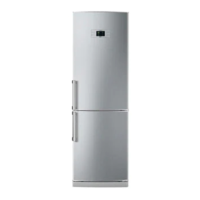
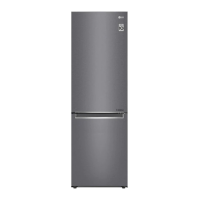
This document outlines the features, usage, maintenance, and safety instructions for a fridge-freezer appliance.
Function Description
The fridge-freezer is designed with two independent temperature controls for the refrigerator and freezer compartments. It includes a "Super Freezer" function for rapid freezing of food, which operates for approximately 3 hours before returning to normal operation. A "Vacation" mode is available to reduce energy consumption when the appliance is not in active use, such as during holidays. The appliance also features a "Memory feature" that restores the last set temperature and vacation status after a power failure. A "Self Test" function is integrated to automatically detect failures during operation; in case of a failure, users are advised not to turn off the power but to contact a service center. Ice making is facilitated by an ice tray, and a "Super FRZ." setting can be used for faster ice production. Defrosting is automatic, with water flowing to an evaporating tray. A water dispenser is also included, designed to be filled with potable water only.
Important Technical Specifications
- Refrigerant: The appliance uses isobutane refrigerant (R600a), which is an environmentally friendly natural gas. The amount of refrigerant varies by model and is indicated on the identification plate inside the appliance. For every 8g of R600a refrigerant, the room must be at least 1m² in size to avoid a flammable gas-air mixture in case of a leak.
- Water Dispenser Capacity: The water tank can hold up to 3.5L of water.
- Temperature Control Range (Freezer): The freezer temperature can be adjusted from -15°C to -23°C.
- Power Supply: The appliance requires a dedicated electrical outlet. The supply cord is replaceable by the manufacturer or a qualified service agent if damaged.
- Installation Clearance: For proper air circulation, maintain at least 2 inches (5 cm) from the rear wall and sufficient space on the sides and top.
Usage Features
Temperature Control:
- Refrigerator: Initially set to "4". Adjust the knob towards "WARM" or "COLD" as desired. If the surrounding temperature is low, adjust to "WARM".
- Freezer: Controlled via a display panel. Press the 'FRZ. TEMP.' button to cycle through temperature settings: -18°C → -19°C → -20°C → -21°C → -22°C → -23°C → -15°C → -16°C → -17°C → -18°C.
- Note: The indicated setting temperature is a target, and actual internal temperature may vary. Initial refrigeration function may be weak; allow 2-3 days for stabilization.
Special Functions:
- Super Freezer: Activates rapid freezing. Press 'SUPER FRZ./VACATION' once to turn on (SUPER FRZ. light on). Press again to turn off.
- Vacation: Activates power-saving mode. Press 'SUPER FRZ./VACATION' twice to turn on (VACATION light on). Press again to turn off.
- Combined Function Activation: Pressing 'SUPER FRZ./VACATION' once activates Vacation mode. Pressing it twice activates Super Freezer mode. Pressing it three times turns both off.
Ice Making:
- Fill the ice tray to the water level and place it in the freezer.
- For faster ice cubes, use "SUPER FRZ." mode.
- To remove ice cubes easily, hold the tray ends and twist gently, or run water over the tray before twisting.
Water Dispenser:
- Filling: Turn the HANDLE Tank backward, open the CAP TANK (SMALL), and fill with potable water up to 3.5L, observing the sight glass. Fix the CAP TANK (SMALL) and HANDLE TANK back in position.
- Dispensing: Press the Dispenser Pad with a cup. Water will be supplied. Slowly remove the cup to prevent spills.
- Water Level: Keep the water level under MAX to prevent leakage. If the level is below MIN, add more water.
- Caution: Only use spring water. Other beverages, especially those with grain, may cause failure.
Door Reversal:
- The fridge-freezer doors are reversible to suit kitchen design.
- Precaution: Remove all food and accessories before reversal. Use a torque wrench or spanner for bolts. Do not lay the appliance down. Be careful not to drop doors.
- Procedure: Involves separating door handles, unscrewing hinge covers and bolts, removing doors, loosening screws, moving door stoppers and bushes, disconnecting and swapping cables/door switches, and reassembling in reverse order.
- Note: Door reversal is not covered by warranty.
Maintenance Features
General Information:
- Power Failure: 1-2 hours of power failure will not harm stored food. Avoid frequent door openings during this time.
- Moving the Appliance: Remove food and secure loose items with tape. Turn leveling screws until they stop to prevent floor scratches.
- Anti-Condensation Pipe: Located around the front and between compartments to prevent dewing. It is normal for this area to feel warm, especially after installation or in high ambient temperatures.
Lamp Replacement:
- Unplug the power cord.
- Remove fridge shelves.
- Insert a type driver into the underside of the lamp cover and pull it out.
- Turn the lamp counterclockwise.
- Assemble in reverse order. The replacement lamp must have the same specifications as the original. Ensure the O-RING (rubber ring) is in place to prevent electric sparks.
Cleaning:
- Before Cleaning: Unplug the power cord.
- Exterior: Clean with a soft cloth soaked in hot water or liquid detergent. Wipe with a clean wet cloth if detergent is used.
- Interior: Clean as described for the exterior.
- After Cleaning: Check that the power cord is not damaged, the plug is not overheated, and it is tightly inserted into the outlet.
- Warning: Dry the appliance thoroughly after washing. Do not use abrasive cleaners, petroleum, benzene, thinner, hydrochloride acid, boiling water, or rough brushes, as these may damage parts.
- Grille and Drip Tray: Wipe moisture around the door part and drip tray with a clean cloth.
- Exterior Dispenser: Wipe moisture from the dispenser and pad with a cloth.
- Water Tank: Lift the tank by pressing the fixing lever, remove the CAP TANK (BIG), and clean inside/outside with neutral cleansing agent.
- CAP TANK (Big & Small): Clean with neutral cleansing agent, using a small brush for grooves.
- VALVE ASSEMBLY: Clean with a small brush, operating the bottom part of the assembly. Ensure the Sealing Rubber is correctly fixed to prevent leakage.
Troubleshooting:
- Appliance not operating: Check if the power plug is securely inserted, if a house fuse has blown or circuit breaker tripped, or if there's a power cut.
- Compartment too warm: Check temperature control settings, proximity to heat sources, frequent/long door openings, or blocked air ducts.
- Vibration/Rattling/Abnormal Noise: Check if the appliance is level (adjust leveling screws) or if unnecessary objects are placed at the back.
- Frost/Ice Crystals on frozen food: Check for open doors, too frequent/long door openings. Frost within packages is normal.
- Moisture on Cabinet Surface: Common in wet spaces; wipe with a dry towel.
- Moisture inside: Caused by frequent/long door openings or humid weather.
- Odor: Check for strong-smelling or spoiled food; clean the interior.
- Door not closing properly: Check for obstructing packages, unlevel appliance (adjust leveling screws).
- Interior light not working: Check for power at the outlet or if the lamp needs replacing.
Disposal:
- When disposing of the appliance, remove doors and leave shelves in place to prevent child entrapment.
- Contact local authorities for proper disposal of electrical and electronic products, as they contain specific refrigerants and insulation blowing gases requiring special procedures.

 Need help?

 To Next Page
 General