Need help?
Do you have a question about the LG GN-B372SQCB and is the answer not in the manual?
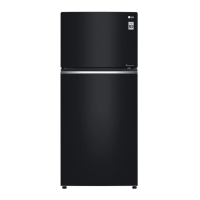
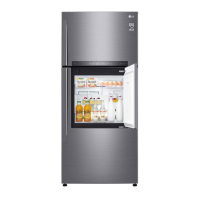
This document is an owner's manual for an LG REFRIGERATOR-FREEZER, providing essential information for its installation, operation, and maintenance.
The LG REFRIGERATOR-FREEZER is designed for household and similar applications, including staff kitchen areas, farm houses, hotels, motels, bed and breakfast environments, and catering. It features separate compartments for refrigeration and freezing, each with independent temperature controls to ensure optimal storage conditions for various food items. The appliance utilizes isobutane refrigerant (R600a) and is designed for energy efficiency. Some models may include a HYGIENE FRESH filter for antibacterial and deodorizing functions, removing viruses, bacteria, and scents from the refrigerator interior. The refrigerator also includes a SMART DIAGNOSIS function (for applicable models) to assist in troubleshooting by transmitting diagnostic data to a service center.
Starting and Temperature Control: Upon initial installation, the refrigerator should be allowed 2-3 hours to stabilize before loading with food. If operation is interrupted, a 5-minute delay is recommended before restarting. The refrigerator compartment has a temperature control knob, with a default setting of '4'. For colder temperatures, the knob should be adjusted to 'Coldest', and for warmer temperatures, to 'Cold'. The freezer compartment has a temperature control dial, with default settings of '3' for Type A & C models and '2' for Type B & D models. A higher number on the freezer dial indicates a lower temperature in the freezer compartment. Quick freezing can be achieved by setting the knob to 5-7, after which it should be returned to 'Normal'. It's important to note that making the freezer colder can make the refrigerator compartment warmer, as they share a fixed amount of cooled air.
Ice Making: The refrigerator offers two types of ice-making systems:
Defrosting: Defrosting is automatic. Defrosted water flows to an evaporating tray at the lower back of the refrigerator, where it evaporates naturally.
Pull Out Tray (Optional): Some models feature a pull-out tray for easy access to items at the rear of the food drawer. To remove, fully extend the tray, lift the front, and pull it out slowly. Care should be taken not to hold the bottom of the tray when sliding it in to avoid injury.
Deodorizer (Optional): For models with a deodorizer, it is located at the cooling air inlet in the fresh food compartment. It works automatically and requires no handling. Users should avoid pricking the cooling air inlet with sharp objects. Foods with strong odors should be wrapped or stored in lidded containers to prevent odor transfer. The deodorizer can be revived by separating it from the refrigerator ceiling, using a hair dryer to remove moisture or malodor, and then exposing it to sunlight for ultraviolet oxidation.
Food Storage Suggestions:
Cleaning: Regular cleaning is crucial to prevent odors and maintain hygiene. Spilled food should be wiped immediately to prevent acidification and staining of plastic surfaces. Avoid using metallic scouring pads, brushes, coarse abrasive cleaners, or strong alkaline solutions. When cleaning, remember that damp objects can stick to cold surfaces, so avoid touching frozen surfaces with wet hands.
Lamp Replacement: This product uses an LED lamp that cannot be replaced by the user. Contact an authorized service center for lamp replacement.
Vacation Time: For average-length vacations, it's best to leave the refrigerator operating, placing freezable items in the freezer for longer life. For extended periods, remove all food, disconnect power, thoroughly clean the interior, and leave both doors open to prevent odor.
Power Failure: Most power failures are short and won't affect refrigerator temperatures. Minimize door openings during power outages. For longer durations, place dry ice on top of frozen packages, ensuring adequate ventilation due to CO2 vaporization.
Moving the Appliance: If moving, empty the refrigerator completely, wash with a mild baking soda solution, and ensure it is dry.
Anti-Condensation Pipe: The outer cabinet wall may feel warm, especially after installation. This is normal and due to the anti-condensation pipe pumping hot refrigerant to prevent sweating.
Smart Diagnosis (for applicable models): This function allows for precise diagnosis of malfunctions by transmitting data to the LG Customer Call Centre. To use, open all doors, turn the refrigerator knob to Middle, then to Warm for 2 seconds, then to Cold within 3 seconds for 2 seconds, and again to Middle within 3 seconds for 2 seconds. Place the phone near the speaker hole in the top right-hand door hinge, ensuring the microphone faces the hole. Do not move the phone or create background noise during transmission. A buzzer will ring 4 times to indicate SDS input and again upon completion. The consultant will then provide diagnosis and advice. After transmission, the refrigerator will automatically turn off and on. Note that regional call quality and mobile phone reception can affect performance.
 General
| Color | Shiny Steel |
|---|---|
| Noise Level | 39 dB |
| Ice Maker | Yes |
| Water Dispenser | No |
| Defrost System | Frost Free |
| Door Open Alarm | Yes |

 To Next Page