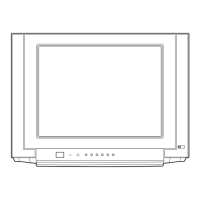
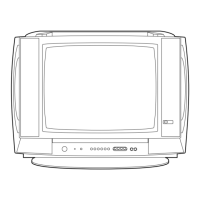
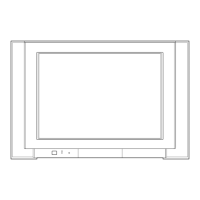
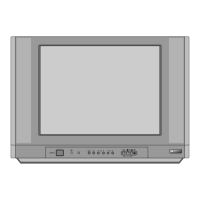
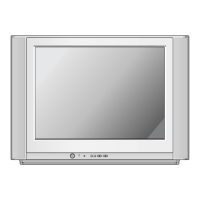
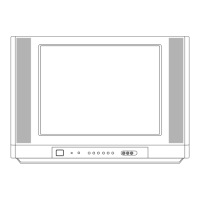
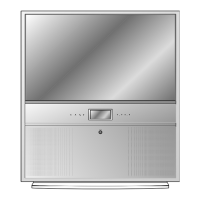
This document is a service manual for the LG Color TV models RF-21FA20/Q/PQ and CF-21Q20EH, chassis MC-014A. It provides comprehensive information for servicing, including safety precautions, specifications, control descriptions, disassembly instructions, adjustment procedures, and troubleshooting.
Function Description
The LG Color TV is a television receiver designed for displaying video and audio content. It supports multiple video input systems and tuning ranges, offering various features for enhanced viewing and listening experiences. The television can be controlled via a remote control handset or buttons on the front panel.
Important Technical Specifications
Video Input System:
- PAL-B/G, D/K, I/I
- SECAM-B/G, D/K
- NTSC 4.43 (AV)
Intermediate Frequency (Unit: MHz):
- VISION IF: 38.9MHz
- COLOR IF:
- 34.47MHz (4.43)
- 35.32MHz (3.58) (NTSC-M)
- VIF-4.25000MHz (SECAM)
- VIF-4.40625MHz
- SOUND IF:
- 33.4MHz (B/G)
- 32.9MHz (I/I)
- 32.4MHz (D/K)
Power Requirements:
- Power requirement: 110~240V, 50/60Hz
- Power consumption: 95W
CPT (Cathode Ray Tube):
Tuning Range:
- For TV:
- VHF-Low: B/G Ch2-4, D/K Ch1-5, I/I S1'-S3', S1
- VHF-High: B/G Ch5-12, D/K Ch6-12, I/I Ch4-13, S2-S10, S11-S20
- Hyper: S21-S41
- UHF: Ch21-69
- For CATV: All ranges are supported.
Tuning System:
- FVS (Frequency Synthesized Tuning System)
- 100 Programme memory
Antenna Input Impedance:
- VHF/UHF 75 ohm, unbalanced
OSD (On Screen Display):
Voice Coil Impedance:
Sound Output:
- 10W+10W (Max 12W+12W)
- Dual/Stereo: AV Stereo
External Connection:
- Head Phone Jack (Front or Side)
- A/V in: 1 pair (Front or Side)
- A/V in/out (Back)
External In/Output:
- Audio-In: 0.5Vrms ± 3db, over 10Kohm
- Audio-Out: 0.5Vrms ± 3db, below 1Kohm
- Video-In/Out: 1Vp-p ± 3db, 75ohm
Usage Features
The LG Color TV offers a variety of user-friendly features:
- Remote Control Handset: Provides full control over all TV functions, including power, mute, volume, channel selection, menu navigation, and special features.
- Front Panel Controls: Essential functions like power, volume, channel, and menu access are available directly on the TV's front panel.
- Picture and Sound Adjustments:
- ARC (Aspect Ratio Control): Allows changing the picture format.
- EYE/ (Option):* Switches the eye function on or off, likely for automatic picture adjustment based on ambient light.
- TURBO PICTURE / SOUND BUTTON: Quickly selects predefined "Turbo" picture or sound modes.
- PSM (Picture Status Memory): Recalls preferred picture settings.
- SSM (Sound Status Memory): Recalls preferred sound settings.
- Channel and Input Management:
- TV/AV: Selects between TV and AV input modes.
- LIST: Displays the program table.
- Programme Up/Down (▲/▼): Selects programs or navigates menu items.
- SWAP or Q.VIEW: Returns to the previously viewed program.
- VCR BUTTONS (option): Controls a connected LG video cassette recorder.
- OSD (On Screen Display): Provides a graphical interface for menu navigation and settings adjustments.
- Sleep Timer (SLEEP): Sets a timer for the TV to automatically turn off.
- Multi-language Support:
- I/II: Selects language during dual language broadcasts (option) and sound output.
- PIP (Picture-in-Picture) BUTTONS (option):
- PIP/*: Switches the sub-picture on or off.
- PR +/-: Selects a program for the sub-picture.
- SWAP: Alternates between main and sub-picture.
- INPUT: Selects the input mode for the sub-picture.
- SIZE: Adjusts the sub-picture size.
- STILL: Freezes motion of the sub-picture.
- POSITION: Relocates the sub-picture in a clockwise direction.
- 9/4 PIP: Switches on or off the program scan mode through 9 or 4 sub-pictures.
- Automatic Features:
- Auto program/Manual program
- Digital Eye
- Digital Comb Filter
- Auto Sleep
- Dynamic Focus (Option)
- Program Editing
- PSM (Picture Status Memory)
- CTI
- Turbo Search, Picture & Sound
- ACMS
- ARC (Zoom 1, 16:9 ↔ 4:3)
- 2 TUNER PIP (Double Window PIP) - Option
Maintenance Features
The service manual outlines several procedures and precautions for maintenance and repair:
- Safety Precautions:
- Isolation Transformer: Always use an isolation transformer when servicing to prevent electric shock and protect components.
- Special Safety Parts: Replace identified safety-related parts with specified components to prevent hazards like X-RADIATION, shock, or fire. Do not modify the original design.
- High Wattage Resistors: Keep resistors (over 1W) 10mm away from the PCB.
- Wiring: Keep wires away from high voltage or high-temperature parts.
- Picture Tube Handling: Exercise extreme care due to high vacuum and large surface area. Do not lift the picture tube by its neck.
- X-RAY Radiation Warning: The high voltage section and picture tube are sources of X-RAY RADIATION. For continued protection, replace the tube with the specified type. High voltage measurement (23.5 ± 1.5KV for 14-19 inch, 26 ± 1.5KV for 19-21 inch, 29.0 ± 1.5KV for 25-29 inch, 30.0 ± 1.5KV for 32 inch) must be within tolerance.
- AC Leakage Current Check: Perform both cold and hot checks on exposed metallic parts before returning the receiver to the customer to ensure electrical safety.
- Disassembly Instructions: Detailed steps for removing the back cabinet, chassis assembly, speaker assembly, and CPT.
- Adjustment Instructions:
- Test Equipment: Requires RF signal generator, multimeter, and color analyzer.
- Warm-up Time: Perform adjustments after the TV has warmed up for 15 minutes.
- RF AGC (Automatic Gain Control) Adjustment: Procedure to adjust AGC data in SVC mode to a specified voltage.
- Screen Voltage Adjustment: Adjust FBT screen volume to achieve a specific luminance for the white window.
- Focus Adjustment: Adjust upper and lower FBT focus volumes for optimal focus on digital circle patterns.
- Deflection Data Adjustment (Line SVC-2): Detailed procedures for adjusting Vertical Linearity (VL), Vertical Amplitude (VA), Vertical "S" Correction (SC), Vertical Shift (VS), Horizontal Shift (HS), Horizontal Width (EW), East-West Parabola (EP), East-West Corner (EC), and East-West Trapezium (ET) using specific remote control button sequences to enter service modes.
- White Balance Adjustment (LINE SVC 1): Procedure to adjust low light and high light status of CR, CB, RG, and BG to specific color coordinates.
- Troubleshooting Flowcharts: Provides step-by-step diagnostic guides for common issues such as "No Power ON (SMPS working)", "No Power (Not working SMPS)", "No Vertical Deflection", "No Sound (Picture OK)", "No Sound from H/P Jack (Option)", "Don't Catch Channel", "No PIP", and "Barrel Distortion". These flowcharts direct technicians to check specific voltages, waveforms, or replace particular components (ICs, diodes, transistors, fuses, coils, etc.).
- Exploded View and Parts List: Provides diagrams and lists of all components, including critical safety parts marked for specific replacement.
- Schematic Diagram and Block Diagram: Detailed circuit diagrams for various sections of the TV (Main, CPT, Q20 Control, PIP, MSP, IF, Power Supply, Side A/V Board, Super Woofer Board, Control (21Q20), MPX).
- Printed Circuit Board Layout: Visual representation of component placement on the main PCB.
- Wiring Diagram: Illustrates the internal wiring connections of the TV.
- Replacement Parts List: Comprehensive list of all replaceable parts, categorized by type (IC, Diode, Transistor, Capacitor, Fuse, Core, Coil & Transformer, Connector, Resistor, Spark Gap, Switch, Filter & Crystal, Accessories), with part numbers and descriptions. Critical safety parts are identified.

 Need help?

 To Next Page
 General