45
6-4-2. Overview of Major Repair Work
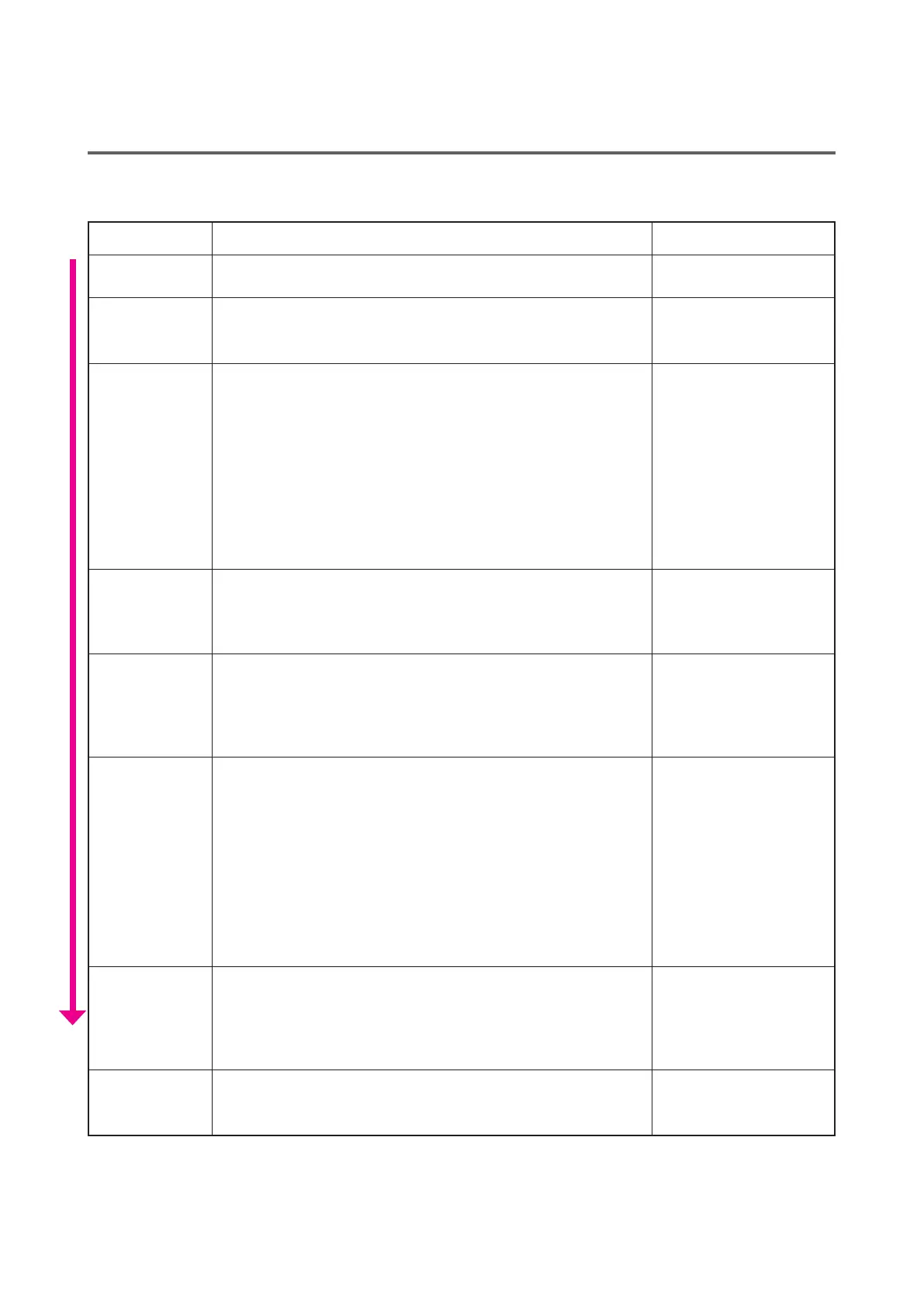
Work sequence Details of major repair Work tools
1. Diagnosing
failure
2.
Removing the remaining
refrigerant
Cut the ends of the pipe on the dryer side (high pressure) and the
compressor charging side to drain the refrigerant.
Plier, wire cutter
3.
Replacing and
welding parts
- Be sure to use the R134a refrigerant and the compressor, dryer, and oil
that are designed for R134a.
- If the part you are using is nitrogen- or vacuum-packed, check whether
you can hear the sound of nitrogen gas coming out when you open the
packing. If you can, it means the packing is in good condition. Only use
the part whose packing is in good condition. Assemble or weld the part
immediately once you open the packing.
- Be sure to perform nitrogen substitution when you weld the parts.
Nitrogen pressure: 0.1 - 0.2 kg/cm2
- Be sure to conduct repair work on a clean and dry place.
Pipe cutter, gas welding
machine, nitrogen gas
welding rod (silver soldering:
IS-430B, copper soldering:
Bcup-2)
Flux (Hydrox Korea)
4.
Vacuum
degasication
- Connect the hose and vacuum pump of the manifold gauge to the high
pressure side (dryer part) and low pressure side (compressor refrigerant
charging part) and apply vacuum for 60 minutes or more.
- Vacuum degasication speed: 113 ℓ/min
Vacuum pump (for R134a),
manifold gauge
5.
Charging the
refrigerant and
welding the inlet
- Measure the cylinder for R134a provided by LG using the electronic
scale in vacuum state within ±5 g of the specied volume and inject the
refrigerant into the refrigerant charging part of the styler compressor
(inject refrigerant while operating the product).
- Pinch the inlet and carefully weld it.
Cylinder for R134a, refrigerant
R134a, manifold gauge,
electronic scale, pinch-o
plier, gas welding machine
6.
Checking leakage
and performance
of refrigerant
- Conduct leakage inspection on the part that you welded.
- Fine leakage: Use the electronic leakage detector.
- Excessive leakage: Leakage of the compressor oil can be detected visually
or with nger.
* Caution: Do not conduct leakage inspection with soapy water.
- Cooling performance inspection
Check if it is warm when you touch the pipe, cond In, and condenser
with your hand.
Check if the moisture is evenly distributed on the surface of the
evaporator.
Electronic leakage detector,
screwdriver (+)
7.
Cleaning machine
room and tools
- Clean the ux on the silver welding part with soft brush or wet cloth (ux
can be a cause of corrosion and leakage).
- Wipe out the dust and moisture from the tools for R134a and store them
in a clean tool box. Put the tool box in a location where you can nd it
easily.
Brass brush, cloth, tool box
8.
Moving /
installation
Installation after moving the product should be conducted according to the
installation method described in the Repair Work Standards for Styler.
(Keep
the distance of 5 cm or more from the wall.)
6-4. Conducting Major Repair of Heat Pump Cycle
6-4-1. Repair Work Standards for the Styler that Uses Refrigerant R134a
No.
Work Category
Unit Work Standards Purpose Remarks
Opening time for pipe
and pipe parts
Minutes
Pipe parts: Within 1 hour
Compressor: Within 10 minutes
Dryer: Within 20 minutes
To prevent water from
penetrating
When it is rainy, reduce the time to
lower than half of the specied time.
(Water penetrating into pipe can be
detrimental.)
Welding work
Nitrogen
supply
pressure
Be sure to perform welding while
supplying nitrogen.
(Nitrogen pressure: 0.1 - 0.2 kg/cm
2
)
To prevent oxidation
scale from forming
inside the pipe due to
the welding heat
- For the details on the work methods
for dierent parts, refer to the
Precautions for Major Repair.
- When you weld the pipes, delicate
welding is required since the size of
R134a refrigerant molecule is very
small. Otherwise, the refrigerant may
leak through tiny holes.
- Do not apply force to the pipe parts
before/after welding. Otherwise, it
may cause crack (leakage) on the
pipe.
Styler
cycle
Vacuum time Minutes 40 minutes or more To remove moisture
Vacuum level
Torr
0.03 Torr or below (reference value)
Vacuum area
Apply high/low pressure vacuum at
the same time.
Vacuum pipe
EA
Use manifold for R134a.
Pipe coupler
EA
Model and manufacturer compatible
with R134a
Socket
EA
Plug for
R134a
EA
For R134a
Measuring the amount of
refrigerant
(Cylinder)
EA
Use R134a. The measurement
tolerance is ±5 g.
Note) In the winter, you may want to
reduce the amount by 5 g and, in the
summer, increase the amount by 5 g.
Do not mix it with
other refrigerant.
- Do not measure the refrigerant
amount in a place where the ambient
temperature is too high or too low
(the ambient temperature of approx.
25 is most suitable).
- Use the copper (Cu) on the body
part when you manufacture another
cylinder.
Replacing dryer
- Use the one for R134a.
- Be sure to replace the dryer when
you repair the cycle pipe.
To remove the
moisture left inside
the pipe.
Leakage inspection
- Never use soapy water to check for
the leakage. Soapy water may ow
into the pipe during the vacuum
cycle due to the vacuum inside the
pipe.
- Leakage detector model:
10170.16500 Manufacturer:
Robinair, U.S.A
To detect the leakage
of refrigerant
- When you check for the leakage of
refrigerant, be sure to check whether
oil has leaked. If you cannot detect
the oil leakage, use an electronic
leakage detector.


 To Next Page
 Loading...