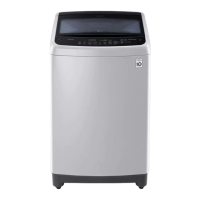
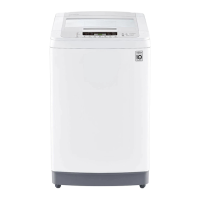
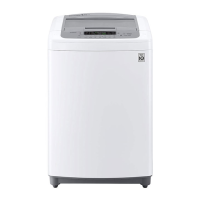
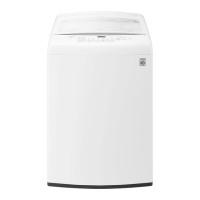
This document is an owner's manual for an LG washing machine, specifically models WT13DPBPK, WT13WPBPK, and WT13MPBPK. It provides comprehensive information on safety, installation, operation, smart functions, maintenance, and troubleshooting.
Function Description
The LG washing machine is designed for household use, offering various wash programs and customizable settings to clean different types of laundry. It features automatic load sensing to optimize wash, rinse, and spin settings, and includes functions for adding detergents, softeners, and bleaches. The appliance is equipped with a control panel for program selection and adjustments, and supports LG ThinQ application for smart functionalities like Smart Diagnosis.
Important Technical Specifications
- Model: WT13DPBPK / WT13WPBPK / WT13MPBPK
- Power Supply: 120 V~, 60 Hz
- Product Weight: Approx. 38 kg
- Dimensions (W x D x H): 590 mm x 610 mm x 965 mm (W x D' x H': 590 mm x 620 mm x 1310 mm)
- Maximum Capacity: 13 kg (dry clothes)
- Inlet Water Pressure: 50 - 800 kPa (0.5 - 8.0 kgf/cm²)
- Drain Hose Discharge Height: Approximately 90 - 120 cm from the floor
- Softener Dispenser Capacity: Max 35 mL
Usage Features
- Operation Overview: The manual guides users through the process of sorting clothes, loading items, adding detergents, selecting wash cycles, and starting the appliance. It highlights the importance of preparing the wash load according to fabric care labels, separating clothes by fabric type, soil level, color, and lint production.
- Wash Programs:
- Normal: For normal laundry, with automatic detection of laundry weight and adjustment of wash, rinse, and spin settings. Allows manual water level adjustment for lightweight and bulky items.
- Wool: For delicate fabrics like lingerie and woollens, using a slow spin to prevent damage. Requires cold water only.
- Duvet: For washing blankets or bedclothes with a hand wash sign. Recommends using a laundry net and submerging items to prevent floating. Advises against washing electric blankets, carpets, rugs, pet accessories, soft toys, or shoes.
- Rinse+Spin: For rinsing and spinning laundry separately, useful for preventing fresh stains. Fabric softener should not be added when this option is selected.
- Pre Wash+Normal: For pretreating immediate stains without handwashing, especially for clothes that might smell bad if not washed promptly.
- Quick Wash: For lightly soiled clothes, with a recommended laundry amount under 2.5 kg.
- Extra Clean: To increase rinsing performance, recommended for underwear and baby clothes, or for users with sensitive skin.
- Tub Clean: A special function to clean the inside of the drum.
- Customizing Programs: Users can adjust wash temperature, spin speed, and other settings using option buttons. The appliance automatically detects water level, but it can be manually increased to avoid linting and unbalanced errors with bulky but lightweight loads.
- Manual Washing: Provides instructions for setting up spin only, rinse and spin, rinse only, wash and rinse, or wash only cycles.
- Child Lock: A function to disable controls, preventing children from changing programs or operating the appliance. It locks all buttons except the POWER button and displays "CL" and remaining time alternatively. This function is not reset by turning off the power.
- Auto Restart: In case of power failure, the cycle restarts from the stage where it stopped.
Maintenance Features
- Cleaning after Every Wash:
- What to Clean: Recommends using warm or hot wash at regular intervals (e.g., every 5th wash) if cold water is always used. Advises turning off water taps after use, unplugging the power cord, wiping the door and drum interior, and cleaning around the bleach dispenser.
- Cleaning the Exterior: Suggests wiping spills immediately with a damp cloth, then a dry cloth, and avoiding pressing sharp objects on the surface or display.
- Cleaning the Appliance Periodically:
- Tub Clean: A special function to clean the drum by soaking, washing, rinsing, and spinning. Recommended once a month or more often if needed, and weekly for three weeks if there's a bad smell or mildew.
- Dispenser Drawer: Advises removing and cleaning the drawer and inserts once or twice a month to prevent detergent buildup.
- Water Inlet Filter: Recommends regular cleaning to remove lime or small objects. Instructions include turning off power and water, unscrewing the hose, removing the filter with pliers, and cleaning it with a brush.
- Lint Filter: An important part for efficient washing performance. It should be cleaned after at least 2-3 washes. Instructions detail how to push down release tabs, pull forward the cover, open the lid, remove lint, wash the filter, and reinsert it.
- Drain Pump Filter: Collects threads and small objects. Should be checked regularly. Instructions include turning on the appliance, selecting "Spin" to empty water, turning off power, placing a towel, unscrewing the cap, removing foreign objects, and refitting the cap. Caution is given regarding hot residual water.
Safety Instructions
The manual emphasizes safety with "WARNING" and "CAUTION" messages. Key safety points include:
- Supervising children around the appliance.
- Replacing damaged power cords by qualified personnel.
- Ensuring ventilation openings are not obstructed.
- Using new hoses to prevent leaks.
- Maintaining inlet water pressure between 50 and 800 kPa.
- Transporting the appliance with two or more people.
- Avoiding installation in damp, dusty, outdoor, or freezing areas.
- Ensuring the power plug is fully inserted and not using multiple outlet sockets or extension cords.
- Grounding the appliance properly.
- Securing the drain hose to prevent separation.
- Connecting to cold water only for single inlet models.
- Avoiding sharp objects on the control panel.
- Not disassembling or repairing the appliance without qualified personnel.
- Keeping animals out of the appliance.
- Keeping the area around the appliance free of combustible materials.
- Not leaving the door open to prevent injury to children.
- Not washing or drying items cleaned with combustible or explosive substances.
- Not using or storing flammable substances near the appliance.
- Not reaching into the appliance while operating.
- Disconnecting power in case of water leak or gas leakage.
- Thawing frozen hoses before use.
- Keeping detergents, softeners, and bleach away from children.
- Not touching power plug or controls with wet hands.
- Not bending the power cable or placing heavy objects on it.
- Not putting hands/feet under the appliance during operation.
- Avoiding contact with drained water.
- Ensuring proper drainage to prevent flooding.
- Discontinuing operation if the drum doesn't stop within 10 seconds of opening the door during spinning.
- Using power outlets with adequate electric capacity.
- Wiping off dirt/dust from power plug contacts.
- Unplugging and cutting the cable before discarding an old appliance.
- Disposing of packaging materials safely.
- Removing the door before discarding to prevent entrapment.
Smart Functions
- LG ThinQ Application: Allows communication with the appliance via smartphone. Users can download the app from Google Play Store or Apple App Store.
- Smart Diagnosis: A feature within the LG ThinQ app to diagnose and solve appliance problems. Users press and hold the Water Level button for 3 seconds while holding their smartphone mouthpiece to the POWER button to transfer data for diagnosis.
Troubleshooting
The manual includes a detailed troubleshooting guide for various error messages (dE, IE, OE, UE, FE, PE, LE) and common operational issues (noises, appliance not operating, detergent not dispensed, water leaking, appliance not filling/draining, long cycle time, poor stain removal, wrinkling, musty odor). It provides possible causes and solutions for each problem, often recommending checks like door closure, water tap status, hose condition, filter cleanliness, and load balance.

 Need help?

 To Next Page
 General