PULSE AND HEART RATE
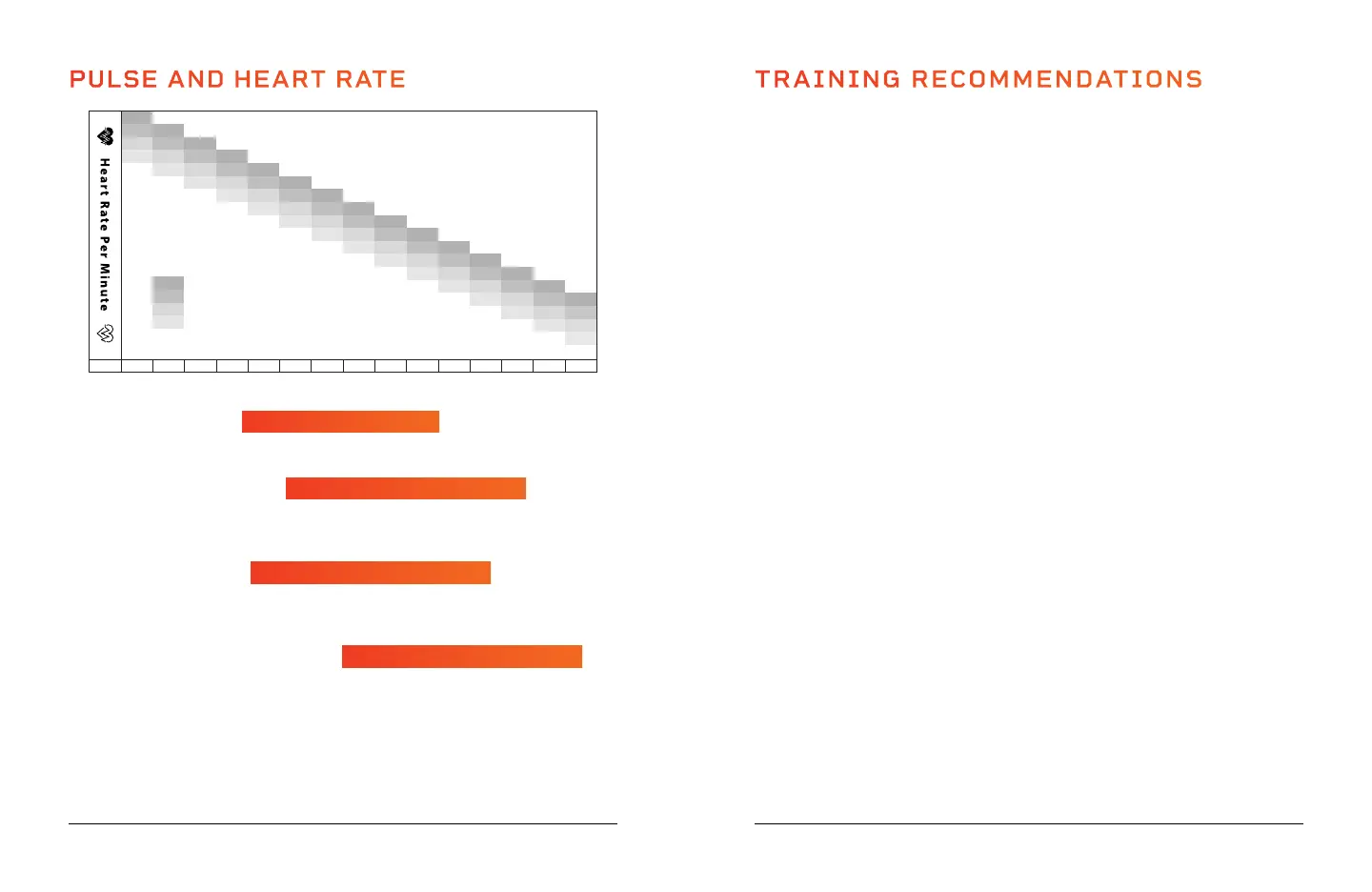
Calculate your personal target heart rate when training based on your fitness goals:
MAXIMUM HEART RATE
This value represents your maximum heart rate and serves as a basis from which to
calculate your personal training heart rate.
HEALTH & WELLNESS TRAINING
• Ideal for people who are overweight, older, beginners, and/or who do not exercise regularly.
• Burn approx. 4-6 calories per minute to produce energy in this zone. The percentage ratio
per calorie is approx. 70% fat, 25% carbohydrate, and 5% protein.
FAT BURNING TRAINING
• Ideal for athletes and sports people who aim to lose weight.
• Burn approx. 6-10 calories per minute to produce energy in this zone. The percentage rate
per calorie is approx. 85% fat, 10% carbohydrate, and 5% protein.
CONDITIONING & FITNESS TRAINING
• Ideal for athletes and sports people who want to improve their stamina and/or conditioning.
• Burn approx. 10-12 calories per minute to produce energy in this zone. The percentage
rate per calorie is approx. 35% fat, 60% carbohydrate, and 5% protein.
For optimal training results, calculate the average value of selected target zone (also see
chart above):
• Health & Wellness: target zone average = 55% of max heart rate (max heart rate x 0.55)
• Fat Burning: target zone average = 65% of max heart rate (max heart rate x 0.65)
• Conditioning & Fitness: target zone average = 75% of max heart rate (max heart rate x 0.75)
20Age
200
150
130
110
195
146
127
107
100%
75%
65%
55%
of maximum heart rate
of maximum heart rate
of maximum heart rate
of maximum heart rate
190
143
124
105
185
139
120
102
180
135
117
99
175
131
114
96
170
128
111
94
165
124
107
91
160
120
104
88
155
116
101
85
150
113
98
83
145
109
94
80
140
105
91
77
135
101
88
74
100
98
85
72
25 30 35 40 45 50 55 60 65 70 75 80 85 90
Target Zone = 70-80% of Max Heart Rate
Target Zone = 50-60% of Max Heart Rate
220 - Your Age = Max Heart Rate
Target Zone = 60-70% of Max Heart Rate
TRAINING RECOMMENDATIONS
PREPARING FOR TRAINING
If you have not done endurance or cardio training for a long period of time, you should
make an appointment with your physician for a checkup and to discuss your training
goals. This is especially important for people who are over 35, overweight, or have
heart/circulatory problems.
TRAINING RECOMMENDATIONS
HYDRATION
Adequate hydration is essential before and during exercise. During a training session of
30 minutes it is possible to lose up to 1 liter of liquid. You should drink about 1.5 cups of
water or appropriate electrolyte drink 30 minutes before beginning exercise. Take care
to maintain balanced hydration during the workout.
TRAINING FREQUENCY
Experts recommend endurance training 3-4 days a week to keep your cardiovascular
system fit. Of course, the more you train, the faster you will achieve your training goals.
However, it is important to plan sufficient breaks, to give your body enough time for
rest and recovery. After each training session, you should take at least one day off.
EXERCISE INTENSITY
Many beginners make the mistake of training too intensely. If your goal is to run a
marathon, your training intensity will certainly be high. However, most people have
training goals such as weight reduction, cardiac/exercise training, stress reduction,
etc., and therefore should exercise at a lower intensity. We recommend aiming for the
appropriate target heart rate for your particular training goal. See PULSE AND HEART
RATE on page 24 for more information.
DURATION OF INDIVIDUAL TRAINING SESSIONS
For optimal endurance or weight-reduction training, the duration of each training
session should be 25-60 minutes. Beginners and those who have not exercised regularly
for a long period of time should start with short training sessions of 10 minutes or less
in the first week and then slowly increase training duration week by week.
TRAINING DOCUMENTATION
To stay motivated and to evaluate the effectiveness of your training, you should create
a training plan, in written or computer spreadsheet format, before beginning exercise.
In your plan you should document data from each training session, such as distance,
training time, pulse/heart rate, as well as personal data, such as body weight, blood
pressure, resting heart rate (measured in the morning immediately after waking up) and
how you feel during exercise. See the sample training plan on the next page.
Recovery + Fitness Collection 25
24 Electrostride User Manual Lifepro


 To Next Page
 Loading...