23
For important information on limitations, see the insert that
comes with your test strips. To maximise your chances of an
accurate comparison between meter and laboratory results,
follow a few basic guidelines:
Before going to the lab
• Perform a control solution test to make sure the meter is
working properly.
• Do Not eat for at least eight hours before you test your blood.
• Take your meter with you to the lab.
While at the lab
• Conduct your meter test within 15 minutes of the lab test.
• Use only fresh, capillary blood obtained from the fingertip.
• Follow all instructions in this Owner’s Guide for performing a
blood glucose test with your meter.
1. Sacks, D.B.: “Carbohydrates.” Burtis, C.A., and Ashwood, E.R. (ed.), Tietz Textbook of Clinical
Chemistry. Philadelphia: W.B. Saunders Company (1994), 959.
Detailed information about your system
Comparing meter and laboratory results
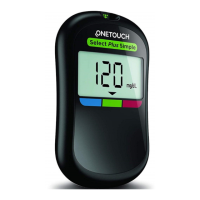
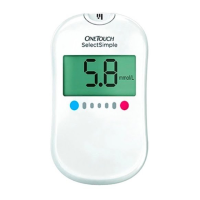
Test results with the OneTouch® SelectSimple™ Meter are plasma-
calibrated. This helps you and your healthcare professional to
compare your meter results with laboratory tests. If you have been
using another type of meter — one that provides whole blood-
calibrated results — you may notice that your test results with the
OneTouch® SelectSimple™ Meter are approximately 12% higher.
OneTouch® SelectSimple™ Meter test results and laboratory test
results both are expressed in plasma-equivalent units. However,
your meter result may differ from your laboratory result due to
normal variation. Meter results can be affected by factors and
conditions that do not affect laboratory results in the same way.
Your OneTouch® SelectSimple™ Meter glucose value is considered
accurate when it is within ±20% of the laboratory measurement.
There are some specific situations that could cause a difference of
more than ±20%:
• You have eaten recently. After meals, the blood glucose level
from a fingertip can be up to 70 mg/dL higher than blood drawn
from a vein (venous sample) used for a lab test.
1
• Your haematocrit (percentage of blood that is red blood cells) is
high (above 55%) or low (below 30%).
• You are suffering from severe dehydration.
• Your blood glucose is high and you tested when the temperature
was at the low end of the operating range (10°C), so the result
on your meter may be lower than your actual glucose level.
Re-test in a warmer environment with a new test strip as soon
as possible.


 To Next Page