Need help?
Do you have a question about the Lindab RECTANGULAR Series and is the answer not in the manual?
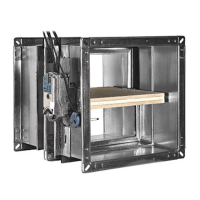
This document describes the WK25 rectangular fire damper, a device designed to prevent the spread of fire and smoke through ventilation systems. The manual provides comprehensive information on its installation, operation, and maintenance.
The primary function of the WK25 fire damper is to automatically close in the event of a fire, thereby compartmentalizing the building and containing the spread of flames and hot gases. This is achieved through a thermal fuse that triggers the blade closure when the temperature in the duct exceeds a predefined threshold (typically 70°C or 95°C). The damper can be installed in various wall and floor types, including rigid walls, flexible walls (plasterboard, gypsum blocks), and concrete floors, with specific installation guidelines provided for each scenario. The device is designed for both vertical and horizontal blade axis positioning, offering flexibility in installation.
The WK25 fire damper offers several usage features depending on the mechanism type. Manual and compact manual versions allow for direct interaction. In these versions, the blade can be opened by rotating a lever anti-clockwise and closed by pressing a button or automatically via the thermal fuse. For the compact manual with magnet version, an electromagnet facilitates remote closing, either when power is interrupted (interruption magnet version) or supplied (input magnet version). After a thermal closure, the blade can be manually reopened by rotating the lever counterclockwise once the thermal element has been replaced. Motorized versions, such as those with Belimo or Siemens servomotors, provide automated control. In these versions, the blade closes automatically upon reaching the temperature threshold or if power to the motor is cut off. To open the blade in motorized versions, power must be supplied to the motor. Manual opening is also possible using a handle, with specific instructions for clockwise or counterclockwise rotation and securing the blade in the open position. Position indication microswitches are an optional feature for all versions, signaling whether the blade is open or closed, which can be integrated into a building management system for enhanced monitoring.
The WK25 fire dampers are designed to require no maintenance. However, periodic inspections are mandated by national law and specific European standards (EN 15423 annex C and EN 15650 annex D) to ensure their continued functionality and compliance with fire safety regulations. These inspections should verify the correct working of the damper, especially if a remote control system is used to close the fire dampers in response to smoke or other alarm signals. Proper testing of such alarm signals is crucial during these periodic checks. In the event of the device's end-of-life, disposal must be carried out in accordance with national legislation, with particular attention to electrical and electronic components as per EU Directive 2011/65.
Installation guidelines emphasize the importance of flexible connectors to compensate for duct thermal expansion and wall bending during a fire, especially in light walls and plasterboard/rock wool sealings. These connectors should have normal flammability and not interfere with blade movement. Minimum distances between the fire damper and other elements (doors, electrical cables, hydraulic pipes) or other fire dampers are specified to ensure proper operation and maintenance access. The manual also details the characteristics of construction supports, including rigid walls (aerated concrete blocks, poured concrete, brick) and light plasterboard vertical walls (metal frames, rock wool filling), ensuring the structural integrity required for fire resistance. For paired installations, specific connection kits and intumescent gaskets are used, allowing two dampers to be installed side-by-side or vertically, functioning as a single unit.
 General
| Material | Galvanized steel |
|---|---|
| Fire resistance rating | EI 120 |
| Leakage class | Class 3 |
| Actuation | spring return |
| Standards | EN 15650, EN 1366-2, EN 13501-3 |


 To Next Page