Need help?
Do you have a question about the Lindab SDJR-S and is the answer not in the manual?
Lists certifications, test standards, and leakage classes for the damper.
Details operating parameters like pressure, velocity, installation axis, and climate.
Describes the use of Belimo actuators for damper operation and their mounting.
Technical data for various Belimo actuators (BEN, BEE, BE) used with the damper.
Covers BKNE 230-24 power/supply and BKSE 24-6 communication/control devices.
Table listing weights and effective areas for various damper sizes and actuators.
The Lindab SDJR-S is a smoke control damper designed for use in smoke exhaust piping systems. Its primary function is to remove heat and combustion products, such as smoke, from a single fire compartment in the event of a fire. The damper operates by opening in the affected section of the system, allowing for the efficient removal of smoke and heat.
The SDJR-S damper is a shutter-type device that integrates into smoke exhaust ductwork. It is designed to operate under specific conditions, handling both underpressure (up to 1500 Pa) and overpressure (up to 500 Pa) within the piping system. The damper blades can be installed with either a horizontal or vertical axis, offering flexibility in system design.
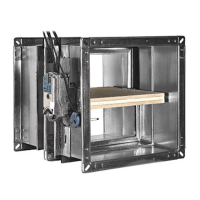
The core of the damper's operation is its actuating mechanism, which controls the movement of the damper blade between "OPEN" and "CLOSED" positions. This mechanism is housed within an insulated cover/box, ensuring protection and accessibility for maintenance. Electrical connection to the actuator is made via a non-flammable cable, which passes through a fire-resistant opening in the cover.
For enhanced control and monitoring, the SDJR-S can be integrated with a communication and power supply unit, such as the BKNE 230-24. This unit acts as a decentralized network device, providing power to the actuator and transmitting signals from a central control device (e.g., BKSE 24-6). This setup simplifies electrical installation, enables "on-site inspection," and allows for central control and inspection of multiple dampers via a simple two-wire line. The communication unit transmits damper position (OPEN/CLOSED) and fault messages, and it receives commands to adjust the actuator. It also retains the last control command even after a temporary network failure.
The control system, like the BKSE 24-6, indicates the operating condition and faults of the dampers through LEDs and can transmit these signals to a higher-level control system via auxiliary contacts. This allows for comprehensive monitoring of the entire smoke control system.
The SDJR-S damper is CE certified according to EN12101-8 and tested in accordance with EN1366-10, ensuring compliance with relevant safety and performance standards. It is classified for smoke control applications, indicating its suitability for critical fire safety systems. The damper exhibits low leakage rates, meeting external casing leakage class B and internal leakage class 3 according to EN1751. It has also undergone cycling tests to ensure reliability over time.
Designed for macroclimatic areas with mild climates, the damper can operate in temperatures ranging from -20°C to +50°C, making it suitable for a wide range of indoor environments. It is specifically intended for systems free from abrasive, chemical, and adhesive particles, which could otherwise impair its function.
During installation, the damper blade must be in the "CLOSED" position, and the damper body should not be deformed. Proper installation ensures that the blade does not grind against the body during opening or closing. The design allows for installation on air ducts or in/onto walls, with the understanding that a wall installation does not impart fire resistance to the wall itself, meaning it does not separate two fire compartments.
In situations without power supply, the damper can be operated manually and fixed in any desired position, providing a crucial override capability.
Maintenance and function checks of the SDJR-S damper must be performed by qualified and trained personnel in accordance with the manufacturer's documentation and international and local norms and laws. All effective safety standards and directives must be observed during assembly and maintenance.
Regular inspections are crucial to ensure reliable smoke exhaust damper function. This includes preventing the blocking of the closing mechanism and contact surfaces by dust, fibers, or sticky materials.
Before initial operation and after sequential revisions, comprehensive checks and functionality tests of all components, including electrical parts, must be successfully completed. If a damper is found to be non-functional, it must be clearly marked, and the operator is responsible for restoring it to a functional state or providing alternative fire protection.
Regular checks should include a visual inspection of the damper's integration, the internal damper area, the damper blade, contact surfaces, and silicon sealing. The displacement of the damper blade should also be checked by actuating the mechanism from a control system or power supply, observing its movement from "OPEN" to "CLOSED" and back.
Results of these checks, any identified imperfections, and all important facts related to the damper's function must be recorded in a "FIRE BOOK" and reported to the operator. Spare parts are available upon order to facilitate repairs and ensure continued operation. The product label, located on the damper casing, provides essential information for identification and ordering.
 General
| Category | Fire and Smoke Dampers |
|---|---|
| Brand | Lindab |
| Model | SDJR-S |
| Material | Galvanized steel |
| Standards | EN 15650, EN 13501-3, EN 1366-2 |

 To Next Page