
 Need help?
Do you have a question about the Little Giant PE-2YSA and is the answer not in the manual?
Important safety warnings and restrictions on solvent usage for the pump.
Details on motor, housing, capacity, discharge, electrical, and model number.
Graphical representation of pump performance based on head and capacity.
Information on compatible fluids (UL listed solvents and aqueous solutions) and incompatible fluids.
Instructions for sealing and connecting the power cord with proper grounding.
Requirement for pump submersion and GFCI protection for water-based solutions.
Guidelines for cleaning pump parts, checking impeller freedom, and lubrication.
Steps to diagnose and resolve operation failures like power issues or trapped air.
Adherence to electrical codes, grounding, and power disconnection before servicing.
Mandatory GFCI protection when pumping water-based solutions.
Visual guide illustrating the proper setup and components for pump installation.
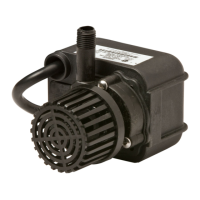
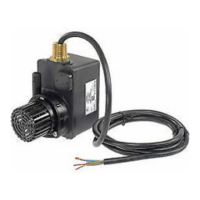
This document describes the Little Giant PE-2YSA 'Aqueous' Parts Washer Pump, a centrifugal pump designed for use in submerged parts washer, Skimarator, or coalescer applications. Its primary function is to circulate cleaning solvents for metal parts.
The PE-2YSA pump is specifically engineered for use with unheated metal parts cleaning solvents that are UL classified as PJQU, as described in the Gas and Oil Equipment Directory. These solvents are refined petroleum distillates that do not spontaneously heat and have a closed cup flash point no lower than 100°F. The pump is also compatible with aqueous cleaning solutions, which are water-based solutions that should not exceed 140°F and a maximum pH of 12. The motor is encapsulated in an epoxy resin, providing protection and durability in submerged environments. The pump's design, including its fully submerged operation, offers added protection from fire risk, especially given the moderate fire hazard presented by the low flash point of combustible cleaning liquids.
The pump is intended for submerged use only, meaning it must be fully immersed in the cleaning solution during operation. This submerged operation is crucial for both its functionality and safety, as it provides additional fire protection. Users must ensure that only UL-approved Metal Parts Cleaning Solvents or aqueous cleaning solutions are used. The use of fluids such as gasoline or lower flash point solvents is strictly prohibited due to the danger of explosions and fire, and doing so will void the product's warranty.
Before operating, users should consult the parts washer manufacturer's instructions for any additional safety devices, such as low liquid level cut-offs, that may be required. The power cord supplied with the pump should not come into contact with the cleaning solution, as the solution can attack the cord insulation, causing it to stiffen or degrade its insulating properties. The power cord is a three-conductor type, with the third conductor serving as a ground to prevent electrical shock. It is essential to seal the power cord inside a liquid-tight, 1/2" NPT steel intermediate metal conduit, taking care to avoid nicks or cuts in the cord.
Proper installation also requires consulting the pump nameplate for correct voltage and frequency. The black (or brown) and white (or blue) wires are live, while the green (or green/yellow) wire is the ground. The pump's power cord must be connected to a properly grounded, grounding-type receptacle. When pumping water-based solutions, the pump must be protected by a Ground Fault Circuit Interrupter (GFCI).
A minimum fluid level of 7.00 inches is required for proper operation, and a minimum distance of 3.00 inches should be maintained from the bottom. If the unit fails to operate, troubleshooting steps include checking the power supply and connections, ensuring the pump is not below the liquid level, checking for trapped air in the pump head, and inspecting for sediment build-up over the pump inlet. An air lock or bubble can prevent the unit from pumping and can usually be cleared by turning the pump off and restarting. The discharge line should slope upward to prevent air pocket formation.
Maintenance procedures require disconnecting the pump from the power source before attempting any service or component removal. The pump unit is permanently lubricated, so no additional oiling is required. Periodic cleaning of the pump parts is recommended to prolong the pump's life and efficiency. This involves lightly cleaning any corrosion or debris that may clog the impeller using a brush and penetrating oil, followed by light scraping. It is crucial to prevent sediment from parts being washed from building up and restricting fluid flow into the pump.
After cleaning, the impeller should be turned by hand to ensure it moves freely. If the impeller does not turn, or if the pump trips a circuit breaker, or does not operate properly after cleaning, the unit should be returned to Little Giant for repair. Users should not attempt repairs themselves. If the impeller turns freely, the volute can be replaced, and the pump reinstalled in the parts washer. Finally, it is important to ensure that the power cord remains protected from solvent and free of nicks or cuts.
Safety information emphasizes consulting solvent and equipment manufacturer's instructions for hazards, following all local electrical and safety codes, including the National Electrical Code (NEC) and OSHA. The pump must be properly grounded to protect the operator from electrical shock. When pumping water-based solutions, GFCI protection is mandatory. If the power disconnect point is out of sight, it should be locked in the open position and tagged to prevent accidental power application. Users are also advised not to attempt to build their own parts cleaners.
 General
| Model | PE-2YSA |
|---|---|
| Category | Water Pump |
| Type | Submersible Utility Pump |
| Discharge Size | 1-1/4 in |
| Power Source | Electric |
| Cord Length | 10 ft |
| Voltage | 115V |



 To Next Page