Need help?
Do you have a question about the Livoo MEN41 and is the answer not in the manual?
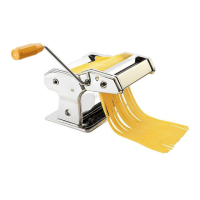
The Livoo Spaghetti and Ravioli Maker (MEN41) is a manual kitchen appliance designed to help users create fresh homemade pasta, including spaghetti and ravioli. It emphasizes a "feel good moments" approach, aiming to make the process of pasta making enjoyable and accessible.
The primary function of this device is to transform prepared dough into various pasta shapes. It features smooth rollers for flattening and thinning dough, and separate cutting rollers for shaping spaghetti and ravioli. The machine is operated manually using a handle, providing a hands-on experience in pasta preparation.
For spaghetti, the device allows users to roll out dough to a desired thickness using adjustable regulators, and then pass it through specific cutting rollers to create long, thin strands. The process involves preparing a dough mixture, kneading it to the right consistency, and then progressively thinning it before cutting.
For ravioli, the machine utilizes a specialized accessory. Dough strips are prepared and then fed through the ravioli accessory, where a filling can be added between two layers of dough before the machine seals and cuts them into individual ravioli. This allows for the creation of stuffed pasta with ease.
The Livoo pasta maker is designed for ease of use, starting with its setup. It can be affixed to a table or work surface using a provided clamp, ensuring stability during operation. The handle is inserted into designated holes for either the smooth rollers or the cutting rollers, depending on the task.
Dough Preparation: The manual provides a recipe for a basic pasta dough, suggesting ingredients like soft wheat flour and eggs. It also offers variations, such as using mineral water instead of eggs or combining soft wheat flour with durum wheat semolina for an "al dente" texture. The instructions guide users through mixing ingredients, kneading the dough until it's homogenous and consistent, and ensuring it doesn't stick to the fingers. The dough is then cut into small pieces for easier processing.
Dough Rolling and Thinning: The machine features a regulator with multiple positions (from 1 to 9) to control the thickness of the dough. Users start with the rollers completely open (position 1) and gradually reduce the thickness by adjusting the regulator. This iterative process involves passing a piece of dough through the smooth rollers multiple times, folding it over, and adding flour if necessary, until it achieves a regular shape and the desired thinness (down to a minimum of 0.2mm at position 9). This step is crucial for achieving the correct texture for the pasta.
Pasta Cutting (Spaghetti): Once the dough is rolled to the appropriate thickness, it is cut crossways into pieces approximately 25cm long. The handle is then moved to the hole for the cutting rollers, and the dough is passed through slowly to obtain the preferred type of pasta. The manual notes that if the rollers fail to cut, it indicates the dough is too soft, and more flour should be added before re-rolling. Conversely, if the dough is too dry and doesn't pull under the cutting rollers, a little water should be added.
Ravioli Preparation: For ravioli, the process involves preparing dough strips using the pasta machine, typically with the regulator set at position 5. These strips are then cut lengthwise. The front cutting part of the machine is removed, and the ravioli accessory is inserted. The dough is folded in two, inserted between the rollers, and then separated into two strips. A filling is then inserted between these two strips using a teaspoon, distributed evenly. As the handle is turned slowly, more filling can be added. Once the entire strip of ravioli has passed through, it is laid on a cloth to dry, allowing for easy separation.
Pasta Drying and Storage: After cutting, the fresh pasta (spaghetti or ravioli) is placed on a tablecloth or drying rack and left to dry for at least an hour. Fresh pasta can be stored in a cool, dry place for 1-2 weeks.
Cooking Instructions: The manual provides basic cooking instructions for both fresh spaghetti and ravioli. For spaghetti, it suggests boiling salted water (4 liters per ½ kg of pasta) and cooking for 2-5 minutes, depending on thickness, stirring gently. For ravioli, salt and oil are added to boiling water, and the ravioli are cooked for 3 minutes, with checking for doneness thereafter. Frozen ravioli can be cooked without thawing but will require an additional 5-10 minutes.
Proper maintenance is essential for the longevity and hygiene of the Livoo pasta maker.
Cleaning During Use: During the pasta-making process, users are advised to keep the scrapers underneath the smooth rollers clean using parchment paper.
Post-Use Cleaning: The machine should never be washed with water or placed in a dishwasher. Instead, after use, it should be cleaned with a brush or a wooden rod to remove any dough residue. For internal cleaning, plastic protectors (on some older models) can be removed.
Lubrication: If necessary, a few drops of vaseline oil or mineral oil can be applied to the ends of the cutting rollers to ensure smooth operation.
Safety Precautions: Users are explicitly warned not to insert knives or cloths into the rollers, as this could damage the machine or cause injury.
Storage: After cleaning and maintenance, the machine and its accessories should be replaced in their original box for safe storage.
The Livoo Spaghetti and Ravioli Maker is designed to be a durable and user-friendly tool for anyone looking to enjoy the experience of making fresh pasta at home, with clear instructions for both preparation and care.
 General
| Type | Electric Knife |
|---|---|
| Power | 1380 W |
| Product Type | Electric Knife |
| Voltage | 220-240 V |
| Frequency | 50/60 Hz |
| Material | Stainless Steel |

 To Next Page