Need help?
Do you have a question about the Logik LFFD55S18 and is the answer not in the manual?
Covers reading instructions, manual retention, intended use, and electrical safety.
Guidance on safe manoeuvring, placement, and use by children.
Precautions for storing food, preventing contamination, and avoiding damage.
Warnings regarding unauthorized servicing and electrical shock risks.
Guidelines for choosing a location and ensuring adequate ventilation space.
Instructions for leveling the unit and reversing the door swing direction.
Procedures for cleaning before use and preparing the water dispenser.
Steps for turning on the unit and adjusting internal temperatures.
Best practices for storing food and preparing items for freezing.
Guidance on defrosting, filling the water tank, and dispenser operation.
Steps for manually defrosting the freezer compartment if needed.
Instructions for cleaning internal and external surfaces of the appliance.
Guidelines for moving, professional servicing, and long-term storage.
Advice on managing condensation and environmentally friendly disposal.
This document provides safety warnings, usage guidelines, and maintenance instructions for a refrigerator.
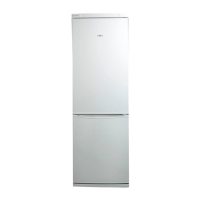
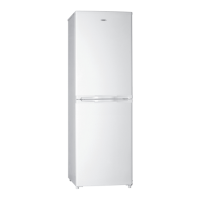
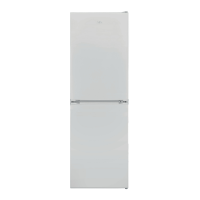
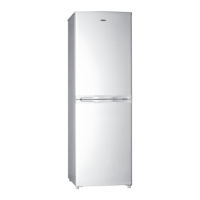
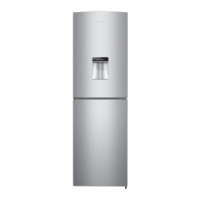
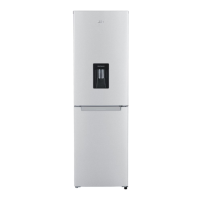
The refrigerator is designed for indoor household use and similar applications, including farmhouses, hotels, motels, bed and breakfast environments, staff kitchen areas in shops and offices, and catering. It features both a fridge and a freezer compartment. The fridge compartment is equipped with glass shelves, a salad bin with a cover, upper and bottom drawers, and upper and bottom balconies on the door. The freezer compartment also includes multiple drawers for storage. An integrated water dispenser is located on the upper door of the refrigerator, allowing for easy access to chilled water. The internal temperature is controlled by a thermostat, with recommended settings for optimal food preservation.
Installation and Setup: Before initial use, the refrigerator requires proper installation. It should be placed on a flat, firm, and well-ventilated floor, away from heat sources and direct sunlight, with an average room temperature between 16°C and 38°C. Specific free space requirements (25 mm on sides, 50 mm at rear, 25 mm at top) must be maintained to ensure proper ventilation and door opening. The unit needs to be levelled using the adjustable feet at the front to ensure proper door alignment and magnetic seal.
Door Swing Reversal: The door swing can be reversed if needed, but this process requires careful handling and is recommended to be performed by a qualified technician due to the risk of damaging the coolant system. If attempting it yourself, ensure the unit is unplugged and empty, and do not lay it flat. The process involves removing screws from the top cover, lifting the cover, detaching hinges, lifting doors, swapping levelling feet, reversing hinge pins, and reattaching components. After reversal, ensure doors are aligned horizontally and vertically, and seals are properly closed. If the door seal is crushed, it can be warmed with a hairdryer and rotated to restore its shape.
Initial Use: After installation, the unit should be cleaned inside and out with a weak bicarbonate soda solution and warm water, then dried completely. It is crucial to wait two hours after moving the unit before plugging it in to allow the coolant fluid to settle. Once plugged in, the unit should be turned on and allowed to run for 24 hours to reach the correct temperature before placing any food inside.
Temperature Adjustment: The internal temperature is controlled by a thermostat. Position 3 is the recommended setting for normal room temperatures (16°C to 38°C). Higher numbers correspond to lower temperatures. For colder environments (winter), settings 1 to 4 are recommended, while for hotter environments, settings 5 to 6 are suggested. A middle temperature setting is generally recommended for optimum food preservation to prevent food from spoiling quickly.
Food Storage Guidelines: The manual provides detailed guidelines for storing different types of food in various compartments:
Freezing Preparations: When freezing food, use quality items and handle them minimally. Freeze in small quantities for faster freezing and defrosting. Cooked food should be cooled completely before freezing. Use special freezer bags, film, plastic containers, or heavy-duty aluminium foil. Avoid thin cling film, glass, or uncleaned containers. Exclude as much air as possible from containers. Leave a small air space for liquids to allow expansion. Label frozen foods with contents and date to prevent spoilage and ensure efficient use of freezer space.
Defrosting Frozen Food: Frozen food should be defrosted at room temperature, but be aware that warm temperatures encourage bacterial growth. Drain and discard any liquid lost during defrosting. Ensure no ice crystals remain before cooking, especially with meat. Cook food as soon as possible after defrosting. Microwaves and ovens with defrost settings can be used if cooking immediately afterwards. Never refreeze defrosted food unless it has been cooked again. Reseal packs properly to prevent drying or freezer burn.
Water Dispenser: The integrated water dispenser requires filling the water tank to the MAX level. Ensure the tank is securely in place before filling. After each use, small amounts of water may drip into the overflow tray, which should be emptied periodically.
Noises: The unit may produce unusual noises due to the circulation of refrigerant liquid in the cooling system, which is normal and does not indicate a fault. These noises are more pronounced with CFC-free gases.
Cleaning: Regular cleaning is essential. The interior should be wiped with a weak bicarbonate soda solution and warm water, then dried. Shelves, drawers, and the salad bin should be removed, washed, and dried. The exterior can be cleaned with a damp cloth and standard furniture polish, avoiding the magnetic door seal. The condenser grille at the back can be vacuumed with a soft brush. Abrasive, acidic, or steam cleaners should not be used.
Defrosting (Freezer): The freezer compartment is frost-free under proper use. However, if frost accumulates (up to 10mm), it should be defrosted. This involves removing food, turning off and unplugging the unit, leaving the door open, and placing frozen food in another freezer or wrapping it to keep it cool. A shallow bowl or pan should be placed below the freezer compartment to collect water. Frost can be scraped away with a plastic scraper. Placing a bowl of hot water inside the freezer with the door closed can speed up defrosting. After defrosting, the interior and exterior should be cleaned. Metal or sharp instruments and electrical appliances should not be used to aid defrosting.
Care When Handling/Moving: When moving the unit, hold it by its sides or base, never by the top surface edges.
Servicing: Servicing should only be performed by an authorised engineer using genuine spare parts. Users should not attempt repairs themselves to avoid injury or malfunction.
Switching Off for Long Periods: If the unit will not be used for an extended period, disconnect it from the mains supply, empty all food, clean the appliance, and leave the door ajar to prevent unpleasant smells.
Condensation: Condensation may appear on the outside of the unit due to room temperature changes. This should be wiped off. If the problem persists, contact a qualified technician.
Disposal: Old units should be disposed of in an environmentally friendly manner to recover valuable raw materials. Special disposal procedures are required for the refrigerant and insulation materials. Ensure no pipes on the back of the unit are damaged. Information on disposal options can be obtained from local council offices. When disposing of an old unit, break off any locks or latches and remove the door as a safeguard against children being trapped.
 General
| Brand | Logik |
|---|---|
| Model | LFFD55S18 |
| Category | Freezer |
| Type | Upright freezer |
| Energy Rating | A+ |
| Number of Drawers | 3 |
| Dimensions (H x W x D) | 84.5 x 55 x 58 cm |
| Weight | 30 kg |
| Defrost System | Manual |
| Door Reversible | No |
| Color | White |
| Noise level | 42 dB |
| Freezing capacity | 4 kg/24h |

 To Next Page