Need help?
Do you have a question about the Logik LNFD55W18 and is the answer not in the manual?
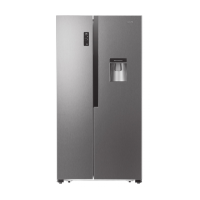
This document provides an installation and instruction manual for the Logik 55cm Total Frost Free Fridge Freezer with Water Dispenser, models LNFD55W18, LNFD55X18, and LNFD55T18. It outlines safety warnings, unpacking instructions, installation procedures, product overview, operation details, maintenance tips, and disposal information.
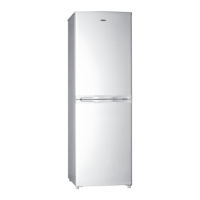
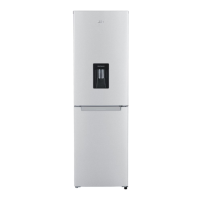
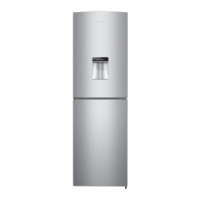
The Logik 55cm Total Frost Free Fridge Freezer is a household appliance designed for indoor use, providing both refrigeration and freezing capabilities. It features a total frost-free system, eliminating the need for manual defrosting. A notable feature is the integrated water dispenser, which allows for easy access to chilled water without opening the main fridge door. The unit is equipped with an electronic control panel for temperature management in both the fridge and freezer compartments.
Installation and Setup: Before initial use, the unit requires careful unpacking and positioning. It should be placed on a flat, firm, and well-ventilated floor, away from heat sources and direct sunlight. Specific free space requirements (25 mm at sides, 50 mm at rear, 25 mm at top) must be maintained for proper ventilation. The unit's levelling feet should be adjusted to ensure stability and proper door seal alignment. The door swing can be reversed, though it is recommended to contact a qualified technician for this procedure due to the complexity and risk of damaging the coolant system. After positioning, the unit should not be turned on for two hours to allow the coolant fluid to settle. Before placing food inside, the unit should be turned on and allowed to cool for 24 hours to reach the correct temperature.
Operation and Temperature Control: The internal temperature of the unit is controlled via an electronic control panel. Users can set the fridge compartment temperature between 2°C and 8°C and the freezer compartment temperature between -16°C and -24°C by repeatedly pressing the respective "Fridge" and "Freezer" buttons. The unit's performance may be affected by extreme room temperatures or frequent door openings. A special fridge/freezer thermometer can be used to verify internal temperatures, which should ideally be 0-8°C for the fridge and -18°C or lower for the freezer.
Super Freeze Mode: For rapid freezing, the "Super Freeze" mode can be activated by pressing and holding the "Freezer" button for 3 seconds. This mode quickly lowers the freezer compartment temperature. It automatically deactivates after 26 hours, or can be manually switched off by pressing and holding the "Freezer" button again for 3 seconds.
Holiday Mode: When away for an extended period, the "Holiday Mode" can be activated by pressing and holding the "Fridge" button for 3 seconds. In this mode, the fridge temperature automatically sets to 15°C. It is advised not to store food in the fridge during holiday mode. To deactivate, press and hold the "Fridge" button for 3 seconds.
Water Dispenser: The unit features a water dispenser with an internal water tank. Before first use, the water tank, valve, and cover must be removed, washed, and thoroughly dried. The tank is then reinstalled, ensuring the valve is properly inserted into the dispenser hole. The tank should only be filled with drinking water, not above the indicated level, and other beverages (especially those with grains) are not recommended to prevent blockage or damage. Hot water should not be filled directly into the tank. To dispense water, ensure the lock device is in the "Unlock" position, place a suitable container underneath, and push the lever. After use, slide the lock device to "Lock" to prevent accidental dispensing, especially by children.
Food Storage Guidelines: The manual provides general guidelines for storing different types of food in various compartments:
Tips for Keeping Food in the Unit: To maintain food quality and unit efficiency:
Preparations for Freezing:
Defrosting Frozen Food:
Cleaning the Interior and Exterior:
Cleaning the Water Tank and Water Dispenser:
Changing the Internal LED Light: The internal LED light is a panel that cannot be changed by the user. For light replacement or issues, contact a qualified service agent.
Care When Handling / Moving Your Unit: When moving the unit, hold it by its sides or base. Do not lift it by the edges of the top surface.
Servicing: Any servicing should be performed by an authorised engineer using genuine spare parts. Users should not attempt repairs themselves to avoid injury or malfunction. Contact a qualified technician for assistance.
Switching Off for Long Periods of Time: If the unit will be unused for an extended period, disconnect it from the mains supply, empty all food, clean the appliance, and leave the door ajar to prevent unpleasant smells and mould development.
Condensation: Condensation may appear on the outside of the unit due to room temperature changes. Wipe off any moisture residue. If the problem persists, contact a qualified technician.
Disposal: Old units should be disposed of in an environmentally friendly manner to recover valuable raw materials. Special disposal procedures are required for the refrigerant and insulation materials. Ensure that no pipes on the back of the unit are damaged before disposal. Contact your local council office for information on disposal options. When disposing of an old unit, remove any locks or latches and the door as a safeguard.
 General
| Type | Upright Freezer |
|---|---|
| Energy Rating | A+ |
| Noise Level | 42 dB |
| Colour | White |
| Defrost System | Manual |
| Freezer Star Rating | 4 Star |

 To Next Page