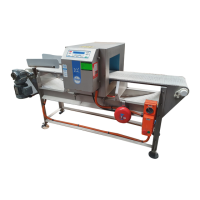
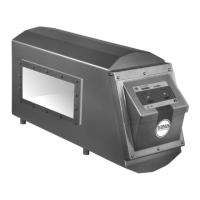
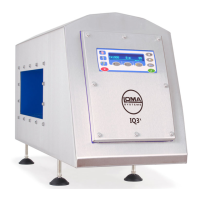
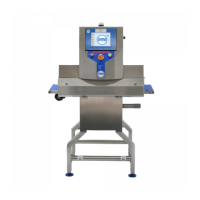
Need help?
Do you have a question about the Loma IQ3 and is the answer not in the manual?
General introduction to the guide's purpose and audience.
Describes the guide's chapter structure and logical sequence.
Details document control, changes, and user feedback process.
Explains special text and icons used for notes and warnings.
Outlines copyright information and disclaimers from Loma Systems.
Lists global offices and contact details for sales and support.
Explains basic principles and operation of metal detectors.
Details product effect and how phasing mitigates its impact on detection.
Automatically adjusts product signal threshold based on average signal values.
Defines the area external to the aperture where metal can cause signals.
Discusses factors affecting performance and typical detection levels.
Covers different metal types and their detectability based on properties.
Explains how metal contaminant shape and orientation affect detection.
Provides guidance on testing metal detector performance and support programs.
Automates detector settings configuration for products using Learn processes.
Emphasizes personnel compliance with safety instructions and regulations.
States compliance with EU Directives when installed and operated correctly.
Lists general safety warnings applicable to Loma metal detectors.
Describes safety labels attached to highlight potential hazards.
Highlights the importance of guarding to restrict operator access to hazardous areas.
Outlines warranty conditions and user responsibilities for safe operation.
Lists basic checks before using the detector to ensure it is safe.
Specifies detectors are for industrial use to detect metal contaminants.
Assesses noise levels generated by detectors during operation.
Provides guidelines for recycling electrical and electronic equipment.
Lists potential emergencies and associated procedures.
Recommends steps for assuring product quality and customer protection.
Covers calibration certificates and procedures for quality assurance.
Details the licensing terms for the metal detector software.
Provides technical specifications for the IQ3 Metal Detector Head.
Details technical specifications for European Belt Conveyors.
Guidance for installing a metal detector head only.
Lists safety warnings applicable during metal detector head installation.
Basic checks upon receipt to ensure the detector head is undamaged.
Guidance for safely lifting and moving the metal detector head.
Contains standard mounting positions for Loma Metal Detector heads.
Integration rules for fitting a detector head to a conveyor for optimal performance.
Guidance on connecting an electrical supply to the detector head.
Guidance for installing a metal detector system with a head on a conveyor.
Lists safety warnings applicable during metal detector system installation.
Basic checks upon receipt to ensure the system is undamaged.
Guidance for safely lifting and moving the metal detector system.
Procedures for adjusting conveyor operating height for production line integration.
Specifies sufficient free space needed around the system for access.
Guidance on connecting a clean and dry compressed air supply to the system.
Guidance on connecting an electrical supply to the system.
Procedures for checking that all guards are securely fastened.
Instructions for checking belt tracking before running the conveyor.
Guidance on setting up and adjusting reject mechanisms.
Information on mounting the user interface remotely.
Instructions for connecting external devices via a serial link.
Overview of Loma's metal detectors and their innovations.
Details available aperture sizes and standard/optional features.
Describes flat belts and plastic modular belts for conveyors.
Details three types of plastic modular belts supplied by Loma.
Lists available reject devices for removing contaminated products.
Describes available reject bin sizes for product collection.
Explains electrical supplies connection inside the box.
Emphasizes the importance of guarding for safety.
Details the function of the air pressure failure switch.
Lists available optional equipment for the system.
Options for mounting the Electrical Services Box overhead.
Useful for centering products and controlling presentation.
Photo-eye for counting packs and timing reject devices.
Illuminates when a PV test is required.
Stops conveyor if reject solenoid fails to trigger.
Confirms pack rejection into the reject bin.
Bin door lock managed via user interface.
Confirms good packs exit and bad packs do not.
Brief description of the machine's user interface for navigation.
Details four levels of user access and their functions.
Guidance for logging into and out of the IQ3 Metal Detector.
Guidance on starting, stopping, and emergency stopping the machine.
Guidance on setting up basic features like time, date, language, and machine ID.
Describes how to set the time and date for data timestamping.
Describes how to set the language for the detector's interface.
Describes how to set a unique identifier for the metal detector.
Explains setting passwords for different user access levels.
Information on configuring options for an effective metal detection system.
Configures options for the metal detector search head.
Configures system settings related to the conveyor.
Configures service options like Tracker and Reject time.
Balances P and Q channels for maximum sensitivity.
Sets transmitter drive for optimal detector performance.
Configures user interface display options.
Sets up serial connection for data transmission and communication.
Tunes the detector for products with no product effect.
Adjusts working threshold to optimize sensitivity with product signal drift.
Configures reject modes, relay, and timing.
Guidance for adding new products for inspection.
Guidance on setting up the Learn feature and learning products.
Guidance on setting up PV feature and performing PV tests.
Contains machine and product setup data for current product.
Records reject activity for monitoring contamination levels.
Provides information on product learn processes and settings.
Contains accumulated product run data for investigating issues.
Records completed performance testing for compliance evidence.
Records completed batch information for analysis.
Lists and analyzes run errors for production improvement.
Records completed shift information for analysis.
Monitors and analyzes serious system faults for production downtime reduction.
Stores records of reject activity for monitoring.
Stores records of run errors for analysis.
Stores records of serious system faults requiring immediate action.
Stores records of completed batch information.
Stores records of completed performance testing activity.
Stores records of completed shift information.
Lists safety warnings applicable when performing maintenance.
Provides guidance for cleaning the metal detector.
Guidance for maintaining the compressed air regulator.
Guidance for maintaining the conveyor belt.
Guidance for adjusting the reject devices.
Guidance for upgrading the metal detector software.
 General
| Supply Frequency | 50/60 Hz |
|---|---|
| Operating Temperature | 0°C to +40°C (32°F to 104°F) |
| Humidity | Up to 95% non-condensing |
| Outputs | Relay outputs |
| Detection Principle | Balanced Coil Induction |


 To Next Page