Need help?
Do you have a question about the Loma IQ3X and is the answer not in the manual?
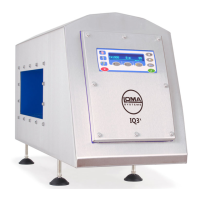
This guide explains how to use the IQ3X Metal Detection System. It walks through the process required to operate the machine.
This guide is organised into the following chapters: Introduction, Safety First, Getting Started, User Interface, Operating Instructions, Maintenance.
Information is subject to changes and additions over time to improve on the information provided and in line with changes made to the system.
Explains the meaning of special text, icons, and colour coding used throughout the document for notes and warnings.
Details copyright information for Loma Systems and acknowledges contributions or sources used in the document.
Provides contact details for Loma Systems offices worldwide for sales and support services.
Emphasizes the importance of reading and complying with instructions, statutory requirements, and regulations for safe operation.
Lists EU Directives the IQ3X Metal Detection System complies with, provided it's installed, operated, serviced and maintained correctly.
Provides general safety warnings applicable when using the system. Personnel should read and understand these warnings.
Details safety labels attached to the system, highlighting areas of caution to avoid potential hazards.
Explains the importance of guarding, covers, panels, and interlocks to prevent operator access to hazardous areas.
Outlines warranty conditions, stating that claims are subject to proper use, maintenance, and no unapproved changes.
Lists basic checks before use and points to observe for safe operation, including interlocking devices and emergency stops.
Defines permitted use for detecting metal contaminants in industrial environments and lists improper uses.
Discusses background noise levels in industrial environments and states the system does not emit hazardous noise.
Covers recycling requirements for electrical and electronic equipment according to WEEE Regulations and CE Directive.
Details emergency shutdown, dealing with fire, audible alarms, and visual indications for system status or faults.
Recommends commissioning, regular testing, record keeping, and training to assure product quality and customer protection.
Covers calibration certificates, product learn process, metal test pucks, and work instructions for quality testing.
Details the terms and conditions governing the use of the system software, including grant of license and rights.
Provides a description of the machine's two-line display and navigation buttons for system options and changes.
Details the function of each operator key: Cancel, Menu Soft Key, Menu Navigation Up/Down, Access Levels, and OK/Enter.
Explains the meaning of the System Fault, Run Error, and Inspecting LEDs, indicating system status.
Describes the Threshold/Signal Display and the Bargraph Display for monitoring inspection results.
Explains how to access and navigate menus using Soft Menu Keys and Menu Navigation Keys to set up and configure.
Details the process for editing menu option values, including increasing/decreasing numbers or cycling alternatives.
Guides on editing text fields character by character using navigation keys and confirming selections.
Identifies switches and buttons on the Electrical Services Box: Isolator Switch, Start/Stop, and Emergency Stop buttons.
Provides a visual overview of the IQ3X display menu structure and navigation paths for system setup and operation.
Explains the four password-protected access levels (Operator, Supervisor, Quality, Engineer) for managing system functionality.
Provides guidance on how to log into the IQ3X Metal Detection System and how to securely log out when finished.
Step-by-step instructions for logging into the machine using the Keylock button and password entry.
Instructions on how to log out of the machine and lock it using the Keylock button.
Provides guidance on starting and stopping the IQ3X Metal Detector, including emergency procedures.
Details the procedure to start the machine, including power supply checks and using the Isolator and Start buttons.
Instructions on how to stop the machine using the Stop button and how to switch off the electrical supply.
Explains how to stop the machine in an emergency by pressing the red Emergency Stop button.
Steps to restart the machine after an emergency stop, including clearing the issue and releasing the button.
Provides guidance on setting up basic features of the metal detector for optimal performance.
Describes how to set the time and date for accurate logging and synchronisation with production equipment.
Explains how to select the system language from a wide range of available options.
Details how to set a unique identifier for data analysis and reporting purposes.
Explains how to set passwords for four access levels to manage system features and functionality.
Provides instructions on how to disable the user access levels feature for unrestricted access.
Details options and parameters for configuring the metal detector for effective system operation.
Guides on configuring search head parameters like Type, Coil Gap, and Frequency Bands for optimal detection.
Explains system configuration for Photo-eye, PEC fault, speed modes, belt speed, and CTB constant.
Covers service options such as Tracker, Reject time, Set Up Learn, Access ferrite, and Reject in Learn.
Details VF Balance setup for maximizing detector sensitivity, covering Frequency, Pot position, and Auto Balance.
Explains VF Drive setup for transmitter performance, including Frequency, Drive On/Off, and Restore Drive options.
Guides on setting user options like Menu Scroll and Bar Graph for display customization.
Details the process of performing a Ferrite Tune to establish a baseline configuration for 'Dry' products.
Covers configuration of reject options: Mode (Pulse, Toggle), Reject Relay, Reject Timing, and Reject Confirm.
Explains how to add a new product, including setting Product No, Name, and Product Type (Unknown, Dry, Metal film).
Describes the Learn feature for optimizing detector performance per product, covering Full Learn, Update Learn, and Reverse Learn.
Details the Full Learn process, which automatically configures settings based on product effect on the electromagnetic field.
Explains the Update Learn process for fine-tuning phase values to minimize signal, especially when production line is running.
Lists and explains messages that may appear during a Learn process, providing guidance for troubleshooting.
Guides on manually adjusting product Learn parameters like Auto-Frequency, Frequency, and Working mode.
Covers setting parameters for the Learn process, including IQ Gain, RF Gain, Normal Drive, Film Drive, and Threshold.
Describes the benefits of the Performance Validation System and setting up the detector for PV testing.
Details how to set up PV testing, including Test Type, Timing, Test Window, and Number of Passes.
Guides on how to manually run a PV test, enter Operator ID, and pass test sample packs.
Lists safety warnings applicable when performing maintenance operations on the system.
Provides guidance on inspecting the system and cleaning procedures using mild detergent and clean water.
Lists materials required for cleaning, including grade of stainless steel and guidelines for chemical use.
Step-by-step guidance for cleaning the system, including checks on air regulator and reject mechanism.
Describes a typical cleaning regime consisting of five stages: Pre-Rinse, Detergent Rinse, Rinse, Disinfectant Rinse, Final Rinse.
Discusses types of detergents and disinfectants, risks of corrosion with certain stainless steel grades, and hygiene levels.
Covers maintenance of the air regulator unit, including pressure adjustment and water trap removal.
Provides guidelines for conveyor belt maintenance, including cleaning, inspection, and checking security.
Discusses specific maintenance points for PU belted and plastic modular belt conveyors.
Step-by-step instructions for replacing sections of a plastic modular conveyor belt.
Guides on adjusting belt tension and tracking to ensure proper alignment and prevent slippage.
Details the procedure for adjusting the conveyor belt drive chain tension.
Explains how to adjust Pusher, Retracting Band, and Air Blast Rejects for optimal operation.
Provides details for upgrading the IQ3X Metal Detection System software, including required files and procedure.
 General
| Brand | Loma |
|---|---|
| Model | IQ3X |
| Category | Metal Detector |
| Language | English |

 To Next Page