This document is an installation and operation manual for the LOVATO EASY FAST SMART gas conversion system, designed for both LPG (Liquefied Petroleum Gas) and CNG (Compressed Natural Gas) vehicles. The system aims to allow vehicles to run on gas while maintaining optimal engine performance and efficiency.
Function Description
The LOVATO EASY FAST SMART system is an electronic control unit (ECU) based gas injection system that allows a vehicle to operate on either petrol or gas (LPG or CNG). It manages the gas injection process by emulating the petrol injection signals, ensuring a smooth transition and operation. The system includes components for fuel storage, pressure reduction, filtration, and precise gas injection into the engine's intake manifold. It is designed to integrate seamlessly with the vehicle's existing engine management system.
The core function of the system is to convert a petrol-powered vehicle to run on gas. This involves:
- Fuel Selection: Allowing the driver to switch between petrol and gas operation.
- Gas Injection Control: Precisely controlling the timing and duration of gas injector openings based on engine parameters.
- Petrol Injector Emulation: Cutting off the petrol injectors when running on gas and sending appropriate signals to the vehicle's original ECU to prevent error codes.
- Safety Features: Incorporating automatic switching to petrol in case of low gas pressure or other detected errors, and providing an emergency gas start option.
- Diagnostic Capabilities: Monitoring system components and operations for errors, and providing diagnostic feedback to the user.
- Calibration: Allowing for self-calibration and manual adjustment of gas injection parameters to optimize performance for specific vehicle models and driving conditions.
Important Technical Specifications
While specific numerical technical specifications like power ratings or dimensions are not explicitly listed in the provided pages, the manual highlights several important technical aspects of the system:
- ECU Certification: The system's Quality Management System is certified by DNV to ISO/TS 16949:2002, indicating adherence to automotive quality standards.
- Fuel Types: Supports both LPG and CNG.
- Cylinder Compatibility: Designed for 3- and 4-cylinder engines.
- Injector Types: Compatible with various LOVATO gas injectors, with specific types selectable in the software.
- Injection Strategies: Supports "SEQUENTIAL" (gas injector enabled at each petrol injection) and "FULL GROUP" (gas injector enabled every 2 petrol injections) injection types. Sequential is the suggested option.
- Revolution Signal Detection: Can detect revolution signals from standard (0-12V square wave or coil negative) or weak (0-5V square wave or static switching-on signal) sources. An oscilloscope is recommended for identifying weak signals.
- Ignition Types: Configurable for "SINGLE COIL" (coil per cylinder), "DOUBLE COIL" (coil per two spark plugs), and "REVOLUTION COUNTER" (coil with mechanical distributor or revolution counter wire).
- Sensors: Utilizes gas pressure and temperature sensors, and supports various gas level indicator types (LOVATO1050, LOVATO 526025, 0-90 ohm, Not standard, Not standard inverted).
- Software Requirements: The calibration software requires Windows 98 2nd edition or later, at least 16 MB RAM, 20 MB free hard disk space, 800x600 or higher screen resolution, and Internet Explorer 5.5 or later.
- Connectivity: Connects to a PC via serial cable (Code 0570001) or serial USB adapter (Code 4685001), or wirelessly (Code 1685001).
- Power Supply: The control unit requires connection to +12V battery (RED-BLACK wire), ground (BROWN wire), and 12V under key (dashboard ON - engine OFF).
Usage Features
The LOVATO EASY FAST SMART system offers a range of features for both the installer and the end-user:
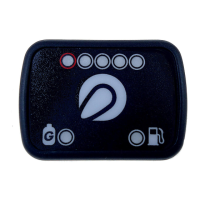
- Switch Operation: A dashboard-mounted switch allows the driver to select fuel type (petrol or gas) and provides visual feedback on system status (e.g., car running on petrol/gas, reserve, gas quantity, diagnosis indicator) via LEDs and an internal buzzer.
- Automatic Switching: The system can automatically switch from petrol to gas when engine conditions (e.g., revolutions, temperature, delay time) are met. It also switches back to petrol automatically in case of low gas pressure or system errors.
- Emergency Gas Start: Allows the car to start directly on gas if there are problems with the petrol feeding system, though this is considered an emergency operation due to potential catalytic converter damage.
- Calibration Software (EASY FAST INTERFACE SOFTWARE):
- Car Configuration: Allows setting parameters such as fuel type (LPG/METHANE), injection type, injector type, revolution signal type, and number of cylinders.
- Switching Settings: Configures switching thresholds (RPM, delay time for warm engine), idle operation (GAS, CHANGE BACK TO PETROL, PETROL), and high-revolution operation (GAS, PETROL, PETROL CONTRIBUTION).
- Sensor Configuration: Sets the number of main bearings and the type of gas level indicator.
- Map Adjustments: Provides a numerical display of multiplication coefficients (K) for gas injection time, allowing fine-tuning of the fuel mixture. This includes ABSOLUTE, LINEAR, and PERCENTAGE modification modes.
- Diagnostics: Displays error messages, allows testing of petrol and gas injectors, and shows operational timers (GAS TIMERS, PETROL TIMERS).
- Display: Provides a real-time overview of engine revolutions, gas temperature, gas pressure, gas and petrol injection times, gas level, and system status indicators (CUT-OFF, extra-injections, diagnostics, acquisition).
- Acquisition: Records and displays real-time data tracks of various system variables, which can be saved and loaded for analysis.
- Self-Calibration: An automatic procedure to obtain an "averagely correct carburetion" for the car, guiding the user through steps like starting on petrol, pressing ENTER, and performing accelerations for CNG systems.
- Save/Load Configuration: Allows saving all calibration parameters to a file and loading existing configurations, facilitating setup for similar vehicles.
- Firmware Update: Enables updating the ECU firmware.
- Language Selection: The software interface supports multiple languages.
- Diagrams: Provides access to wiring and pneumatic diagrams for installation and troubleshooting.
Maintenance Features
The manual outlines several features and recommendations related to maintenance and system health:
- Error Messages and Diagnostics: The system continuously monitors its components and operations. Detected errors are signaled via the switch's LEDs and buzzer, and detailed error codes and descriptions are available in the diagnostic software. This allows for quick identification of issues such as sensor failures, injector problems, or low gas temperature.
- Timers: The software includes "GAS TIMERS" and "PETROL TIMERS" to track absolute and partial operating hours on each fuel. The partial gas timer can be reset after maintenance, which is useful for scheduling service intervals.
- Forced Gas Start Counter: The system tracks the number of "forced gas starts" (emergency starts). If a certain limit is reached (e.g., 10 times), this function is disabled to safeguard the car's carburetion, and can only be reset via the PC software.
- Injector Test: The diagnostic software includes a "Petrol injectors signal diagnosis" to check wiring integrity and a "Correspondence verification of gas/petrol injectors" to ensure correct pneumatic and electrical connections.
- Firmware Updates: The ability to update the ECU firmware ensures the system can benefit from improvements and bug fixes, potentially enhancing performance and reliability over time.
- Installation Recommendations (Preventive Maintenance):
- Disconnect battery earth cable before installation.
- Smooth drilled holes and apply anti-rust.
- Apply silicon to cable through-holes to prevent water ingress.
- Install the control unit away from water, heat, and high-voltage cables, with the connector pointing downwards.
- Do not replace blown fuses with higher current ratings.
- Do not open the control unit.
- Use proper electrical connections (joints or soft solder).
- Observe local laws and regulations for LPG/CNG systems.
- Disconnect fuses before mounting the ECU.
- Do not wash the engine after installation.
- Warning on Petrol Pump Disconnection: It is strongly suggested never to disconnect the petrol pump, implying that the petrol system should remain functional even when running on gas.


 To Next Page
 General