the remote will showcase an aggregate voltage of both batteries combined. Ie. Battery voltage will display as
50.4 voltages to 42 volts. When aggregate battery voltage deplets to 42 volts, pilots should land immediately.
Each battery has two sets of wires protruding from the cell pack. The larger thicker gauge wires are connected
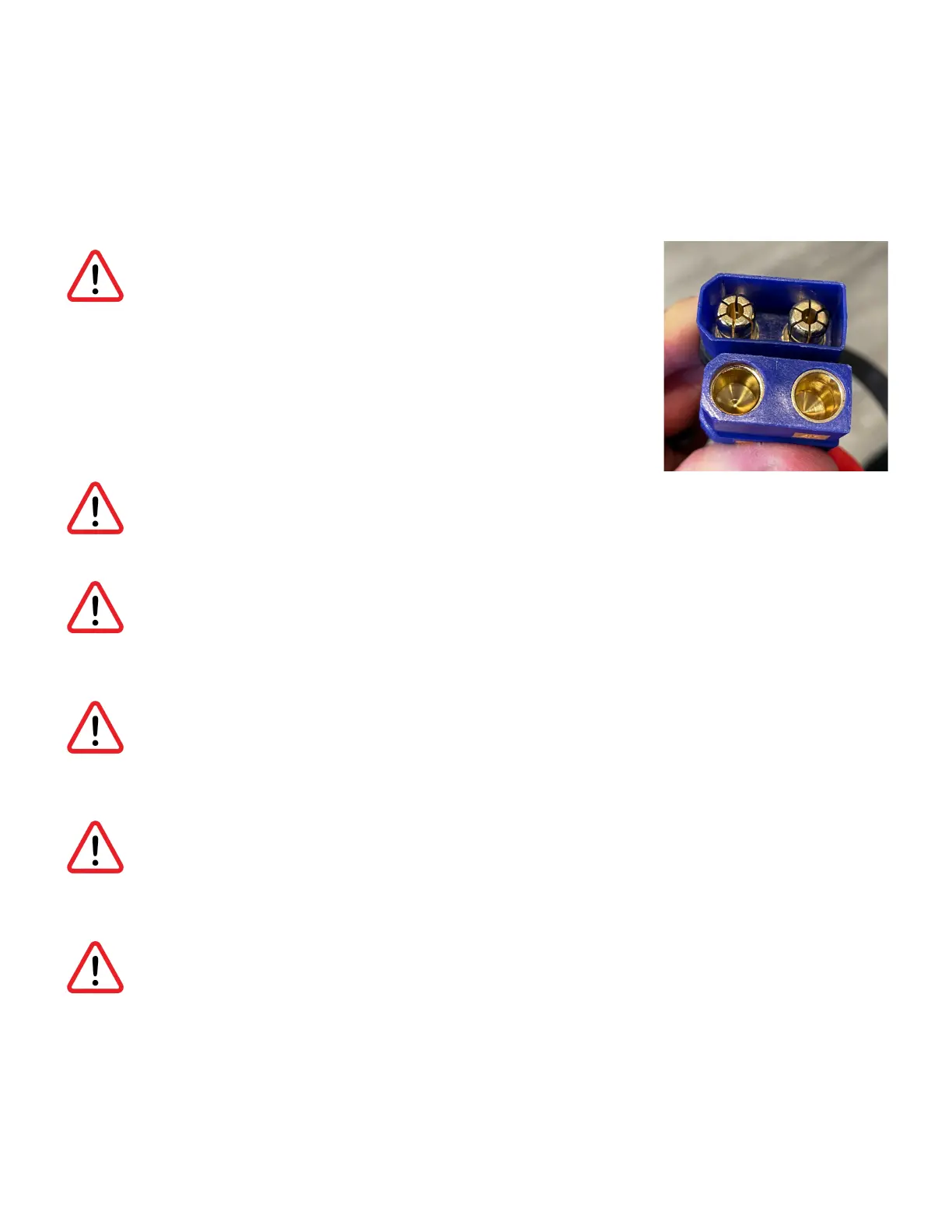
to an EC5 port and provide power to the drone. The blue EC5 port connectors are plugged into the
corresponding receiver on the drone. The second set of smaller, thinner wires provide battery information to
the flight controller, and power the battery indicator/warning lights. These smaller and thinner set of wires are
defined as our balance wires. The 7 smaller balance wires have a smaller white connection port.
When plugging the batteries into the drone, ensure the
battery port connector is properly aligned to the
corresponding port. Ensure that the red wires are plugged
into the corresponding port correctly, so the red wires from
the battery are matching the red wires on the aircraft! Ensure
the black wires on the battery are plugged into the
corresponding port matching the black wires from the
aircraft. Crossing these power lines can cause catastrophic
failure to the battery and drone.
C1 drones should never be flown without FULLY CHARGED
BATTERIES. Do not fly the C1 drone on batteries that have been flown previously, without
being recharged. Do not fly the C1 on partially charged batteries, as cell depletion is
accelerated and can lead to catastrophic failure.
Batteries should always be stored in fire-proof bags. Batteries should always be charged
on a fire-proof surface. Batteries should never be left unattended while charging. Do not
charge these batteries while sleeping or if a person is not present.
Do not ship batteries via air, ever, per FAA regulations. When traveling via air carrier or via
plane, do not check your batteries. Batteries must be carried on board the aircraft. FAA
does have limitations on batteries that can be brought onboard an aircraft. It is the pilots
responsibility to know these FAA regulations.
Handle batteries with extreme care. Do not puncture batteries and do not drop the batteries.
If batteries are dropped ensure the protective shield has not been damaged or cut. If the
battery is indented, do not fly with the battery. Replace it immediately.
Batteries should maintain their shape. If a battery becomes PUFFed, immediately replace
the battery and do not fly with it. Puffed batteries showcase a battery failure.
Motors
The motors on the C1 drone spin the propellers to create thrust and lift. The motors are brushless electric
motors. The C1 drone’s hexacopter design requires 6 motors on the aircraft. Motors on the drone are
quintessential to sustain flight. These motors are waterproof and will operate in wet weather conditions.


 To Next Page
 Loading...