3
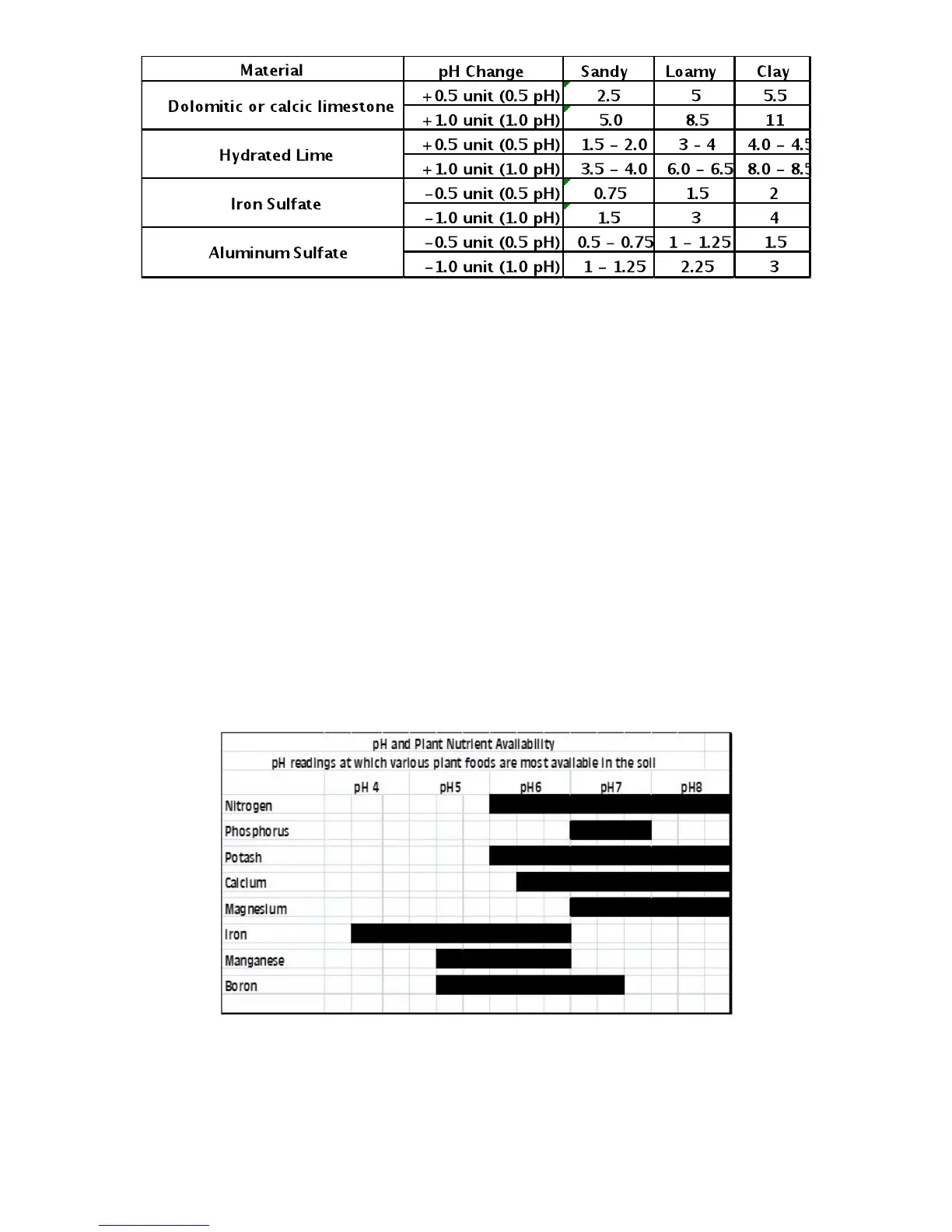
Amounts listed are pounds per 100 square feet. Do not add more than 5lbs. of lime or sulfur in one application.
Please note: To use Sphagnum Peat Moss to increase soil acidity, mix in up to one third total soil volume when planting acid loving plants.
Excessive acidity in the soil causes calcium, phosphorous and magnesium to be changed into forms that plants cannot use, causing them to suffer a
deficiency of these elements. Plants won‘t tolerate highly acid conditions. Slowdown of beneficial bacterial action is part of the reason; increased toxicity
from certain trace elements like aluminum is another. Deficiency of calcium and magnesium is a third possibility. The best explanation is that in acid soils,
chemical reaction can lock up major nutrients, especially phosphorous, making them unavailable to plants. Heavy use of inorganic, high-analysis fertilizers
causes soil to become more acid, as does heavy use of sulfur-containing fungicides. The same result can stem from using organic fertilizers that have an
acidifying effect. Acidity and alkalinity are measured in pH units, the pH being a symbol for the relative amount of hydrogen in a substance. On a pH scale
from I to 14, 5 and below are extremely acid and 10 or more extremely alkaline. Soil alkalinity or acidity, then, is determined by the reaction of various
minerals and organic compounds with moisture in the soil. Plants are often listed according to their pH preference. Some plants respond differently to pH
in different soils. Other plants tolerate a comparatively wide range of pH. Obviously, for high yields, the gardener or farmer must know the soil‘s pH. Then
the gardener/farmer can either grow the kinds of plants that do best in soil of that particular pH, or steps can be taken to change the soil pH to within
the preferred range for the plants desired. For the majority of common plants, a pH of 6.5 to 7 is optimum. Soils in this pH range offer the most
favorable environment for microorganisms that convert atmospheric nitrogen into a form available to plants. It also offers the best environment for the
bacteria that decompose plant tissue and form humus. In this pH range, all of the essential mineral nutrients are available to plants in sufficient quantities,
and generally in a much greater amount than at any other pH. Also, soil having a pH within this range is more workable, because a good crumb structure is
more easily maintained. Too acid a soil means the bacteria which decompose organic matter cannot live. Manganese & aluminum are so soluble in very acid
soil that they become present in amounts toxic to plants. Strong acidity also decreases nutrient availability, and plants may literally starve to death for
one essential mineral nutrient while having so much of another that it poisons them. This becomes accelerated the more you fertilize. On the other hand,
too alkaline a soil decreases nutrient availability. It causes loss of soil structure and development of “puddling”. Strong alkalinity dissolves and disperses
humus. “Black alkali” is caused by the accumulation of alkali and humus at the surface of the soil. Strong alkalinity causes a concentration of salts that
completely inhibit plant growth.
TO RAISE OR LOWER pH OF YOUR SOIL
Raising and lowering pH is not an exact science and most plants have a reasonably wide tolerance, certainly to within 1 pH point. Consult plant pH
preferences in this booklet and you will see that the majority can manage well on a pH around 6.5 but some need an alkaline soil and some a particularly
acid soil. Altering pH takes time so do not expect rapid changes; rather, work steadily towards giving a plant its ideal conditions.
FERTILITY
A fertile soil is one which produces satisfactory yields of crops and, because of the incorporation of plant and animal residues, contains an abundance of
organic matter or humus. It has good texture, not too loose and light nor too heavy and stiff, is well drained and has a proper pH for best plant growth. A
fertile soil has sufficient amounts of the three major elements, nitrogen, phosphorous and potassium (potash). It also contains a sufficient supply of the
micronutrients such as boron, copper, iron, sulfur, magnesium and molybdenum and consists of an abundance of organic matter and humus.
The
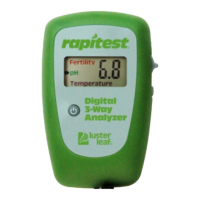
fertility portion of the instrument measures the soil‘s Nitrogen, Phosphorous and Potash (NPK) content, in combination.


 To Next Page
 Loading...