9
4.3 Guiding Speed adjustment
The SmartGuider automatically adjusts the exposure time a
ccording to the
guide star’s brightness: shorter for bright stars, longer for dim ones. This also
affects the frequency of corrections to the mount: bright stars allow for continuous
position control, which also ensures that all sorts of tracking errors, including the
component resulting from periodic error and atmospheric turbulence, will be
easily guided out. Bright stars are best to compensate for the most erratic
periodic errors, or with guide scopes having a shorter focal length than that of the
main optics. In this case, we advise using a moderate guiding speed (0.15 - 0.5X)
with HIGH aggressiveness.
On the other hand, fainter stars imply a less frequent correction of tracking
errors: this makes them not as suitable for mounts with an irregular periodic error.
However, long exposure times required by faint stars could come in handy to
minimize the influence of bad seeing. Here we suggest a very low guiding speed,
best if no higher than 0.25X with MILD aggressiveness.
Medium brightness stars (visual magnitude between 3 and 6) generally yield
best performance.
4.4 Search for a suitable guide star
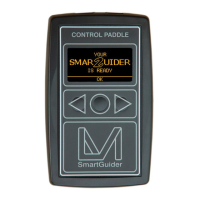
The telescope must not be touched during calibration,
otherwise the relevant
parameters could not be calculated correctly. This also appl
ies to the Control
Paddle unit which must not stay in your hand!
I
f the search for the guide star fails, you can manually move the guide scope
looking for a brighter star.
If the camera does not manage to find a sufficiently bright star, a micrometric
guide scope support will help. In case an off-axis guider is being used, the pick-
off prism and tube can be moved and/or rotated to find a brighter star.


 To Next Page
 Loading...