8
4.1 Error messages
> STAR LOST!
– This message may occur in such cases:
1. Clouds rolling in (during AUTOGUIDING READY and GUIDING).
2. Lenses getting wet (during AUTOGUIDING READY and GUIDING).
3. Too high guiding speed (during MOVING MOTORS…).
Case 1 and 2: the SmartGuider warns the user both with a visual message and
an audible signal, one beep per second until the star becomes visible again, for
up to 30 seconds. Case 3 and 4: adjust the guiding speed to a lower level
through the mount controls or check the Control Paddle to ST-4 mount cable.
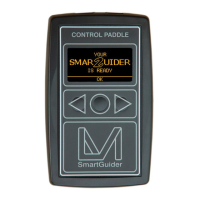
> STAR NOT FOUND! – This message may occur when the SmartGuider
camera cannot find a suitable star after STAR SEARCH… command.
> MOTOR NOT MOVING! – This message may occur when the SmartGuider
camera cannot move mount’s motors during calibration. You might want to check
the autoguiding cable or the mount’s autoguiding port pin assignment.
> COMMUNICATION ERROR! – The following message is displayed if the cable
connecting the CPU and the camera head gets accidentally disconnected, or in
case of problems with the electrical connections or the power supply.
4.2 Choosing a suitable guide scope
Thanks to its sub-pixel guiding capability, the SmartGuider does not call for
telescopes with very long focal length or particularly wide aperture. As a rule of
thumb, when imaging with digital SLRs or CCDs (pixel size between 5 and 8
microns), the guide scope should have no less than the half of the focal length as
that of the main instrument. In any case, it is advisable to use refractors instead
of slow catadioptric reflectors (e.g. Maksutovs with f/ratio of 10 and upwards),
since focusing by movable primary mirror can easily lead to exposure trailing
even if the tracking performance looks apparently good. Moreover, there are
cases where high magnification is not always an advantage, due to lower
brightness and increased sensitivity to atmospheric turbulence (seeing).


 To Next Page
 Loading...