
 Need help?
Do you have a question about the M-Audio BX8 D2 and is the answer not in the manual?
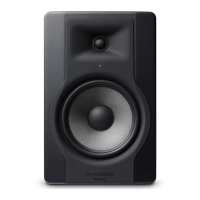
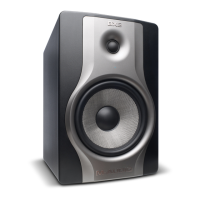
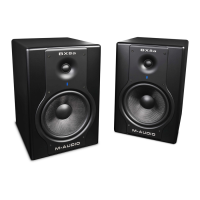
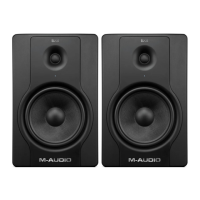
The M-Audio BX8 D2 [MA02] is a professional studio monitor, designed to provide accurate audio reproduction for mixing, mastering, and critical listening applications. As a powered monitor, it integrates amplification directly within the speaker enclosure, simplifying setup and ensuring optimal performance matching between the amplifier and speaker components. The BX8 D2 is part of the M-Audio BX Carbon and BX D2 series, indicating a lineage of monitors focused on delivering high-fidelity sound.
At its core, the M-Audio BX8 D2 functions as an active, two-way studio monitor. This means it contains separate drivers for high and low frequencies, each powered by its own amplifier section. The "BX8" designation typically refers to the size of the woofer, in this case, an 8-inch driver, which is responsible for reproducing bass and lower midrange frequencies. A separate tweeter handles the high frequencies, ensuring a broad and detailed sound spectrum. The internal crossover network precisely divides the audio signal between these two drivers, preventing interference and optimizing their individual performance.
The monitor is designed for near-field listening, meaning it's intended to be placed relatively close to the listener, typically in a studio control room or home recording setup. This placement minimizes room acoustics' impact on the sound, allowing engineers and producers to hear their mixes with greater clarity and accuracy. The BX8 D2 aims to provide a flat frequency response, which is crucial for studio monitors, as it ensures that the audio played back is as close as possible to the original recording, without artificial coloration or enhancement. This neutrality allows users to identify issues in their mixes and make informed decisions during the production process.
The internal amplifier, indicated by the "powered" or "active" nature of the monitor, eliminates the need for an external power amplifier. This integration ensures that the amplifier is perfectly matched to the speaker drivers, optimizing efficiency and sound quality. The power supply section, as detailed in the schematic, handles the conversion of AC mains power into the various DC voltages required by the amplifier and other internal circuitry. Safety features, such as fuse protection, are incorporated to safeguard the device from electrical overloads.
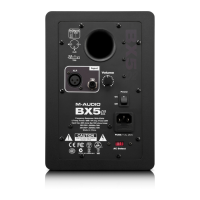
The M-Audio BX8 D2 is equipped with standard audio input connectors, typically balanced XLR and/or TRS inputs, allowing it to connect to a wide range of professional audio interfaces, mixing consoles, and other studio equipment. Balanced connections are preferred in studio environments as they help to reduce noise and interference over longer cable runs.
A volume control is usually present on the monitor, allowing users to adjust the output level to suit their listening environment and preferences. This control is often located on the rear panel, maintaining a clean aesthetic on the front. Some models in the BX series may also include acoustic space controls or high-frequency trim switches, which allow users to fine-tune the monitor's response to compensate for room acoustics or personal taste. These features are valuable for adapting the monitor's sound to different studio environments, ensuring consistent and accurate monitoring regardless of the room.
The front panel of the monitor typically features an LED indicator, which provides visual feedback on the monitor's operational status, such as power on/off or standby mode. This simple feature helps users quickly ascertain the monitor's state. The overall design emphasizes functionality and durability, with a robust enclosure designed to minimize unwanted resonances and provide a stable platform for the drivers.
The service manual outlines several key maintenance and repair procedures, indicating that the BX8 D2 is designed with serviceability in mind, albeit by authorized personnel. The document emphasizes that repairs should only be performed by M-Audio authorized service centers to maintain warranty validity and ensure proper functioning.
Common repair procedures detailed include:
The manual also provides important safety warnings regarding power supply fuses and internal batteries (though the BX8 D2 is a mains-powered device, this general warning is included). For fuse replacement, it stresses the importance of using only the same type or equivalent type recommended by the manufacturer to prevent fire or electrocution. This underscores the critical role of proper component selection in maintaining safety and performance.
The emphasis on authorized service centers and the detailed repair steps suggest that M-Audio provides specific tools, parts, and training for technicians to perform these operations correctly. The modular nature of the components (drivers, amplifier module, LED) simplifies troubleshooting and replacement, reducing the overall repair time and cost when performed by qualified personnel. The document serves as a comprehensive guide for maintaining the operational integrity and longevity of the M-Audio BX8 D2 studio monitor.
 General
| Type | Active Studio Monitor |
|---|---|
| Woofer Size | 8 inches |
| Frequency Response | 38 Hz - 22 kHz |
| Crossover Frequency | 2.2 kHz |
| LF Amplifier Power | 80W |
| HF Amplifier Power | 50W |
| Signal-to-Noise Ratio | > 100 dB |
| Polarity | Positive signal at + input produces outward LF cone displacement |
| Power Output | 130W |
| Input Connectors | XLR, TRS |
| LF Driver | 8 inches |
| HF Driver | 1.25-inch silk dome |
| Input Impedance | 20 kΩ balanced, 10 kΩ unbalanced |
| Power | 100–240V ~ 50/60 Hz |
| Tweeter Size | 1.25-inch |
| Inputs | Balanced XLR, Balanced 1/4" TRS, Unbalanced RCA |



 To Next Page