31
MAC 6000 Hydronic Heater
Trailer Axle Manual
2106 East Indiana Ave., Bismarck, ND 58504 U.S.A. • www.macheaters.com • +1-800-272-4604
8
Rev: 07.25.2013
ELECTRIC BRAKES
The basic structure of the Electric Brakes on your trailer will resemble the brakes on
your car or tow vehicle, with one major difference; your trailer implements an Electric
Actuation system and your tow vehicle utilizes a hydraulic system. The Electric Braking
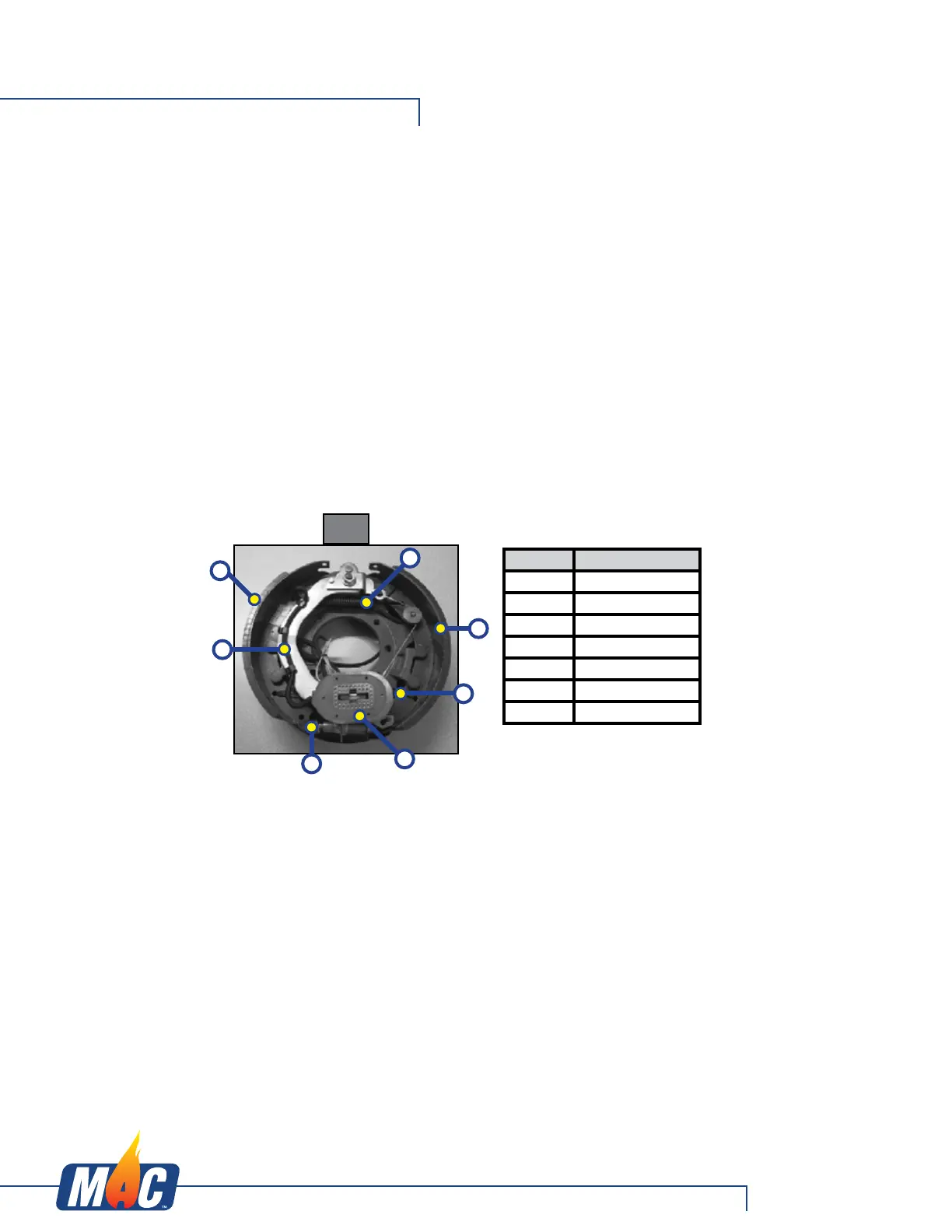
System operates in the following order of steps; refer to the Electric Braking System
Diagram and the brake diagram (Fig. 5) to follow along:
1. Electric current is supplied to the trailer’s braking system when the tow vehicle’s
brakes are applied.
2. From the tow vehicle’s battery, the electricity flows to the brake’s electromagnet.
3. When energized the magnets are attracted to the rotating surface of the drums.
4. This moves the actuating levers in the direction the drums are turning.
5. The actuating cam at the end of the shoe forces the primary shoe out to the
drum surface.
6. The force of the primary shoe actuates the secondary shoe to contact the drum.
7. The force applied to the brake drum can be increased by elevating the current
flow to the magnet.
Fig. 5
A
B
C
D
E
F
G
Callout Component
A Primary Shoe
B Actuating Lever
C Adjuster
D Magnet
E Adjusting Spring
F Secondary Shoe
G Retracting Spring
HOW TO USE LIPPERT ELECTRIC BRAKES PROPERLY
The Lippert Components, Inc. Electric Braking System is synchronized with the tow
vehicle brakes. Never attempt to stop the combined load of the tow vehicle and
the trailer by using either the tow vehicle brakes or the trailer brakes only. They are
designed to work together.
Small manual adjustments may occasionally be necessary to accommodate changing
loads and driving conditions. Synchronization of tow vehicle to trailer braking can only
be accomplished by road testing. Locking up, excessive grab, or delayed application is
quite often due to the lack of synchronization between the tow vehicle and the trailer
being towed. High voltage (2V+), Low voltage (2V-) or improperly adjusted brakes are
the most common causes of these problems and can be easily remedied.
Prior to any adjustments, your trailer brakes should be burnished-in by applying the
brakes 20-30 times with a 20 m.p.h. decrease in speed, e.g. 40 m.p.h. to 20 m.p.h. Allow
ample time for brakes to cool between application. This allows the brake shoes and
magnets to begin seating to the brake drum.


 To Next Page