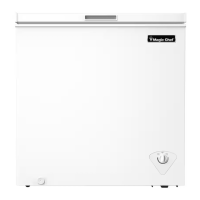
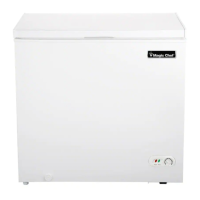
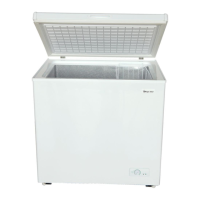
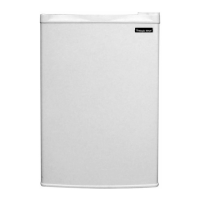
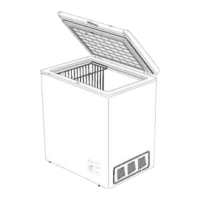
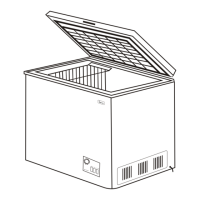
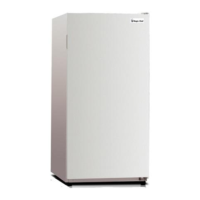
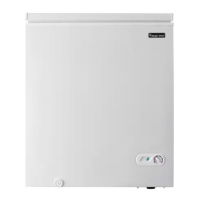
This document is a user's manual for a Magic Chef Chest Freezer, covering models HMCF35W4, HMCF5W4, HMCF5B4, HMCF7W4, and HMCF7B4. It provides essential information for safe operation, installation, maintenance, and troubleshooting of the appliance.
Function Description:
The Magic Chef Chest Freezer is designed for the long-term storage of frozen food in household and similar environments. It functions by maintaining a low temperature to preserve food quality for extended periods, typically up to three months. The appliance uses a refrigeration system with a compressor and refrigerant to cool its interior. It features a temperature control dial to adjust the cooling level, an interior basket for organizing items, and a drainage hole for defrosting. The freezer is intended for free-standing use and should not be recessed or built-in.
Important Technical Specifications:
- Models Covered: HMCF35W4, HMCF5W4, HMCF5B4, HMCF7W4, HMCF7B4.
- Power Requirements: Standard 115/120 Volt A.C. ~/60Hz electrical outlet with a three-prong ground.
- Refrigerant: Flammable refrigerant (specific type not detailed, but disposal guidelines emphasize its flammability).
- Storage Capacity:
- HMCF35W4: 1 storage basket (3.5 Cu. Ft.)
- HMCF5W4/HMCF5B4/HMCF7W4/HMCF7B4: 2 storage baskets (5/7 Cu. Ft.)
- Temperature Control: Dial with 7 settings (1-coldest, 7-coldest) and a '0' (OFF) setting.
- Indicator Lights: "Power" (red) and "Run" (green).
- LED Light: Included for 5/7 Cu. Ft. models.
- Interior Divider: Included for 5/7 Cu. Ft. models.
- Operating Environment: Designed for temperatures between 32°F and 110°F.
Usage Features:
- Installation:
- Requires removal of exterior and interior packing.
- Must stand upright for approximately 4 hours before connecting to power to prevent cooling system malfunction.
- Requires 5 inches of space around the back and sides for proper air ventilation.
- Should be placed on a strong, level floor away from direct sunlight, heat sources, and moist areas.
- Not designed for use with an inverter or installation in an RV.
- Electrical Connection:
- Must be plugged into a dedicated, properly installed-grounded wall outlet.
- The power cord has a three-prong plug for safety; do not cut or remove the ground prong.
- Avoid using extension cords as they can negatively affect performance.
- The "Power" light (red) indicates proper electrical connection.
- Temperature Control:
- The temperature control dial allows users to select the desired cooling level.
- Setting '1' is the coldest, and '7' is the coldest.
- Setting the dial to '0' (OFF) stops cooling but does not shut off power to the freezer.
- For first-time use, set to '4' and allow 24 hours for the cabinet to chill before adding food.
- Adjustments should be made one numerical increment at a time, allowing several hours for stabilization.
- A 3-5 minute delay is required before restarting the unit after unplugging or power loss.
- Food Storage:
- Designed for long-term storage (up to three months).
- Follow manufacturers' instructions for pre-packed commercially frozen food.
- Place frozen food into the freezer as quickly as possible after purchase.
- A storage basket is provided for organizing odd-shaped items and can be slid or lifted out.
- The freezer lid is susceptible to breaking from excessive ice build-up, necessitating regular defrosting.
- Safety Precautions:
- Keep ventilation openings clear.
- Do not use mechanical devices or other means to accelerate defrosting, other than those recommended by the manufacturer.
- Do not damage refrigerant tubing.
- Do not use electrical appliances inside food storage compartments unless recommended by the manufacturer.
- Risk of child entrapment: Remove doors and leave baskets in place before discarding old freezers. Never allow children to play in or crawl inside.
- Unplug the appliance before maintenance.
- Children aged 8 and above, and persons with reduced capabilities, can use the appliance with supervision and instruction.
- Do not store or use flammable liquids near the freezer.
- Do not attempt repairs yourself; refer to authorized service personnel.
- Never touch the interior chamber or frozen foods with wet hands to avoid frostbite.
- Do not use sharp or metallic instruments to remove frost to avoid damaging cooling coils and voiding the warranty.
Maintenance Features:
- Cleaning:
- Recommended upon installation and each time the unit is defrosted.
- Unplug the freezer, remove food and baskets.
- Wash the interior with a damp warm cloth soaked in a solution of 2 tablespoons baking soda per quart of water.
- Wash storage baskets with mild detergent.
- Keep the door gasket (seal) clean for efficient operation.
- Clean the exterior with mild detergent and warm water.
- Dry all parts with a soft cloth.
- Defrosting:
- Defrost when frost on walls is 1 to 1½ inches thick (approximately every 3 months) for efficient operation and minimum energy consumption.
- Choose a time when frozen food stock is low.
- Remove frozen food and place it in a cooler.
- Unplug the freezer (both "Power" and "Run" lights should be off).
- Ice melts into the cabinet during defrosting.
- Unscrew and remove the drain cap on the exterior front (lower left) and place a shallow pan to collect defrost water.
- Do not use boiling water or sharp/metallic instruments for defrosting.
- Pouring warm (not boiling) water on ice/frost can speed melting. Leaving the door open also helps.
- Vacation Time:
- Short vacations (less than three weeks): Leave the freezer operating.
- Long vacations (several months): Remove all food, unplug, clean and dry the interior thoroughly. Leave the door open slightly (or removed) to prevent odor and mold.
- Moving the Freezer:
- Unplug the freezer, remove all food.
- Securely tape down loose items and tape the doors shut.
- Ensure the freezer stays in an upright position during transportation.
- Energy Saving Tips:
- Locate the freezer in the coolest area of the room, away from heat sources and direct sunlight.
- Allow hot foods to cool to room temperature before placing them in the freezer.
- Avoid overloading the freezer.
- Wrap foods properly and wipe containers dry to reduce frost build-up.
- Do not line freezer storage bins with aluminum foil, wax paper, or paper toweling.
- Organize and label food to reduce door openings and search times; remove multiple items at once.


 To Next Page
 General