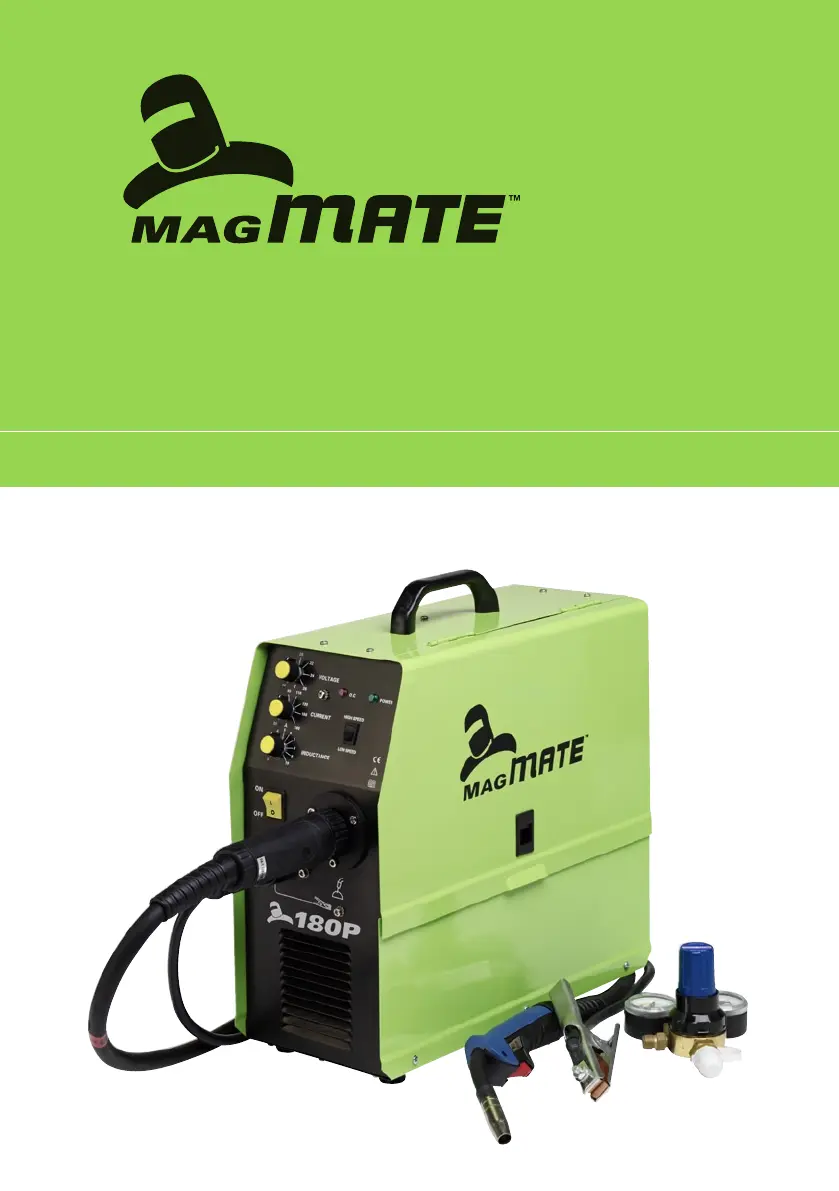
Why does my Magmate 180P weld have excessive spatter?
- LLori LongSep 23, 2025
If the weld has an excessive amount of spatter, it could be because the wrong polarity has been selected. Select the correct polarity for welding.
Why does my Magmate 180P weld have excessive spatter?
If the weld has an excessive amount of spatter, it could be because the wrong polarity has been selected. Select the correct polarity for welding.
What to do if the arc will not initiate on my Magmate 180P Welding System?
If the arc won't initiate, it could be due to damaged, loose, or undersized cables and clamps. Inspect your cables and clamps, and replace any that are damaged.
Why is there erratic or no output control on my Magmate Welding System?
Erratic or no output control can occur if the switches are damaged or incorrectly set for the application. Test the switches for any damage and ensure they are set correctly for the specific welding application.
How to stop connectors and lugs from overheating on my Magmate 180P?
Overheating of connectors and lugs is often due to loose or badly crimped connectors. Tighten or replace the connectors and make sure they are crimped properly.
What causes no gas flow or continuous gas flow in Magmate Welding System?
If you have no gas flow or the gas flows continuously, the gas valve may be faulty or sticking in the open position. In this case, replace or repair the faulty gas valve.
What causes no gas flow and porosity in the weld in Magmate 180P Welding System?
If you have no gas flow and porosity in the weld, the gas cylinder may be closed or empty, or the cylinder valves may be faulty. Check the gas cylinder and replace any faulty valves.
How to fix no gas flow and gas leaks at regulator body or cylinder valve on Magmate 180P Welding System?
If you're experiencing no gas flow and gas leaks at the regulator body or cylinder valve, it may be due to a blocked inlet stem, a leaking inlet stem to body thread, or the bullnose not being properly seated in the cylinder case. Clear any blockage and ensure proper seating.
What causes leaks at connections or in the hose and porosity in the weld in Magmate 180P?
Leaks at connections or in the hose, leading to porosity in the weld, can be caused by poorly fitted “o” clips, a damaged hose, or air being drawn into the gas stream. Replace the damaged hose and ensure proper fitting.
How to prevent wire spool drag or overrun on Magmate 180P Welding System?
Wire spool drag or overrun can be caused by the spindle brake being set too tight or too loose, or the spool not being properly located on the spindle. Adjust the spindle brake and make sure the spool is correctly located.
What causes erratic feeding, wire shudder, wire burnback, unstable arc and spatter in my Magmate 180P?
Erratic feeding, wire shudder, wire burnback, unstable arc, and spatter can be caused by an incorrect size of contact tip, incorrect contact tip to nozzle distance for metal transfer mode, or inferior contact tip material. Select the correct size contact tip and ensure proper distance.
Hazards of MIG welding including UV rays, fumes, and skin exposure.
Respiratory protection and clothing recommendations for welding safety.
Precautions and advice to avoid electric shock during welding operations.
User duties for safe operation, maintenance, and avoiding warranty voidance.
Explains the MIG welding process, operation, and common gas types.
Details how Flux Cored Arc Welding (FCAW) works and its relation to MIG.
Explains the working principles of Metal Cored Arc Welding (MCAW).
Covers essential techniques and fundamentals for MIG, FCAW, and MCAW welding.
Provides indicative welding parameters for various gases and material thicknesses.
Explains welding gun tilt and direction for MIG (push) and Flux Cored (drag) welding.
Lists common fault symptoms and causes for the welding machine's power source.
Details fault symptoms and causes for various wire feeder components.
Lists fault symptoms and causes for welding gun issues like overheating and erratic feed.
Covers faults related to regulator, flowmeter components, and gas flow.
Addresses faults concerning shielding gas supply, cylinders, and bulk tanks.
Details faults related to welding wire, including feed issues and excessive spatter.
Step-by-step guide for connecting and setting up the welding machine.
Maintenance checks and cleaning procedures for the welding machine's power source.
Details the limited warranty coverage for manufacturing and material defects.
Lists conditions and exclusions not covered by the warranty terms.
Specifies the duration of the warranty validity.
Outlines the procedure for obtaining warranty repairs and approved service providers.
| Output Current Range | 30-180A |
|---|---|
| Wire Diameter | 0.6-1.0mm |
| Protection Class | IP21S |
| Welding Process | MIG |
| Duty Cycle | 60% at 180A |