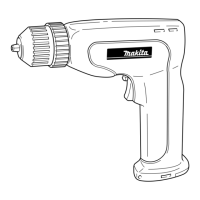
Need help?
Do you have a question about the Makita 6013B and is the answer not in the manual?
Explains symbols used on the equipment for clarity.
Details the double insulation feature for enhanced safety.
Defines the tool's purpose for wood, metal, and plastic.
Guidance on connecting the tool to a power source.
Presents typical A-weighted noise level measurements.
Provides vibration emission data according to EN60745.
Ensures a safe operating environment free from hazards.
Crucial precautions for safe electrical operation.
Guidelines for user protection during operation.
Best practices for using and maintaining the tool.
Explains how to operate the switch trigger and lock button.
Emphasizes secure grip and stable stance for control.
Safety measures to avoid shock from hidden wiring.
Advises caution around moving parts and hot surfaces.
Covers toxic materials and proper tool usage restrictions.
Instructions for securely attaching the auxiliary handle.
Procedure for fitting and removing drill bits.
Guidance on performing drilling tasks effectively.
Specific techniques for drilling into wood.
Specific techniques for drilling into metal.
How to inspect and replace worn carbon brushes.
This document provides an instruction manual for the Makita Drill models 6013B and 6013BR, covering safety warnings, functional descriptions, assembly, operation, and maintenance.
WARNING: Read all safety warnings and instructions. Failure to follow these warnings and instructions may result in electric shock, fire, and/or serious injury. Save all warnings and instructions for future reference. The term "power tool" in the warnings refers to your mains-operated (corded) power tool or battery-operated (cordless) power tool.
Work area safety:
Electrical safety: 4. Power tool plugs must match the outlet. Never modify the plug in any way. Do not use any adapter plugs with earthed (grounded) power tools. Unmodified plugs and matching outlets will reduce the risk of electric shock. 5. Avoid body contact with earthed or grounded surfaces such as pipes, radiators, ranges, and refrigerators. There is an increased risk of electric shock if your body is earthed or grounded. 6. Do not expose power tools to rain or wet conditions. Water entering a power tool will increase the risk of electric shock. 7. Do not abuse the cord. Never use the cord for carrying, pulling, or unplugging the power tool. Keep the cord away from heat, oil, sharp edges, or moving parts. Damaged or entangled cords increase the risk of electric shock. 8. When operating a power tool outdoors, use an extension cord suitable for outdoor use. Use of a cord suitable for outdoor use reduces the risk of electric shock. 9. If operating a power tool in a damp location is unavoidable, use a residual current device (RCD) protected supply. Use of an RCD reduces the risk of electric shock. 10. Use of power supply via an RCD with a rated residual current of 30mA or less is always recommended.
Personal safety: 11. Stay alert, watch what you are doing, and use common sense when operating a power tool. Do not use a power tool while you are tired or under the influence of drugs, alcohol, or medication. A moment of inattention while operating power tools may result in serious personal injury. 12. Use personal protective equipment. Always wear eye protection. Protective equipment such as a dust mask, non-skid safety shoes, hard hat, or hearing protection used for appropriate conditions will reduce personal injuries. 13. Prevent unintentional starting. Ensure the switch is in the off-position before connecting to the power source and/or battery pack, picking up, or carrying the tool. Carrying power tools with your finger on the switch or energizing power tools that have the switch on invites accidents. 14. Remove any adjusting key or wrench before turning the power tool on. A wrench or a key left attached to a rotating part of the power tool may result in personal injury. 15. Do not overreach. Keep proper footing and balance at all times. This enables better control of the power tool in unexpected situations. 16. Dress properly. Do not wear loose clothing or jewelry. Keep your hair, clothing, and gloves away from moving parts. Loose clothes, jewelry, or long hair can be caught in moving parts. 17. If devices are provided for the connection of dust extraction and collection facilities, ensure these are connected and properly used. Use of dust collection can reduce dust-related hazards.
Power tool use and care: 18. Do not force the power tool. Use the correct power tool for your application. The correct power tool will do the job better and safer at the rate for which it was designed. 19. Do not use the power tool if the switch does not turn it on and off. Any power tool that cannot be controlled with the switch is dangerous and must be repaired. 20. Disconnect the plug from the power source and/or the battery pack from the power tool before making any adjustments, changing accessories, or storing power tools. Such preventive safety measures reduce the risk of starting the power tool accidentally. 21. Store idle power tools out of the reach of children and do not allow persons unfamiliar with the power tool or these instructions to operate the power tool. Power tools are dangerous in the hands of untrained users. 22. Maintain power tools. Check for misalignment or binding of moving parts, breakage of parts, and any other condition that may affect the power tool's operation. If damaged, have the power tool repaired before use. Many accidents are caused by poorly maintained power tools. 23. Keep cutting tools sharp and clean. Properly maintained cutting tools with sharp cutting edges are less likely to bind and are easier to control. 24. Use the power tool, accessories, and tool bits, etc., in accordance with these instructions, taking into account the working conditions and the work to be performed. Use of the power tool for operations different from those intended could result in a hazardous situation.
Service: 25. Have your power tool serviced by a qualified repair person using only identical replacement parts. This will ensure the safety of the power tool is maintained. 26. Follow instructions for lubricating and changing accessories. 27. Keep handles dry, clean, and free from oil and grease.
CAUTION: Always be sure that the tool is switched off and unplugged before adjusting or checking function on the tool.
Switch action: CAUTION:
For Model 6013B: To start the tool, simply pull the switch trigger. Release the switch trigger to stop. For continuous operation, pull the switch trigger and then push in the lock button. To stop the tool from the locked position, pull the switch trigger fully, then release it.
For Model 6013BR: The switch is reversible, providing either clockwise or counterclockwise rotation. To start the tool, simply pull the lower part of the switch trigger for clockwise or the upper part for counterclockwise. Release the switch trigger to stop.
CAUTION: Always be sure that the tool is switched off and unplugged before carrying out any work on the tool.
Installing top grip (auxiliary handle): Screw the top grip on the tool securely.
Installing or removing drill bit:
For tool with standard keyed chuck: To install the bit, place it in the chuck as far as it will go. Tighten the chuck by hand. Place the chuck key in each of the three holes and tighten clockwise. Be sure to tighten all three chuck holes evenly. To remove the bit, turn the chuck key counterclockwise in just one hole, then loosen the chuck by hand. After using the chuck key, be sure to return to the original position.
For tool with keyless chuck: Hold the ring and turn the sleeve counterclockwise to open the chuck jaws. Place the bit in the chuck as far as it will go. Hold the ring firmly and turn the sleeve clockwise to tighten the chuck. To remove the bit, hold the ring and turn the sleeve counterclockwise.
Drilling operation: Always use the top or back grip (auxiliary handle) and firmly hold the tool by top or back grip and switch handle during operations.
Drilling in wood: When drilling in wood, the best results are obtained with wood drills equipped with a guide screw. The guide screw makes drilling easier by pulling the bit into the workpiece.
Drilling in metal: To prevent the bit from slipping when starting a hole, make an indentation with a center-punch and hammer at the point to be drilled. Place the point of the bit in the indentation and start drilling. Use a cutting lubricant when drilling metals. The exceptions are iron and brass which should be drilled dry.
CAUTION:
CAUTION: Always be sure that the tool is switched off and unplugged before attempting to perform inspection or maintenance.
Replacing carbon brushes: Remove and check the carbon brushes regularly. Replace when they wear down to the limit mark. Keep the carbon brushes clean and free to slip in the holders. Both carbon brushes should be replaced at the same time. Use only identical carbon brushes. Use a screwdriver to remove the brush holder caps. Take out the worn carbon brushes, insert the new ones, and secure the brush holder caps.
To maintain product SAFETY and RELIABILITY, repairs, any other maintenance or adjustment should be performed by Makita Authorized Service Centers, always using Makita replacement parts.
CAUTION: These accessories or attachments are recommended for use with your Makita tool specified in this manual. The use of any other accessories or attachments might present a risk of injury to persons. Only use accessory or attachment for its stated purpose. If you need any assistance for more details regarding these accessories, ask your local Makita Service Center.
Accessories include:
 General
| Power Source | Corded |
|---|---|
| Chuck Size | 1/2 inch |
| No Load Speed | 0 - 2, 500 RPM |
| Weight | 1.8 kg |
| Amperage | 5.0 A |
| Voltage | 120 V |
| Type | Drill |

 To Next Page