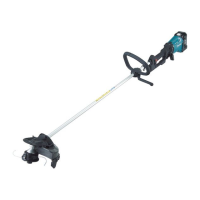
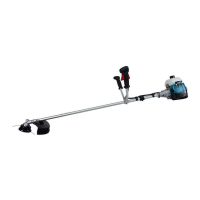
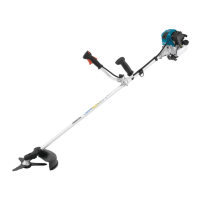
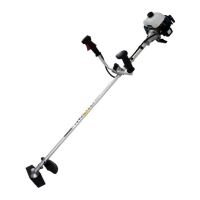
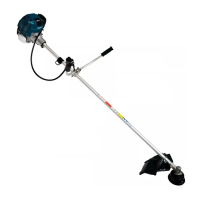
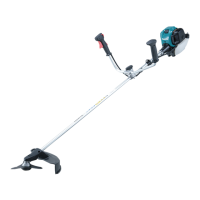
This document is an instruction manual for Makita brushcutters, specifically models BCM2310, BCM2610, BCM3310, BCM2600, BCM3300, and BCM4300. It provides comprehensive information on the device's function, technical specifications, usage, and maintenance.
Function Description
The Makita brushcutters are high-performance, air-cooled two-stroke gasoline engine tools designed for cutting grass and heavy weeds. They are suitable for yard work and greenskeeping, offering ergonomic design and ease of use. The brushcutters utilize a fuel pump (primer) for easy starting. Depending on the model and intended use, they can be equipped with different cutting tools: a 2-line trimmer head for cutting against walls, fences, trees, posts, and lawn edges, or a 4-tooth star blade for cutting grass and heavy weeds. The device is operated by a single person and is intended for outdoor use only.
Important Technical Specifications
The manual provides detailed technical data for each model:
- Displacement: Ranges from 22.6 cm³ (BCM2310) to 42.7 cm³ (BCM4300).
- Bore: Varies from 31 mm to 40 mm.
- Stroke: Varies from 30 mm to 34 mm.
- Rated capacity per ISO 8893: Ranges from 0.7 kW (BCM2310) to 1.27 kW (BCM4300).
- Operating speed: 7,500 to 8,000 rpm.
- Maximum engine speed (with one-part metal cutting tool): 7,370 to 8,100 rpm.
- Maximum spindle speed (with one-part metal cutting tool): 10,000 rpm.
- Idling speed: 2,500 to 3,000 rpm.
- Carburetor type: Diaphragm carburetor, electronic.
- Ignition system: Electronic.
- Spark plug: NGK BPMR 8Y, with an electrode gap of 0.6 - 0.7 mm.
- Sound power level LWA, eq per ISO 10884: Ranges from 99.5 dB(A) to 110 dB(A) depending on the model.
- Sound pressure level LpA, eq at the workplace per ISO 7917: Ranges from 89.9 dB(A) to 97.1 dB(A).
- Vibration acceleration ahv, eq per ISO 7916: Values are provided for right handle (idling/maximum speed), left handle (idling/maximum speed), round handle (idling/maximum speed), and handle on shaft (idling/maximum speed), varying by model.
- Fuel consumption per ISO 8893: Ranges from 0.35 kg/h to 0.49 kg/h.
- Specific consumption per ISO 8893: Ranges from 386 g/kWh to 500 g/kWh.
- Fuel tank capacity: 0.6 L to 0.9 L.
- Mixture ratio (fuel / MAKITA two-stroke oil): 50:1 (when using MAKITA oil, Aspen Alkylat, or other quality grade JASO FC or ISO EGD oils).
- Gear ratio: 14:19 or 17:21 depending on the model.
- Weight (not including guard, cutting tool and fuel): Ranges from 5.1 kg to 7.9 kg.
Usage Features
The manual emphasizes safe and correct usage:
- Assembly: Detailed instructions are provided for installing the handle (different procedures for BCM2600/3300/4300 and BCM2310/2610/3310), mounting the cutter guard, mounting the 4-tooth star blade, and installing the trimmer head. Specific cutter guard combinations are mandated for each cutting tool to ensure safety.
- Fuel Mixture: The brushcutters require a 50:1 mixture of unleaded gasoline (minimum 91 ROZ octane) and synthetic two-stroke engine oil (JASO FC or ISO EGD quality grade, preferably MAKITA high-performance two-stroke engine oil). Ready-mixed fuel from petrol stations is not recommended.
- Refuelling: Instructions include cleaning around the tank cap, placing the brushcutter in a stable position, carefully filling the tank up to the lower edge of the filler neck, and tightly screwing on the cap. Safety precautions against open flames, sparks, and smoking are stressed.
- Harness: The harness must be worn and adjusted so the clip is about a hand-width above the hipbone. A quick-release buckle allows for instant detachment in emergencies, and its red tab must be visible and easily reachable.
- Balancing: The brushcutter should be balanced to reduce strain. For trimmer head use on level terrain, it should lightly touch the ground. For steel bush cutter use or difficult terrain, it should balance about 20 cm above the ground. The eyelet on the shaft tube can be adjusted to shift the center of gravity.
- Starting the Engine: Instructions cover both cold start and warm start procedures, including priming the fuel pump, actuating the half-throttle lock, setting the choke lever, pulling the starter cable, and adjusting to run position. The brushcutter must be started at least 3 meters away from the refuelling spot, with good footing, and the cutting tool not touching the ground.
- Idle Adjustment: The cutting tool must not rotate when the engine is idling. If it does, the idle speed can be adjusted by unscrewing the adjustment screw (H/6) no more than 1/8 turn counter-clockwise. If the tool still rotates, the device should be taken to a service center.
- Cutting Tools: The 2-line trimmer head is for light cutting against obstacles, while the 4-tooth star blade is for grass and heavy weeds, used with a scythe-like swinging motion.
- Kickback: Users are warned about kickback when the 4-tooth star blade contacts hard objects. To prevent this, foreign objects must be removed from the cutting area, and the tool must be turning at full speed before cuts.
- Safety: The manual emphasizes reading the instruction manual, wearing personal protective equipment (helmet with face shield, ear muffs, forestry safety jacket, protective trousers, gloves, safety shoes/boots), maintaining a safe distance from bystanders (15 meters/50 feet), and ensuring the brushcutter is in safe operating condition before each use. It warns against working alone, using damaged tools, or operating in closed rooms due to exhaust gases.
Maintenance Features
Regular maintenance is crucial for long life and trouble-free operation:
- General Checks: Before each start, check the cutting tool for damage and sharpness, guards for correct position and attachment, screws and nuts for tightness, I/O-switch, safety locking button, throttle lever for functional check, fuel tank cap and fuel system for tightness, and idling speed (cutting tool must not turn).
- After Each Use: Clean the air filter and cooling slits.
- Every 6 Months: Check and replace the spark plug if necessary, have the suction head checked by a qualified workshop, clean the fuel tank, and check the starter cable for signs of damage.
- Annually: Have the brushcutter checked at an authorized service center.
- Long-Term Storage: Empty and clean the fuel tank, run the carburetor dry, clean and lubricate metal cutting tools lightly, and use tool protection. Store in a dry room, out of reach of children.
- Air Filter Cleaning: Loosen screws, remove the air filter cover and foam filter. Clean dirty filters with regular dishwashing liquid in lukewarm water. Dry thoroughly and reinstall. Replace damaged filters immediately.
- Spark Plug Replacement: Pull off the spark plug cap, remove the old plug with a 19 mm wrench, and replace with an NGK BPMR8Y spark plug, ensuring an electrode gap of 0.6 - 0.7 mm.
- Spark Plug Inspection: Insert a wrench between the housing and cylinder, connect the spark plug cap to the removed plug, hold it against the wrench with insulated pliers, move the switch to "I", and pull the starter cable to check for a spark at the electrode gap.
- Gear Box Lubrication: After about 50 operating hours, the gear box should be checked and regreased by an OLMAR service center.
- Suction Head in Fuel Tank: Periodically inspect the felt filter of the suction head. If hardened, dirty, or clogged, replace it (at least every three months).
- Muffler Opening Cleaning: Regularly inspect and scrape out carbon residues from the muffler opening.
- Sharpening Cutting Tools: Metal cutting tools, especially the 4-tooth star blade, must be sharpened only at a qualified workshop to avoid imbalance and engine damage. The 4-tooth star blade can be turned once to use both cutting sides.
- Service and Guarantee: Maintenance and repair work not described in the manual should only be performed by an authorized MAKITA service center. Using non-original MAKITA spare parts or unauthorized repairs will void the warranty.



 To Next Page
 General