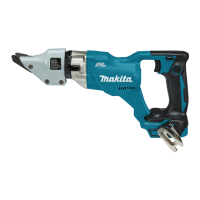
This document is an instruction manual for the Makita Cordless Metal Shear, models DJS161 and DJS101. It provides detailed information on the tool's specifications, safety warnings, operational procedures, and maintenance.
Function Description
The Makita Cordless Metal Shear is designed for cutting sheet steel and stainless sheet steel. It is a battery-operated power tool, emphasizing portability and ease of use without the constraint of a power cord. The tool features a slide switch for operation, with a lock-on function for continuous use, enhancing operator comfort during extended tasks. An indication lamp with multi-function capabilities provides feedback on battery status and accidental re-start prevention. The shear's design allows for adjustment of blade clearance to accommodate different workpiece thicknesses, ensuring optimal cutting performance. Lubrication points are highlighted for maintaining the center blade and pin, which are crucial for smooth operation and cutting efficiency.
Important Technical Specifications
The manual outlines key specifications for both models:
Max. cutting capacities:
- DJS161:
- Steel up to 400 N/mm²: 1.6 mm (16 ga)
- Steel up to 600 N/mm²: 1.2 mm (18 ga)
- Aluminum up to 200 N/mm²: 2.5 mm (13 ga)
- DJS101:
- Steel up to 400 N/mm²: 1.0 mm (20 ga)
- Steel up to 600 N/mm²: 0.7 mm (23 ga)
- Aluminum up to 200 N/mm²: 2.5 mm (12 ga)
Common Specifications for both models:
- Min. cutting radius: 250 mm (DJS161), 30 mm (DJS101)
- Strokes per minute (min⁻¹): 4,300
- Overall length: 362 mm (DJS161), 364 mm (DJS101)
- Net weight: 1.8 - 2.2 kg (depending on battery cartridge)
- Rated voltage: D.C. 18 V
Applicable Battery Cartridges and Chargers:
- Battery cartridges: BL1815N / BL1820 / BL1820B / BL1830 / BL1830B / BL1840 / BL1840B / BL1850 / BL1850B / BL1860B
- Chargers: DC18RC / DC18RD / DC18RE / DC18SD / DC18SE / DC18SF
Noise and Vibration Information (according to EN62841-2-8):
- Noise:
- Sound pressure level (LPA): 71 dB(A)
- Uncertainty (K): 3 dB(A)
- Noise level under working may exceed 80 dB(A).
- Vibration:
- Work mode: cutting sheet metal
- Vibration emission (ah,M): 13.0 m/s²
- Uncertainty (K): 1.5 m/s²
The manual emphasizes that specifications are subject to change due to ongoing research and development, and may differ by country. The weight can also vary based on the battery cartridge used.
Usage Features
The Makita Cordless Metal Shear is designed for user convenience and safety.
- Battery Installation/Removal: The battery cartridge slides into the tool's housing and locks into place with a click. A red indicator signifies if the battery is not fully locked. Proper handling during installation/removal is crucial to prevent injury or damage.
- Battery Protection System: The tool incorporates a battery protection system that automatically cuts off power to the motor under specific conditions to extend battery life.
- Overload Protection: If the tool draws abnormally high current, it will stop. The user must turn the tool off, stop the application, and then restart.
- Overheat Protection: If the battery overheats, the tool will not start. The user must allow the battery to cool down before restarting. This feature works only with battery cartridges marked with a star.
- Low Battery Voltage Protection: If the battery capacity is too low, the tool will not operate, requiring removal and recharging of the battery.
- Indicating Remaining Battery Capacity: Battery cartridges with an indicator allow users to check the remaining capacity by pressing a check button. Indicator lamps light up for a few seconds, showing capacity levels from 75-100% down to 0-25%, and also indicate when the battery needs charging or if it has malfunctioned.
- Switch Action: The tool is started by sliding the switch lever to the "I (ON)" position. For continuous operation, the front of the switch lever can be pressed to lock it. To stop, the rear of the switch lever is pressed, and then it is slid to the "O (OFF)" position.
- Accidental Re-start Prevention: If a battery cartridge is inserted while the slide switch is in the "I (ON)" position, the tool will not start. The lamp will flicker slowly, indicating this safety feature is active. To start, the user must first slide the switch to "O (OFF)" and then to "I (ON)".
- Blade Clearance Adjustment (DJS161): The clearance between the side blade and the center blade can be adjusted using a hex wrench to loosen/tighten a hex socket head bolt. This adjustment is critical for optimal cutting performance based on workpiece thickness. A table provides recommended markings on a thickness gauge for different material thicknesses (less than 0.8 mm, 0.8-1.3 mm, more than 1.3 mm).
- Operation: Before cutting, the contact point of the center blade and the pin should be lubricated. A cutting lubricant is also recommended during operation. To cut, the tool is turned on, and the front ends of the side blades are set on the workpiece. The tool is then moved forward, keeping the side blades flush with the workpiece surface.
- Hex Wrench Storage: The hex wrench can be conveniently stored on the tool itself when not in use.
Maintenance Features
Regular maintenance is crucial for the longevity and safe operation of the tool.
- General Maintenance:
- Always ensure the tool is switched off and the battery cartridge is removed before any inspection or maintenance.
- Avoid using gasoline, benzine, thinner, alcohol, or similar substances, as they can cause discoloration, deformation, or cracks.
- Keep the tool and its air vents clean. Regularly clean the air vents, especially when they start to become obstructed.
- Replacing Carbon Brushes:
- Carbon brushes should be removed and checked regularly. They need to be replaced when they wear down to the limit mark.
- Both carbon brushes must be replaced at the same time, using only identical carbon brushes.
- The process involves inserting a slotted bit screwdriver into a notch to remove the brush holder cap cover, then using a screwdriver to remove the brush holder caps, taking out the worn brushes, inserting new ones, and securing the caps.
- Replacing Blades:
- The service life of the blades varies depending on the workpiece material.
- Reference tables are provided for approximate blade life for different materials (Mild steel plate SPCC, Stainless steel plate SUS304, Aluminum plate A-5052) and cutting thicknesses for both DJS161 and DJS101 models.
- When blades become dull, they should be replaced by Makita Authorized Service Centers.
- Battery Maintenance:
- Charge the battery cartridge before it is completely discharged. Stop tool operation and charge the battery when power decreases.
- Avoid overcharging fully charged battery cartridges, as this shortens service life.
- Charge battery cartridges at room temperature (10 °C - 40 °C / 50 °F - 104 °F). Allow hot battery cartridges to cool down before charging.
- Charge the battery cartridge if it will not be used for a long period (more than six months).
The manual also lists optional accessories such as thickness gauges, center blades, side blades (R and L), hex wrenches, and Makita genuine battery and chargers, noting that some may be included as standard accessories depending on the region. For repairs and adjustments, it is recommended to use Makita Authorized Service Centers and genuine Makita replacement parts to maintain product safety and reliability.

 Need help?
 General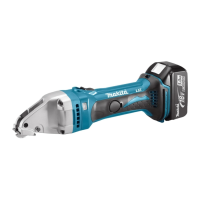

 To Next Page