Need help?
Do you have a question about the Makita HM1812 and is the answer not in the manual?
Covers proper plug use, avoiding body contact with grounded surfaces, and protection from water.
Advises staying alert, using personal protective equipment, and avoiding fatigue or impairment.
Focuses on secure bit placement, checking screws, warm-up procedures, and firm footing.
Emphasizes holding firmly with both hands, keeping hands away from moving parts, and not leaving tool running.
Warns against pointing the tool at anyone and ensures no one is below when working at height.
Provides operational guidance for chiselling, including posture and debris management.
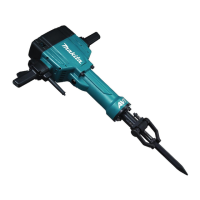
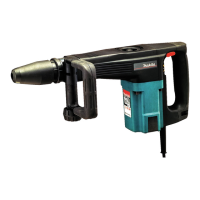
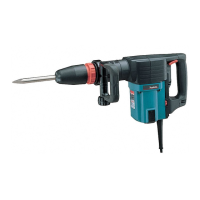
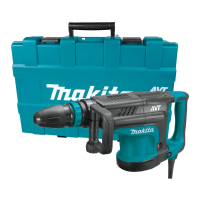
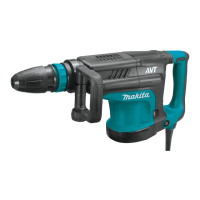
The Makita Electric Breaker, models HM1802 and HM1812, is a robust power tool designed for heavy-duty chiselling, demolition work, and compacting tasks. It is intended for professional use, offering reliable performance for demanding applications. The tool is double-insulated, ensuring enhanced safety during operation by providing protection against electric shock, and can be operated from standard single-phase AC power outlets.
The primary function of the Electric Breaker is to deliver powerful blows per minute, making it highly effective for breaking concrete, asphalt, and other hard materials. The tool operates by generating a hammering action that drives a bit (such as a bull point, cold chisel, or scaling chisel) into the work surface. This percussive action allows for efficient material removal and shaping.
The tool features a switch lever for easy operation. To start the tool, the operator simply squeezes the switch lever. Releasing the lever stops the tool. For model HM1812, there is a notable characteristic regarding its no-load operation: the blows per minute are reduced compared to when the tool is under load. This is a design feature to minimize vibration during no-load conditions and does not indicate a malfunction. Once the bit makes contact with concrete or other material, the blows per minute increase to full operating capacity. In colder temperatures or after prolonged disuse, the tool may require a brief warm-up period under no load to ensure proper lubrication and optimal hammering performance.
The Electric Breaker is equipped with indicator lamps to provide important operational feedback. A green "Power-ON" indicator lamp illuminates when the tool is plugged into a power source, confirming that it is receiving electricity. A red "Service" indicator lamp flickers when the carbon brushes are nearing the end of their lifespan, signaling that the tool requires servicing. After a certain period of use following the illumination of the service indicator, the motor will automatically shut off to prevent damage and ensure safety. If the power-ON lamp is lit but the tool does not start when switched on, it could indicate worn carbon brushes, a malfunction in the controller, motor, or ON/OFF switch.
The tool is designed to accommodate different types of bits, specifically those with or without a collar on their shank. This versatility allows users to select the appropriate bit for various tasks. The bit installation process involves pivoting a tool retainer and inserting the bit into the tool holder until it stops, then securing the retainer. For bits without a collar, the notched portion of the bit must be faced upward during insertion. Proper bit installation is crucial for safe and effective operation.
Operating the Electric Breaker requires adherence to specific safety and handling guidelines to ensure user safety and optimal performance. The tool is heavy, necessitating a well-balanced posture when holding it before, during, and after operation to prevent personal injuries. It is recommended to hold the tool firmly with both hands, utilizing both the soft grip (auxiliary handle) and the main switch handle. Applying slight pressure on the tool when turned on helps prevent it from bouncing uncontrollably; excessive pressure will not increase efficiency.
When the bit gets stuck in the material, operators should avoid pulling the tool out forcefully. Instead, the surrounding material should be broken away from the bit tip to free it. It is also important to secure any debris that may break off into smaller pieces during operation. The tool should always be placed on a stable floor or ground after use.
For outdoor operation, an extension cord suitable for outdoor use must be employed to reduce the risk of electric shock. In damp locations, using a residual current device (RCD) protected supply is recommended. The use of an RCD with a rated residual current of 30 mA or less is always advised for enhanced electrical safety.
Personal protective equipment is mandatory during operation. This includes wearing ear protectors to prevent hearing loss due to noise exposure, a hard hat (safety helmet), safety glasses, and/or a face shield to protect the eyes and face from flying debris. Ordinary eyeglasses or sunglasses are not sufficient as safety glasses. Additionally, wearing a dust mask and thickly padded gloves is highly recommended. The operator must ensure the bit is securely in place before starting the tool.
The tool generates vibration during normal operation, which can cause screws to loosen over time. Therefore, it is important to regularly check the tightness of screws before each use to prevent breakdowns or accidents. Users should also avoid operating the tool at no-load unnecessarily.
Proper maintenance is essential for ensuring the safety, reliability, and longevity of the Makita Electric Breaker. After use, the machine should be stored in a horizontal position to prevent possible grease leakage.
Cleaning the tool is important, but specific precautions must be taken regarding cleaning agents. Users should never use gasoline, benzine, thinner, alcohol, or similar substances, as these can cause discoloration, deformation, or cracks in the tool's components.
For all repairs, maintenance, or adjustments, it is crucial to have the work performed by Makita Authorized Service Centers. These centers use only genuine Makita replacement parts, which is vital for maintaining the tool's safety and performance standards.
The handles of the tool should be kept dry, clean, and free from oil and grease to ensure a secure grip and prevent accidents. Regular checks for misalignment or binding of moving parts, breakage of parts, or any other condition that might affect the tool's operation are necessary. If any damage is found, the tool should be repaired before further use.
Keeping cutting tools sharp and clean is also part of maintenance. Properly maintained cutting tools with sharp edges are less likely to bind and are easier to control, contributing to safer and more efficient operation.
The service indicator lamp serves as a critical maintenance feature, alerting the user when the carbon brushes are nearly worn out and require replacement. This proactive notification helps prevent unexpected tool shutdowns and ensures timely servicing.
 General
| Input power | 2000 W |
|---|---|
| Impact energy (max) | 72.8 J |
| Vibration level (chiseling) | 6.5 m/s² |
| Soft grip | Yes |
| Product color | Black, Blue |
| Toolholder | - mm |
| Impact rate | 870 bpm |
 Weight and Dimensions
| Depth | 210 mm |
|---|---|
| Width | 843 mm |
| Height | 608 mm |

 To Next Page