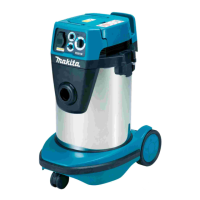
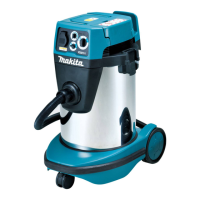
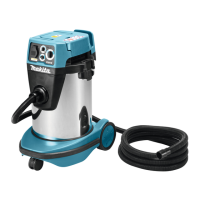
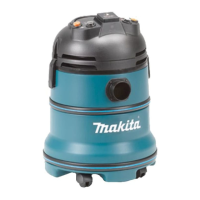
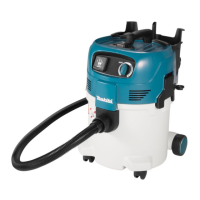
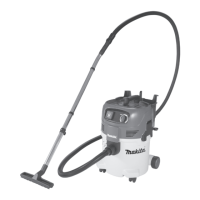
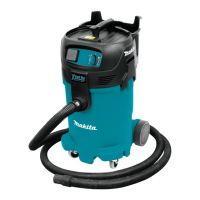
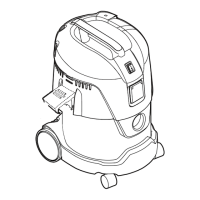
This document provides an instruction manual for the Makita VC3211H Vacuum Cleaner, detailing its specifications, safety warnings, functional description, and maintenance procedures.
Function Description
The Makita VC3211H Vacuum Cleaner is designed for both wet and dry dust collection, suitable for commercial use in various settings such as hotels, schools, hospitals, factories, shops, offices, and rental businesses. It features a switch lever for operation, a suction force adjusting knob, and a hose diameter selection dial to customize performance based on the task and hose size. The cleaner can be connected to an electric power tool, allowing for simultaneous operation where the cleaner switches on and off with the power tool. It also includes an auto-suction stop mechanism to prevent water from immersing into the motor when the tank is full, indicated by a long warning beep. A cap on the mounting port prevents vacuumed dust from escaping when the hose is not connected.
Important Technical Specifications
The VC3211H model has varying specifications depending on the region (EU, Switzerland, UK, Middle East, Africa).
Voltage:
- EU/Switzerland: 230-240V
- UK: 110V (for some models), 230-240V
- Middle East/Africa: 110-120V, 230-240V, 220-240V
Power Consumption:
Connected Load for Appliance Socket:
- EU: 2400 Watt (symbol mode), 2600 Watt (symbol mode)
- Switzerland: 1100 Watt (symbol mode), 1400 Watt (symbol mode)
- UK: 600 Watt (symbol mode), 850 Watt (symbol mode)
- Middle East/Africa: 550 Watt (symbol mode), 850 Watt (symbol mode)
Total Connected Load:
- EU: 3450 Watt
- Switzerland: 2150 Watt
- UK: 1650 Watt
- Middle East/Africa: 1600 Watt, 2950 Watt, 3250 Watt
Volume Flow (air):
- With Ø28mm X 3.5m hose: 2.0 m³/min
- With Ø38mm X 2.5m hose: 3.5 m³/min
Vacuum: 22 kPa
Type of Protection: IP X4 (splash-proof)
Recoverable Capacity:
- Dust: 32 L
- Water: 27 L
Dimensions (L x W x H): 552 mm x 398 mm x 685 mm
Net Weight: 17.0 kg
Safety Class: Class I
Noise Level (A-weighted): Sound pressure level (LPA): 72.5 dB (A), Uncertainty (K): 2.5 dB (A). Ear protection is recommended if the noise level exceeds 80 dB (A).
Vibration Emission Value: Below 2.5 m/s².
The cleaner is capable of picking up dust class L, M, and H, adhering to country-specific regulations for occupational health and safety.
Usage Features
The vacuum cleaner offers several user-friendly features:
- Switch Action: The switch lever allows for easy ON ("I") and OFF ("O") operation.
- Suction Force Adjustment: A knob enables users to adjust the suction force from minimum to maximum, adapting to different cleaning needs.
- Hose Diameter Selection: A dial allows selection between Ø28mm and Ø38mm hose diameters, ensuring optimal performance for the connected hose.
- Connecting Electric Power Tools: The cleaner has a socket outlet for connecting electric power tools. When connected, the cleaner can automatically start and stop with the power tool. Hose bands are provided to secure the power supply cord and hose, preventing entanglement.
- Warning Beep: The cleaner emits short beeps if the air flow speed falls below 20 m/s, indicating a need to check the hose diameter or suction force. A long beep signals that the liquid tank is full, prompting the user to empty it.
- Storage:
- Power Supply Cord: The cord can be wound around the multi-hook or base hook for tidy storage.
- Hose: The hose can be placed on either the base hook or multi-hook.
- Front Cuffs: Front cuffs (22, 24, and 38) can be stored in designated slots (up to two at a time).
- Accessories: A pipe rest allows for storing straight pipes, bent pipes, and other accessories. The cap can also be placed in the multi-hook when the hose is connected.
- Caster Lock: The caster wheels can be locked using a stopper lever, which is useful for storing the cleaner, pausing work, or keeping it stationary.
Maintenance Features
Regular maintenance is crucial for the cleaner's performance and longevity:
- Filter Bag Installation and Disposal: The filter bag is extended and aligned with the dust suction opening, then inserted onto the tool. For disposal, the bag's mouth is closed with paper. A P2-respirator should always be used when handling filter bags.
- Air Filter Removal and Assembly:
- To remove, unhook the tank cover, remove the screw on the stopper lever, flip the stopper lever to unlock filter hooks, cover the air filters with a plastic bag, and carefully remove them.
- To assemble, the powder filter, damper, and prefilter are put together, ensuring the prefilter is over the powder filter and borders are properly set. New air filters are fixed with hooks, and the stopper lever is flipped to lock them.
- The air filter should be changed if clogged or if performance declines, and checked periodically for tears.
- Level Sensor Cleaning: The level sensors, which detect liquid in the tank, should be cleaned with a soft cloth periodically when changing air filters.
- General Maintenance:
- Always ensure the cleaner is switched off and unplugged before any maintenance.
- Do not use gasoline, benzine, thinner, or alcohol for cleaning, as this can cause discoloration or damage.
- Technical inspections, including filters, air tightness, and control mechanisms, should be performed at least once a year by an instructed person.
- Contaminated items that cannot be cleaned must be disposed of in impervious bags according to regulations.
- After use in hazardous areas, the tool's exterior must be decontaminated.
- Never reuse the air filter after removal.
- Do not pick up water or wet dusts with the filter bag, as this can cause breakage.
- Clean the water level limiting device regularly and examine it for damage.
- Do not operate without the filter; replace damaged filters immediately.
- Clean and service the cleaner immediately after each use to maintain optimal operating condition.

 Need help?
 General

 To Next Page