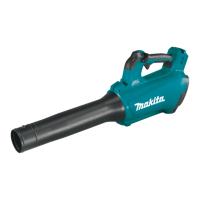
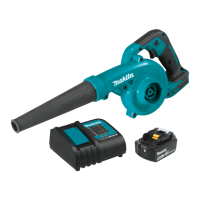
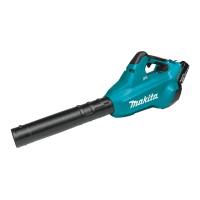
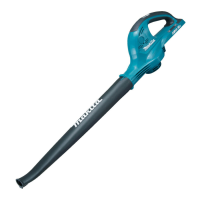
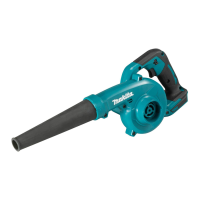
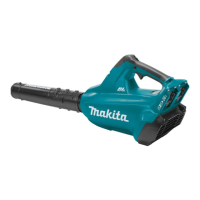
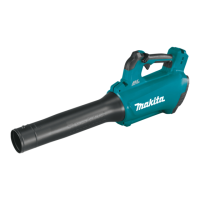
This document provides the instruction manual for the Makita XBU03 Cordless Blower, a battery-powered appliance designed for household use.
Function Description:
The Makita XBU03 Cordless Blower is designed for blowing debris. It operates on a D.C. 18 V battery and features a switch trigger for controlling the speed. The blower also incorporates a cruise control function, allowing the operator to maintain a constant speed without continuously pulling the trigger. To increase the speed, the control lever is turned forward, and to decrease it, the lever is turned backward. An accidental re-start preventive function ensures that the machine does not start if the battery cartridge is installed while the switch trigger is pulled; the trigger must be released or the control lever returned fully before starting. The machine is equipped with a machine/battery protection system that automatically cuts off power to the motor under conditions of overload, overheat, or overdischarge to extend machine and battery life.
Important Technical Specifications:
- Model: XBU03
- Rated Voltage: D.C. 18 V
- Air Volume: 0 - 13.0 m³/min (0 - 459 cu.ft./min)
- Air Speed (average): 0 - 43.2 m/s (0 - 96 MPH)
- Air Speed (max.): 0 - 52.1 m/s (0 - 116 MPH)
- Overall Length (with front nozzle): 825 mm (32-1/2")
- Net Weight: 2.5 - 3.0 kg (5.4 - 6.7 lbs), which may vary depending on the attachment(s) and battery cartridge.
- Applicable Battery Cartridges: BL1815N, BL1820B, BL1830, BL1830B, BL1840B, BL1850B, BL1860B
- Applicable Battery Adapter: PDC01
- Applicable Chargers: DC18RC, DC18RD, DC18RE, DC18SD, DC18SE, DC18SF
Usage Features:
The blower is designed for ease of assembly and use. The front nozzle is attached by aligning the Makita logo and tightening two screws with a hex wrench. Optional accessories like the flat nozzle or extension nozzle can be attached to an adapter pipe, which then locks into the front nozzle. A shoulder strap (optional accessory) can be attached to the machine's hooks or to the buckle of the shoulder strap for comfortable carrying.
The battery cartridge is installed by aligning its tongue with the groove in the housing and pushing it in until it clicks. A red indicator on the button signifies if it's not fully locked. To remove, slide the button on the front of the cartridge while pulling it out. Battery cartridges with an indicator allow users to check the remaining capacity by pressing a check button, which illuminates indicator lamps for a few seconds. These lamps show capacity in ranges: 75-100%, 50-75%, 25-50%, 0-25% (indicating a need to charge), or a malfunction.
When operating, the user should hold the machine firmly and move it slowly to blow debris. It's recommended to start from corners and move to wider areas. The nozzle should be directed away from buildings, large stones, or vehicles.
Maintenance Features:
Regular maintenance is crucial for safety and reliability. Users should always ensure the machine is switched off and the battery cartridge is removed before any inspection or maintenance. Repairs and adjustments should be performed by Makita Authorized or Factory Service Centers using genuine Makita replacement parts.
Cleaning the machine involves wiping off dust with a dry cloth or one dipped in soapy water and wrung out. It's important to never use gasoline, benzine, thinner, alcohol, or similar substances, as they can cause discoloration, deformation, or cracks. Dust and dirt should be removed from the suction inlet at the rear of the machine.
For battery maintenance, it's recommended to charge the battery cartridge before it's completely discharged and to stop operation and charge when less tool power is noticed. Overcharging should be avoided. Batteries should be charged at room temperature (10 °C - 40 °C / 50 °F - 104 °F) and allowed to cool if hot. If the battery cartridge is not used for a long period (more than six months), it should be charged. When storing the machine, it should be hung from a hook hole on the bottom, in a dry place, out of reach of children, and not exposed to moisture or rain.
The manual also provides troubleshooting tips for common issues like the motor not running, stopping after short use, not reaching maximum speed, or abnormal vibration, suggesting remedies such as installing the battery correctly, recharging, or seeking repair from an authorized service center.


 To Next Page
 General