EasyManua.ls Logo

Marantz 250 - Introduction to the Service Manual; Circuit Description Overview; Amplifier Circuit Details

Marantz 250
27 pages
Print Icon
To Next Page IconTo Next Page
To Previous Page IconTo Previous Page
Loading...
INTRODUCTION
This
service
manual
is
intended
for
use
by
author-
ized
warranty
stations.
The
manual
contains
service
information
for
the
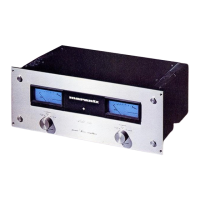
Marantz
Model
250
Stereo
Power
Amplifier,
manufactured
by
the
Marantz
Company,
a
subsidiary
of
the
Superscope
Incorpo-
rated,
Sun
Valley,
California
91352.
Adjustment,
maintenance,
and
troubleshooting
in-
formation
listed
herein
should
be
attempted
only
by
the
experienced
technician,
one
knowledgeable
in
solid
state
amplifier
operation
and
the
use
of
test
equipment.
All
instructions
should
be
read
carefully
and
understood
fully
before
proceeding
with
any
service.
Symptoms
(and
their
remedies)
listed
in
the
trouble-
shooting
section,
are
those
which
might
occur
in
some
units.
As
the
Marantz
Company
becomes
aware
of
other
field
problems,
supplementary
ser-
vice
bulletins
will
be
issued
to
all
stations.
To
improve
this
service,
all
problems
(and
their solu-
tions)
not
covered
in
this
service
manual
should
be
brought
to
the
attention
of
the
National
Service
Manager
at
our
Sun
Valley
location.
CIRCUIT
DESCRIPTION
The
following
circuit
description
will
be
based
on
Channel
A
only.
Channel
B
operates
in
an
identical
manner,
AMPLIFIER
The
input
stage
of
the
power
amplifier,
fig.
1,
is
comprised
of
an
emitter-follower,
Q519,
and
its
current
source,
Q518.
The
output
of
this
stage
is
coupled
through
C502
and
R506
to
the
differential
amplifier
(Q501,
Q502),
which
drives
an
inverter
(Q503)
whose
collector
current
is
tt
through
current
source
Q504.
The
inverter
is
с
pled
to
complementary
pre-drivers
(Q507,
0508).
The
output
of
the
pre-drivers
is
applied
to
their
respective
drivers
(Q510,
Q511)
which
are
coupled
to
their
respective
power
transistors
(Q802,
Q804-
0803,
0805).
Output
current
regulation
is
accomplished
through
a
current-sensing
network.
Excessive
current
levels
are
detected
by
resistors
R531
and
R532.
Volt-
ages
developed
across
these
resistors
are
applied
to
current
sensors
Q516
and
Q517.
When
excessive
current
levels
are
detected,
0816
апа
0517
develop
peak-limiting
signals,
which
are
applied
їо
0505
апа
Q506.
These
transistors
dis-
able the
pre-drivers
on
excessive
output
current
peaks,
thus
limiting
peak
output
current
to
a
safe
level.
Feedback
for
the
amplifier
is
developed
at
the
junc-
tion
of
R531
and
R532.
The
feedback
is
applied
across
two
loops.
Feedback
applied
across
R520
and
C509
completes
the
driver-power
output
loop.
Feedback
applied
across
R519
and
C508
completes
the
loop
for
the
entire
power
amplifier.

Related product manuals