EasyManua.ls Logo

Marantz PROFESSIONAL Series - Circuit Description

Marantz PROFESSIONAL Series
27 pages
Print Icon
To Next Page IconTo Next Page
To Previous Page IconTo Previous Page
Loading...
CIRCUIT
DESCRIPTION
GENERAL
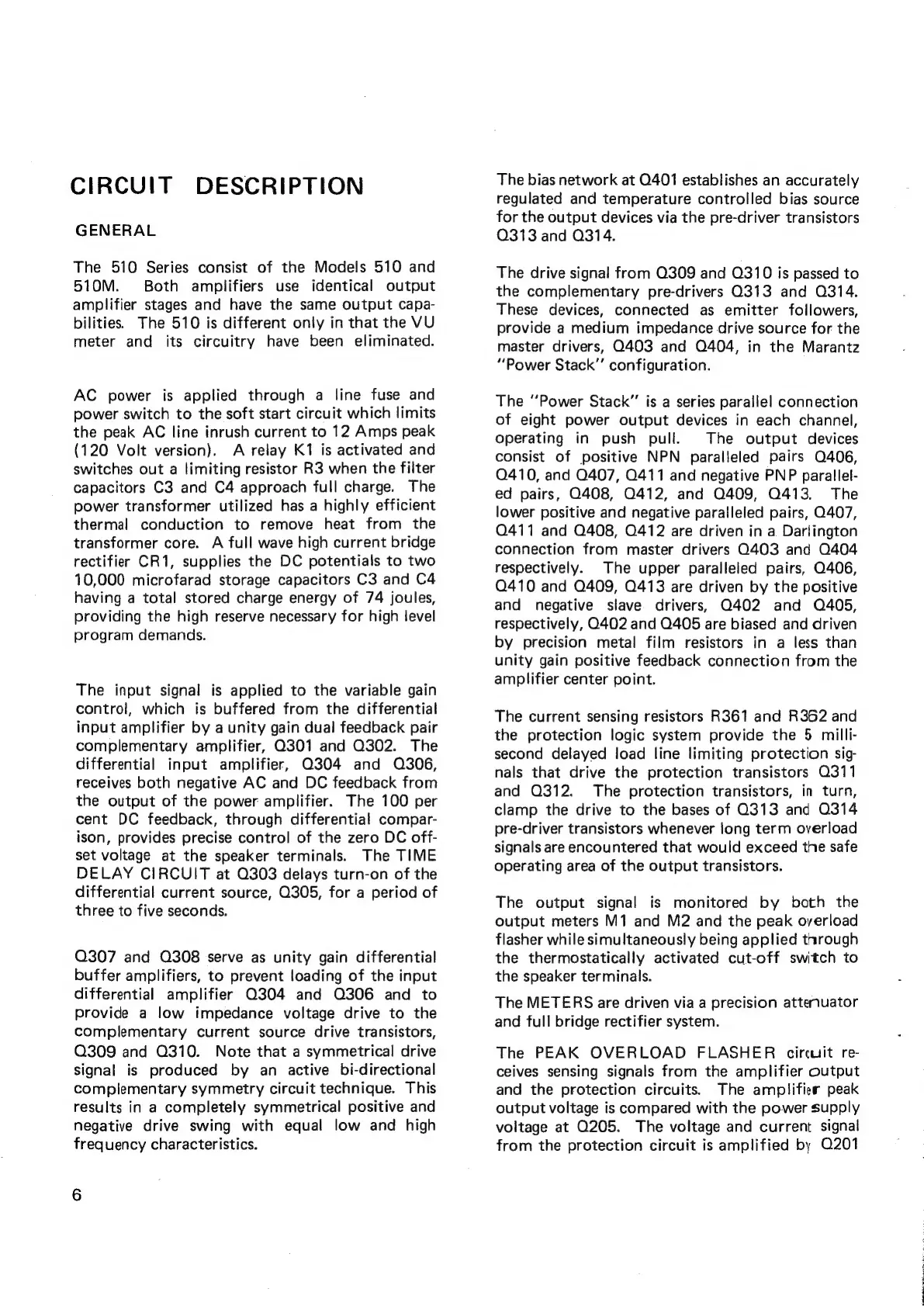
The
510
Series
consist
of
the
Models
510
and
510M.
Both
amplifiers
use
identical
output
amplifier
stages
and
have
the
same
output
capa-
bilities.
The
510
is
different
only
in
that
the
VU
meter
and
its
circuitry
have
been
eliminated.
AC
power
is
applied
through
a
line
fuse
and
power
switch
to
the
soft
start
circuit
which
limits
the
peak
AC
line
inrush
current
to
12
Amps
peak
(120
Volt
version).
A
relay
K1
is
activated
and
switches
out
a
limiting
resistor
R3
when
the
filter
capacitors
C3
and
C4
approach
full
charge.
The
power
transformer
utilized
has
a
highly
efficient
thermal
conduction
to
remove
heat
from
the
transformer
core.
A
full
wave
high
current
bridge
rectifier
CR1,
supplies
the
DC
potentials
to
two
10,000
microfarad
storage
capacitors
C3
and
C4
having
a
total
stored
charge
energy
of
74
joules,
providing
the
high
reserve
necessary
for
high
level
program
demands.
The
input
signal
is
applied
to
the
variable
gain
control,
which
is
buffered
from
the
differential
input
amplifier
by
a
unity
gain
dual
feedback
pair
complementary
amplifier,
Q301
and
Q302.
The
differential
input
amplifier,
Q304
and
Q306,
receives
both
negative
AC
and
DC
feedback
from
the
output
of
the
power
amplifier.
The
100
per
cent
DC
feedback,
through
differential
compar-
ison,
provides
precise
control
of
the
zero
DC
off-
set
voltage
at
the
speaker
terminals.
The
TIME
DELAY
CIRCUIT
at
0303
delays
turn-on
of
the
differential
current
source,
Q305,
for
a
period
of
three
to
five
seconds.
Q307
and
Q308
serve
as
unity
gain
differential
buffer
amplifiers,
to
prevent
loading
of
the
input
differential
amplifier
Q304
and
Q306
and
to
provide
a
low
impedance
voltage
drive
to
the
complementary
current
source
drive
transistors,
Q309
and
0310.
Note
that
a
symmetrical
drive
signal
is
produced
by
an
active
bi-directional
complementary
symmetry
circuit
technique.
This
results
in
a
completely
symmetrical
positive
and
negative
drive
swing
with
equal
low and
high
frequency
characteristics.
The
bias
network
at
Q401
establishes
an
accurately
regulated
and
temperature
controlled
bias
source
for
the
output
devices
via
the
pre-driver
transistors
0313
and
Q314.
The
drive
signal
from
Q309
and
0310
is
passed
to
the
complementary
pre-drivers
Q313
and
0314.
These
devices,
connected
as
emitter
followers,
provide
a
medium
impedance
drive
source
for
the
master
drivers,
O403
and
0404,
in
the
Marantz
“Power
Stack’’
configuration.
The
“Power
Stack”
is
a
series
parallel
connection
of
eight
power
output
devices
in
each
channel,
operating
in
push
pull.
The
output
devices
consist
of
positive
NPN
paralleled
pairs
0406,
Q410,
and
0407,
0411
and
negative
PNP
parallel-
ed
pairs,
Q408,
0412,
and
0409,
0413.
The
lower
positive
and
negative
paralleled
pairs,
0407,
Q411
and
0408,
0412
are
driven
in
a
Darlington
connection
from
master
drivers
Q403
and
0404
respectively.
The
upper
paralleled
pairs,
Q406,
Q410
and
0409,
0413
are
driven
by
the
positive
and
negative
slave
drivers,
Q402
and
Q405,
respectively,
0402
and
0405
are
biased
and
driven
by
precision
metal
film
resistors
in
a
less
than
unity
gain
positive
feedback
connection
from
the
amplifier
center
point.
The
current
sensing
resistors
R361
and
R362
and
the
protection
logic
system
provide
the
5
milli-
second
delayed
load
line
limiting
protection
sig-
nals
that
drive
the
protection
transistors
Q311
and
Q312.
The
protection
transistors,
in
turn,
clamp
the
drive
to
the
bases
of
0313
and
0314
pre-driver
transistors
whenever
long
term
overload
signals
are
encountered
that
would
exceed
the
safe
operating
area
of
the
output
transistors.
The
output
signal
is
monitored
by
both
the
output
meters
M1
and
M2
and
the
peak
overload
flasher
while
simultaneously
being
applied
tnrough
the
thermostatically
activated
cut-off
switch
to
the
speaker
terminals.
The
METERS
are
driven
via
a
precision
attenuator
and
full
bridge
rectifier
system.
The
PEAK
OVERLOAD
FLASHER
circuit
re-
ceives
sensing
signals
from
the
amplifier
Output
and
the
protection
circuits.
The
amplifier
peak
output
voltage
is
compared
with
the
power
supply
voltage
at
Q205.
The
voltage
and
current
signal
from
the
protection
circuit
is
amplified
by
Q201
Fea
ae
Oe
ey
Oe
ae
ee