EasyManua.ls Logo

Marantz SD9000 - Page 15

Marantz SD9000
69 pages
Print Icon
To Next Page IconTo Next Page
To Previous Page IconTo Previous Page
Loading...
am
Detector
Circuit
Sensitivity
Mixing
High-pass
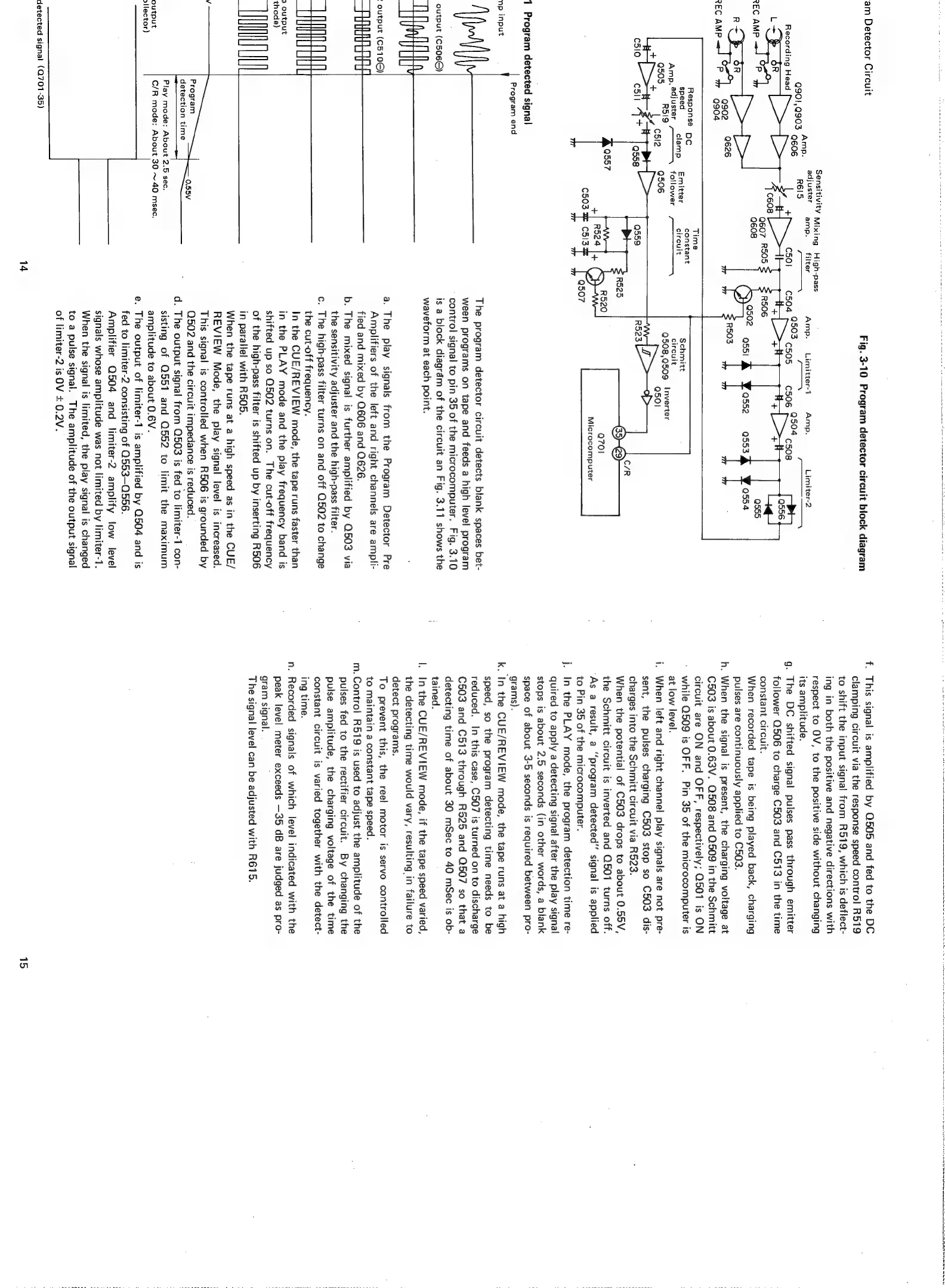
Fig.
3-10
Program
detector
circuit
block
diagram
Amp.
Limitter-1
Amp.
Amp.
ae
amp.
_
filter
Limiter-2
_
901,903
ggog
—F
;
Q503
._..
Q504
Recording
Head
+
C501
c504 c505
C506
L~
#
|
=
i
A
A
C608
607
R505
REC
AMP
Q608
R~
REC
AMP
Q904
RSI9
eel
Q506
Time
Response
pc
constant
speed
clamp
Emitter
circuit
Amp.
2diuster
-~————,_
follower
§=~-~—————
+
|
a558
1
Program
detected
signal
Program
end
np
input
:
'
output
(C506OQ)
output
(C5100)
THRE
>
output
thode)
Program
detection
time
OSSY.
Play
mode:
About
2.5
sec,
output
C/R
mode:
About
30
~
40
msec.
allector)
detected
signal
(Q701-35)
14
Q552
Q553
Schmitt
circuit
Q508,Q509
Inverter
Q501
Microcomputer
The
program
detector
circuit
detects
blank
spaces
bet-
ween
programs
on
tape
and
feeds
a
high
level
program
control
signal
to
pin
35
of
the
microcomputer.
Fig.
3.10
is
a
block
diagrdm
of
the
circuit
an
Fig.
3.11
shows
the
waveform
at
each
point.
a.
The
play
signals
from
the
Program
Detector
Pre
Amplifiers
of
the
left
and
right
channels
are
ampli-
fied
and
mixed
by
O606
and
0626.
b.
The
mixed
signa!
is
further
amplified
by
Q503
via
the
sensitivity
adjuster
and
the
high-pass
filter.
c.
The
high-pass
filter
turns
on
and
off
O502
to
change
the
cut-off
frequency.
In
the
CUE/REVIEW
mode,
the
tape
runs
faster
than
in
the
PLAY
mode
and
the
play
frequency
band
is
shifted
up
so
0502
turns
on.
The
cut-off
frequency
of
the
high-pass
filter
is
shifted
up
by
inserting
R506
in
parallel
with
R505.
When
the
tape
runs
at
a
high
speed
as
in
the
CUE/
REVIEW
Mode,
the
play
signal
level
is
increased.
This
signal
is
controlled
when
R506
is
grounded
by
Q502
and
the
circuit
impedance
is
reduced.
d.
The
output
signal
from
Q503
is
fed
to
limiter-1
con-
sisting
of
Q551
and
0552
to
limit
the
maximum
amplitude
to
about
0.6V.
e.
The
output
of
limiter-1
is
amplified
by
Q504
and
is
fed
to
limiter-2
consisting
of
0553-0556.
Amplifier
Q504
and
limiter-2
amplify
lfow
level
signals
whose
amplitude
was
not
limited
by
limiter-1.
When
the
signal
is
limited,
the
play
signal
is
changed
to
a
pulse
signal.
The
amplitude
of
the
output
signal
of
limiter-2
isOV
+0.2V.
f.
This
signal
is
amplified
by
0505
and
fed
to
the
DC
clamping
circuit
via
the
response
speed
control
R519
to
shift
the
input
signal
from
R519,
which
is
deflect-
ing
in
both
the
positive
and
negative
directions
with
respect
to
OV,
to
the
positive
side
without
changing
its
amplitude.
g.
The
DC
shifted
signal
pulses
pass
through
emitter
follower
Q506
to
charge
C503
and
C513
in
the
time
constant
circuit.
When
recorded
tape
is
being
played
back,
charging
pulses
are
continuously
applied
to
C503.
h.
When
the
signal
is
present,
the
charging
voltage
at
C503
is
about
0.63V.
0508
and
0509
in
the
Schmitt
circuit
are
ON
and
OFF,
respectively;
Q501
is
ON
while
Q509
is
OFF.
Pin
35
of
the
microcomputer
is
at
low
level.
i.
When
left
and
right
channel
play
signals
are
not
pre-
sent,
the
pulses
charging
C503
stop
so
C503
dis-
charges
into
the
Schmitt
circuit
via
R523.
When
the
potential
of
C503
drops
to
about
0.55V,
the
Schmitt
circuit
is
inverted
and
Q501
turns
off.
‘As
a
result,
a
“program
detected”’
signal
is
applied
to
Pin
35
of
the
microcomputer.
j.
In
the
PLAY
mode,
the
program
detection
time
re-
quired
to
apply
a
detecting
signal
after
the
play
signal
stops
is
about
2.5
seconds
(in
other
words,
a
blank
space
of
about
3-5
seconds
is
required
between
pro-
grams).
k.
In
the
CUE/REVIEW
mode,
the
tape
runs
at
a
high
speed,
so
the
program
detecting
time
needs
to
be
reduced.
In
this
case,
C507
is
turned
on
to
discharge
C503
and
C513
through
R525
and
Q507
so
that
a
detecting
time
of
about
30
mSec
to
40
mSec
is
ob-
tained.
|.
In
the
CUE/REVIEW
mode,
if
the
tape
speed
varied,
the
detecting
time
would
vary,
resulting
in
failure
to
detect
programs.
To
prevent
this,
the
reel
motor
is
servo
controlled
to
maintain
a
constant
tape
speed.
m.
Control
R519
is
used
to
adjust
the
amplitude
of
the
pulses
fed
to
the
rectifier
circuit.
By
changing
the
pulse
amplitude,
the
charging
voltage
of
the
time
constant
circuit
is
varied
together
with
the
detect-
ing
time.
n.
Recorded
signals
of
which
level
indicated
with
the
peak
level
meter
exceeds
—35
dB
are
judged.
as
pro-
gram
signal.
:
The
signal
level
can
be
adjusted
with
R615.
15
re
a
Sah
it
Bi
a
sa
aN
ene
A
is
ep
ae
IEDR
AE
IY
Sas