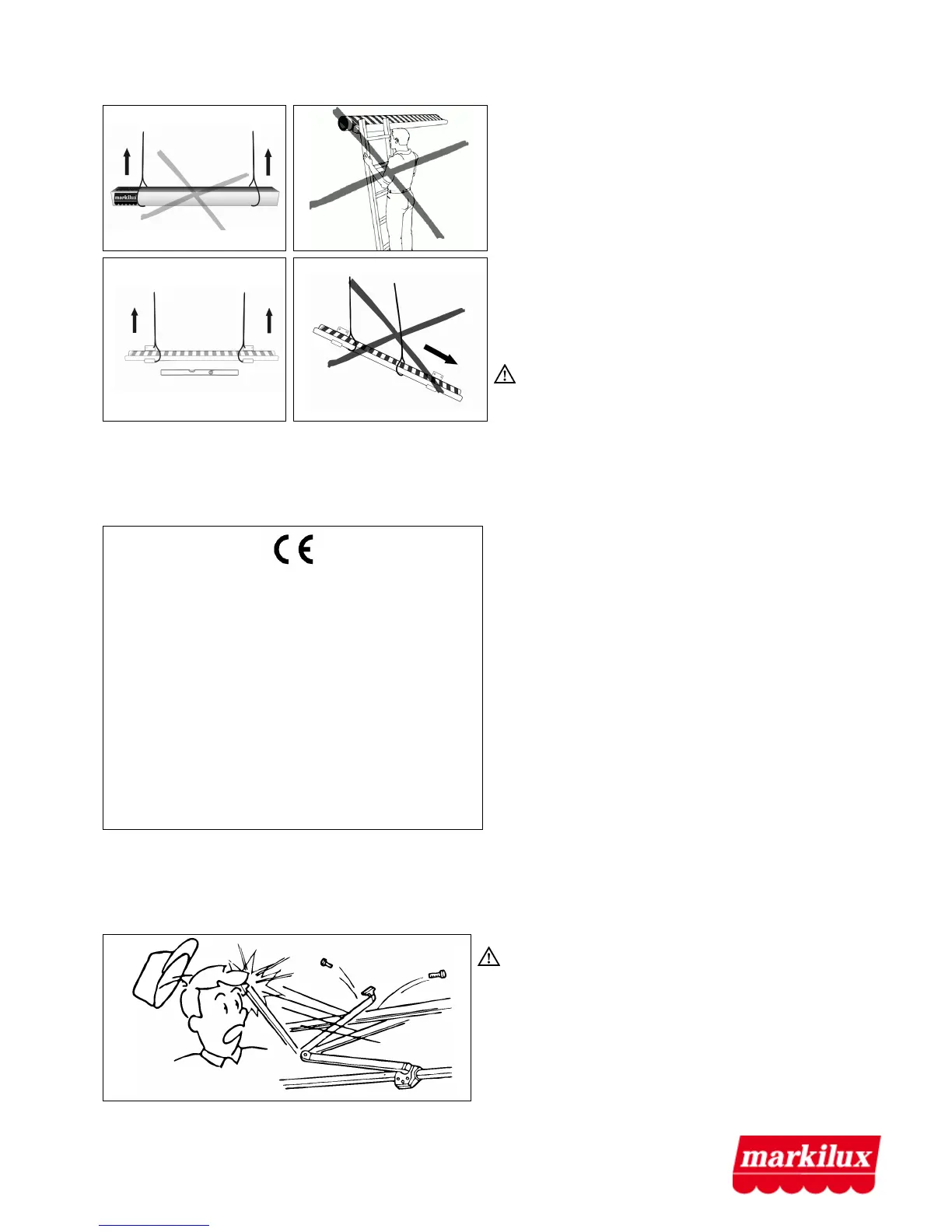
If the awning unit has to be hoisted to a higher area
with the help of ropes, then the awning is
• to be removed from the packaging,
• to be connected with the lifting ropes in such a
way, that it cannot fall out,
• to be pulled up evenly in a horizontal position.
The same also applies for the dismantling of the
awning.
When working at greater heights, there is a risk
of falling. Suitable climbing aids and appropriate fall
safety devices are to be utilized.
5. Wind Resistance Class
markilux
Schmitz-Werke GmbH & Co. KG
Hansestraße 87
D-48282 Emsdetten
DIN EN 13561
Awnings for use on the outside of buildings
Wind resistance class 2
markilux folding-arm awning,
markilux 710/810, 720/820, 725/825, 750/850, 730/830,
791/891, 740/840, 745/845, 893, 8500, 869 (size-dependent)
Wind resistance class 3
markilux 760/860,780/880 und 8000, 869 (size-dependent)
The awning complies with the requirements of the
wind resistance class specified in the CE-conformity
symbol (see handover declaration). When fitted, it only
complies with these requirements, if
• the awning has been fitted with the type and
number of brackets recommended by the
manufacturer,
• during fitting, the instructions of the fastenings
manufacturer of the dowels used have been
observed.
For folding-arm awnings:
• the awning has been fitted taking into account the
dowel pull-out forces specified by the
manufacturer.
6. Partly assembled awnings
With awnings partly assembled at works – e.g.
coupled folding-arm awnings without cover – those
parts under spring tension (see illustration: example
folding-arm awning) are to be secured against
unintentional opening. These safety devices may only
be removed after the installation is complete.
There is a high risk of injury from the marked awning
parts under tension!



 To Next Page