Need help?
Do you have a question about the Marquee ORIENTAL LEAN TO WALL GAZEBO and is the answer not in the manual?
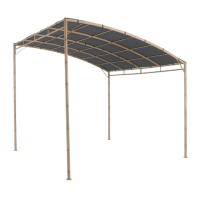
This document provides assembly instructions for the Oriental Lean-To Wall Gazebo, item number 0178005, designed to create an outdoor living space. The gazebo is a semi-permanent structure intended to be attached to an existing wall, offering shade and shelter. Its design features a curved roof, supported by a framework of leg tubes and roof tubes, creating an elegant and functional addition to a patio or garden area.
The primary function of this gazebo is to provide a sheltered outdoor space. It is designed to lean against a wall, making it suitable for areas where a freestanding gazebo might not be practical or desired. The canopy, made of fabric, offers protection from sun and light rain, allowing users to enjoy their outdoor environment more comfortably. The structure is built to be sturdy, with a frame composed of various metal tubes and connectors, ensuring stability once properly assembled and secured. The lean-to design maximizes space utilization, making it an ideal choice for smaller patios or as an extension of an indoor living area. The curved roof design not only adds to its aesthetic appeal but also helps in shedding water, preventing accumulation on the canopy.
The Oriental Lean-To Wall Gazebo is designed for relatively straightforward assembly, as detailed in the provided step-by-step instructions. It requires two types of leg tubes (A1 and A2) to accommodate the lean-to design, ensuring proper height and angle against the wall. The assembly process begins by attaching foot plates (E) to the leg tubes, which provide a stable base for the structure. These foot plates are crucial for securing the gazebo to the ground, enhancing its stability and safety.
The ring beams (B) connect the leg tubes, forming the main rectangular base of the roof structure. These connections are secured using bolts (I) and nuts (J), tightened with an Allen Key (L) and spanner (M). It is important to ensure that the exposed holes on the ring beams face upwards, indicating the correct orientation for subsequent roof tube attachments. This attention to detail during assembly ensures the structural integrity and proper alignment of the gazebo.
The roof structure is formed by various roof tubes, including C1, C2, C3, D1, D2, D3, and D4. The C1 roof tubes are connected to the leg tubes (A1 and A2) using bolts (I) and nuts (J), forming the initial curved sections of the roof. Following this, the C3 roof tubes are attached to the ring beams (B) using bolts (G), further shaping the curved roof. The D-series roof tubes (D1, D2, D3, D4) are then inserted into the C3 roof tubes and connected to the corresponding D2 and D4 tubes, creating a robust and interconnected roof framework. These connections are secured with bolts (H), ensuring the stability of the entire roof assembly.
The final step in assembling the frame involves connecting the D1 and D3 roof tubes with the C2 roof tubes and the A1 and A3 leg tubes, using bolts (I) and nuts (J). This completes the main structural frame of the gazebo. Once the frame is fully assembled and all connections are securely tightened, the canopy (F) is draped over the roof structure. The canopy is then secured to the frame at its corners using bolts (G), ensuring it remains taut and in place.
A critical usage feature is the method of securing the gazebo to the ground. After positioning the gazebo in the desired location, stakes (K) are inserted through the foot plates (E) and driven into the ground. This step is essential for preventing the gazebo from being displaced by wind or other external forces, ensuring its long-term stability and safety. The lean-to design implies that the gazebo should be positioned against a sturdy wall capable of supporting some lateral forces, although the primary support comes from its own leg tubes and ground stakes.
The gazebo is designed for use in various outdoor settings, providing a comfortable spot for relaxation, dining, or entertaining. Its open sides allow for good air circulation, while the canopy offers essential shade. The curved roof design is not only aesthetically pleasing but also functional, allowing rainwater to run off easily, which helps in maintaining the canopy's condition.
Proper maintenance is crucial for extending the lifespan and ensuring the continued functionality of the Oriental Lean-To Wall Gazebo. The materials used, primarily metal tubes for the frame and fabric for the canopy, are selected for outdoor use, but regular care is still necessary.
For the metal frame components, periodic inspection for rust or corrosion is recommended, especially in areas with high humidity or exposure to salt air. Any signs of rust should be addressed promptly by cleaning the affected area and applying a rust-inhibiting paint or coating. All bolts and nuts should be checked periodically to ensure they remain tight. Over time, vibrations or environmental factors can cause fasteners to loosen, which could compromise the structural integrity of the gazebo. Retightening these connections with the Allen Key (L) and spanner (M) as needed will help maintain the gazebo's stability.
The canopy (F) is the most exposed part of the gazebo and requires specific attention. It should be cleaned regularly to remove dirt, leaves, and other debris. A mild soap solution and water, applied with a soft brush or cloth, are typically sufficient for cleaning. Harsh chemicals or abrasive cleaners should be avoided as they can damage the fabric or its protective coatings. After cleaning, the canopy should be thoroughly rinsed and allowed to air dry completely before any prolonged storage or before re-securing it, to prevent mildew growth.
In adverse weather conditions, such as strong winds or heavy snowfall, it is advisable to remove the canopy to prevent damage to both the canopy and the frame. While the gazebo is secured with stakes, extreme weather can still pose a risk. Removing the canopy reduces wind resistance and prevents the accumulation of heavy snow, which could otherwise cause the frame to buckle or collapse. During winter months or extended periods of non-use, disassembling the canopy and storing it in a dry, protected area will significantly prolong its life.
The ground stakes (K) should also be checked periodically to ensure they remain firmly anchored in the ground. If the ground becomes soft due to heavy rain, the stakes might loosen, requiring re-anchoring or repositioning. The foot plates (E) should be kept clear of debris to ensure proper drainage and prevent water from pooling around the base of the leg tubes.
Overall, the Oriental Lean-To Wall Gazebo is designed to be a durable and functional outdoor structure. By following the assembly instructions carefully and performing routine maintenance, users can ensure that their gazebo remains a safe, attractive, and comfortable addition to their outdoor living space for many years. The availability of specific tools like the Allen Key and spanner, often included with such kits, simplifies the assembly and maintenance tasks, making it accessible for most users.
 General
| Frame Material | Steel |
|---|---|
| Roof Material | Polyester |
| UV Protection | Yes |
| Water Resistance | Yes |
| Assembly Required | Yes |
| Type | Gazebo |
| Roof Type | Lean To |

 To Next Page