
 Need help?
Do you have a question about the Marzocchi X-Fly 80 and is the answer not in the manual?
EASTON aluminum steer tube for 1 1/8" diameter, threadless.
Forged and CNC-machined BAM aluminum alloy.
Cast magnesium alloy.
Anodized aluminum with variable section.
Forged and CNC-machined BAM aluminum alloy with disc brake caliper support.
Full length guide bushings with copper base and anti-friction coating.
Computer designed oil seals for high quality.
Specially formulated oil for performance and viscosity stability, with type and quantities.
Guidelines for assembly, cleaning, lubrication, and tool usage.
Addressing oil leaks through slider top or bottom, including causes and remedies.
Resolving fork lockout from non-use and pressure drops.
Fixing excessive stanchion play and fast fork rebound.
Diagnosing and fixing issues where adjuster position has no effect.
Tips on cleaning, lubrication, running-in, oil changes, and polishing.
Guidelines for safe and proper fork installation on a bicycle.
Instructions for assembling disc brake systems and related components.
How to set compression damping using air pressure and specific tools.
Adjusting rebound damping via an external screw for hydraulic setting.
Flowchart showing the quickest procedure and exact disassembling sequence.
Depressurizing fork legs, removing caps, and draining oil.
Procedures for changing the right leg hydraulic cartridge and left leg pumping rod.
Steps to remove crown/stanchions assembly, dust seals, and stop rings.
Procedures for removing and replacing oil seals, upper washer, and pilot bushing.
Operation to replace the air valve on the fork, after draining pressure.
Washing components and assembling pilot bushing, seals, washers, and cartridges.
Fitting the crown/stanchions assembly and dust seals into the sliders.
Re-installing cartridges, rods, foot nuts, and filling with oil.
Securing hydraulic cartridge caps and pressurizing the fork.
List and description of specialized tools required for fork maintenance.
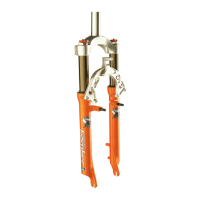
The X-FLY is a specialized air/oil damped cross-country fork designed for mountain biking, emphasizing reduced weight, improved rigidity, and consistent performance. Each leg of the fork utilizes pressurized air as a damping medium, introduced through a special valve located on the stanchion caps. This design contributes to its lightweight nature and responsive handling on varied terrain.
For damping control, the right leg of the fork incorporates a hydraulic cartridge that manages rebound. Rebound damping can be adjusted externally via a top right leg adjuster, allowing riders to fine-tune the fork's response to different trail conditions and personal preferences. This adjustability is crucial for optimizing ride comfort and control, especially during descents or over rough patches. The adjustment mechanism involves turning a screw that alters the hydraulic setting of inner valves, with about 8 turns offering a range of approximately 4 mm of adjustment. It is recommended to start from the minimum damping setting by unscrewing completely counterclockwise when making adjustments.
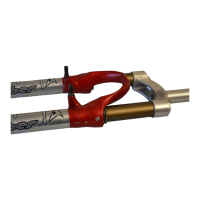
The structural integrity of the X-FLY fork is enhanced by several design features. The stanchions are fitted into the lower crown using a cryofit technique, which ensures a secure and rigid connection. Full-length bushings are incorporated to guarantee superior rigidity throughout the fork's travel, contributing to precise steering and stability. The sliders and arch are integrated into a single assembly, further reducing weight and improving overall rigidity. This monolithic design minimizes flex and enhances the fork's ability to withstand the stresses of aggressive riding.
To ensure smooth operation and longevity, the X-FLY fork incorporates advanced lubrication and sealing technologies. Parts subjected to friction are continuously cooled and lubricated by a specially formulated oil. This oil is designed to eliminate foaming and prevent viscosity breakdown, providing complete stiction-free performance. The fork uses EBH 16 - SAE 7.5 type oil, with specific volumes for each leg: 110 cc for the right leg and 85 cc for the left leg in the 80mm travel version, and 95 cc for the right leg and 115 cc for the left leg in the 100mm travel version. Computer-designed oil seals are used to guarantee the highest quality sealing available, preventing oil leakage and maintaining consistent performance. The slider bushings are full-length guide bushings made of a copper base impregnated with an anti-friction coating, further reducing friction and enhancing durability.
The steer tube is made from EASTON aluminum, available in a 1 1/8" diameter, threadless design, ensuring compatibility with modern bicycle setups. The crown is forged and CNC-machined from BAM* (Bomber Aerospace Material) aluminum alloy, a special alloy developed from aerospace material, highlighting the fork's high-quality construction. The arch is cast from magnesium alloy, contributing to its lightweight yet robust structure. The stanchions are made of anodized aluminum with a variable section, optimizing strength where needed while minimizing weight. The sliders are also forged and CNC-machined from BAM* aluminum alloy, with the left slider specifically designed to include supports for a disc brake caliper.
Maintenance of the X-FLY fork is critical for preserving its performance and extending its lifespan. Regular checks and cleaning are recommended, particularly for the area below the dust seal and the stanchion tube after each use, followed by lubrication with silicone oil. A short running-in period of 5-10 hours may be required for inner adjustments to settle, which will ultimately contribute to longer fork life and consistent top performance. It is important to change the fork oil at least every 100 working hours and to check the air pressure at least every 10 working hours. Polished forks should be cleaned with bodywork polish regularly to maintain their original finish.
When installing the fork, extreme care is advised, and it should ideally be checked by a Technical Service Center. Proper steer tube/headset mounting and adjustment, in compliance with the headset manufacturer's instructions, are crucial for rider safety. Improper installation of the steer tube into the crown can lead to loss of control. For disc brake system assembly, it is strictly forbidden to loosen or remove original brake support fixing pins, as they are essential for securing the slider bottom to the slider-arch monolith. If replacement is necessary, specific screws (part no. 532979QF) should be used and tightened to 15 Nm. Screw and pin threading are treated for hydraulic seal, and removed screws and pins should never be reused. Assembling the brake caliper requires careful attention to avoid overstressing the caliper supports.
Troubleshooting common issues is facilitated by a provided guide. For oil leaking through the top of the slider, causes include a worn oil seal, a scored stanchion tube, or excessive dirt on the slider oil seal. Remedies involve replacing the oil seal, replacing the crown/stanchions assembly along with oil and dust seals, or cleaning the oil seal seat and replacing the oil seal. Oil leaking from the bottom of the slider usually indicates a damaged O-ring on the pumping rod or cartridge securing nut, requiring O-ring replacement. If the fork is locked out after disuse, it's likely due to oil and dust seals sticking to stanchions, which can be remedied by raising the dust seal and lubricating the stanchion tube, dust seal, and oil seal. Pressure drop points to a damaged cap valve, necessitating its replacement. Excessive play of stanchions in the sliders suggests worn pilot bushings, which should be replaced. If the fork rebounds too fast or if adjuster position has no effect, dirt inside the fork legs or legs, respectively, is the likely cause, requiring careful cleaning and oil change.
Disassembly and reassembly procedures are detailed to guide maintenance and repair. When disassembling, it's crucial to follow the specified sequence to avoid damage. For example, when removing the stop ring, care must be taken not to damage its seat, and removed oil seals should not be reused. All metal components should be washed with a biodegradable solvent and dried with compressed air before reassembly. Lubrication of parts in contact with each other using silicone fat spray or specific oil for seals, and greasing lip seal rings, are essential steps during reassembly. Only metric wrenches should be used to prevent damage to fastening devices. The air valve can be replaced when the fork is fully assembled on the bike, but only after draining inner pressure. If the fork is removed, it should be kept vertical to prevent oil leakage during air valve disassembly.
Special tools, such as a slider protector (R 5089 AB) for oil seal removal, an oil seal press (R 5090) for oil seal installation, an inflating pump (R 4008/C), and an adapter fitting (5321038), are recommended for proper maintenance and repair. These tools ensure that operations are performed correctly and without damaging the components, contributing to the overall longevity and performance of the X-FLY fork.
 General
| Travel | 80 mm |
|---|---|
| Spring Type | Coil |
| Adjustments | Preload, Rebound |
| Damper Type | Open Bath |
| Steerer Tube Diameter | 1 1/8 inch |
| Wheel Size | 26 inch |
| Axle Type | 9 mm Quick Release |
| Brake Compatibility | Disc and V-Brake |


 To Next Page