39DO NOT DIVE.
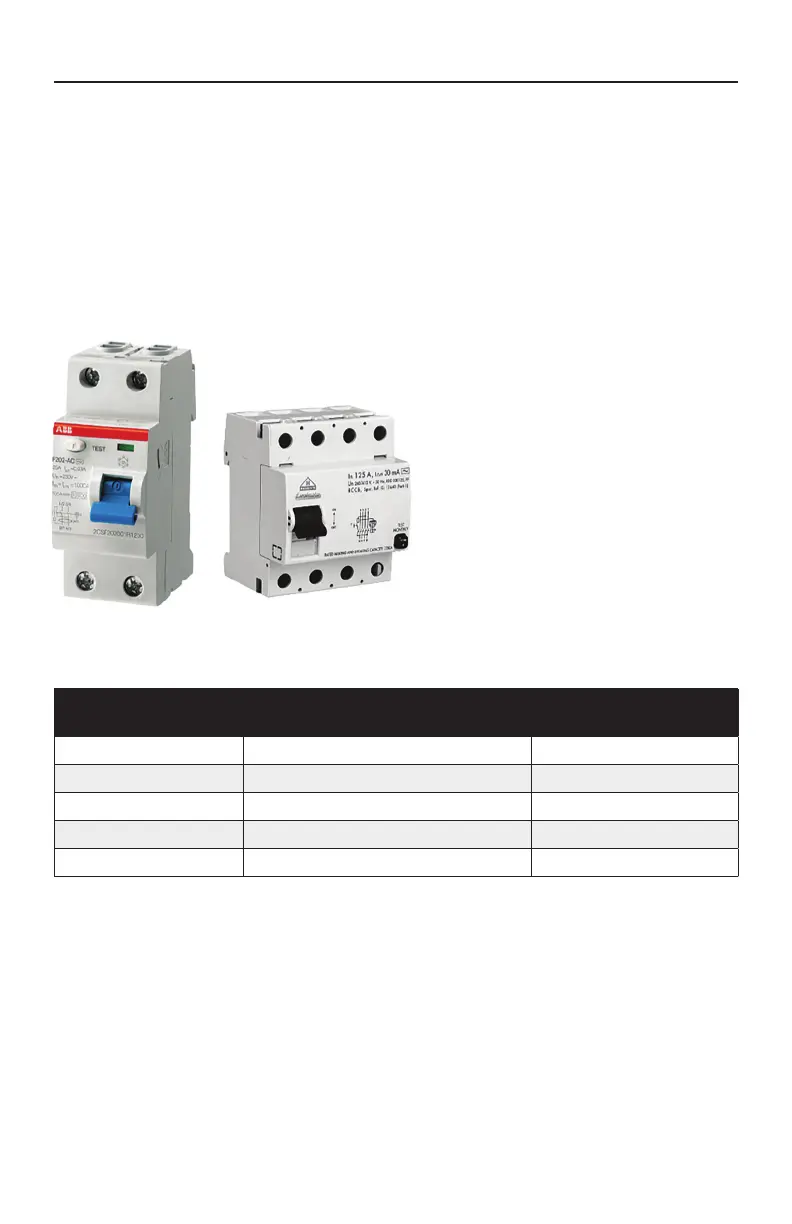
A residual current device (RCD, or R.C.D. henceforth) is the generic term for a device that monitors
the current in the line conductor and the neutral conductor in an earthed system.
In a circuit that’s operating properly, the vector sum of the live and neutral current values added
together will be zero. Current flowing to earth, due to a line earth fault, will return via the earth
conductor, and regardless of load conditions, will be registered as a fault. This current flow will
give rise to a residual current that will be detected by the device. If the residual current exceeds the
rated sensitivity of the RCD, it will automatically activate a tripping of the faulty circuit.
Two Pole RCD Four Pole RCD
Typical specifications are as follows:
Residual Current Devices (RCDs) range
Sensitivity – from 10 to 500mA
Voltage – 2 poles: 230V; 3/4 poles:
230/400V
Connection capacity
- 25A: 6/10 mm
2
(flexible/rigid cable)
- 40,60A: 16/25 mm
2
- 80,100A: 35/50 mm
2
Total Ampere Rating
of Power System
Minimum Wire Size
Use Copper ONLY with 90˚C Insulation
Ampere Rating of
RCD Circuit-Breaker
0 A to 16 A #12 AWG / 3.31 mm
2
20
16 A to 20 A #10 AWG / 5.26 mm
2
25
20 A to 24 A #10 AWG / 5.26 mm
2
30
24 A to 28 A #8 AWG / 8.36 mm
2
35
28 A to 32 A #8 AWG / 8.36 mm
2
40
ELECTRICAL REQUIREMENTS
230 Volt 50 hz – residual current devices (rcds)





 To Next Page