headline bars
continuation tabs
notes
warnings
headline bars
continuation tabs
notes
warnings
6 7
model no. 058-1893-2 | contact us 1-800-689-9928
SAFETY GUIDELINES
SPECIFIC SAFETY GUIDELINES FOR THE SLIDING WET TILE SAW
SAFETY GUIDELINES
6. RISK OF BURNS.
The pump and the manifold generate high temperatures. In order to
avoid burns or other injuries, do not touch the pump, the manifold or the transfer tube
while the compressor is running.
Allow the parts to cool down before handling or
servicing. Keep children away from the compressor at all the times.
7.
Be certain to read all labels when you are spraying paints or toxic
materials, and follow all safety instructions. Use a respirator mask if there is a chance
of inhaling anything you are spraying. Also, NEVER directly inhale the air produced by
a compressor.
8.
Wear ANSI Z87.1 or CSA Z94.3 approved safety goggles when
using an air compressor. Do not point any nozzle or sprayer toward a person or any
part of the body. Serious injury may occur if the spray penetrates the skin.
BREATHING RISK.
RISK OF EYE INJURY.
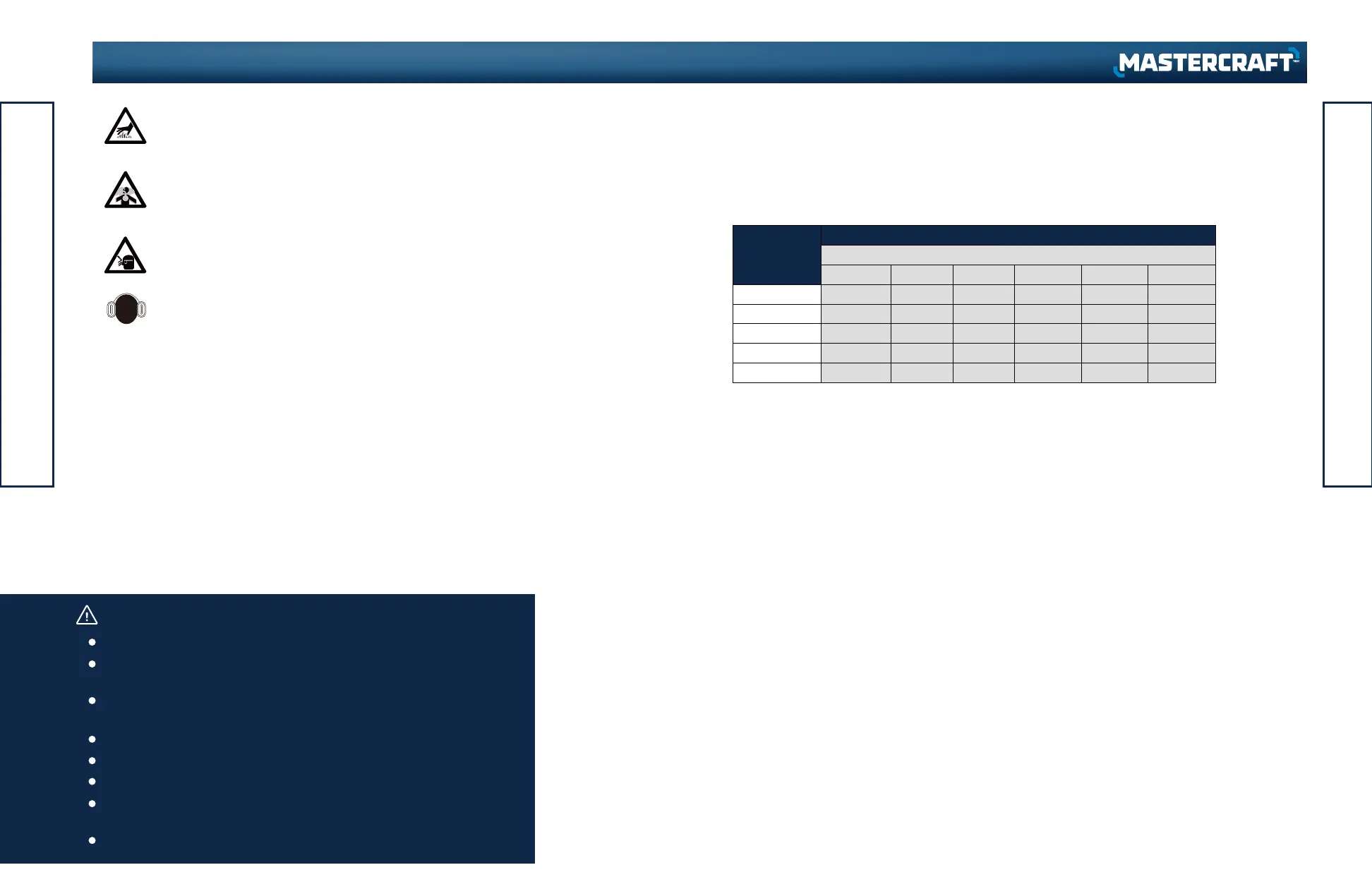
Recommended Minimum Wire Gauge for Extension Cords* (120 V)
* Based on limiting the line voltage drop to 5 V at 150% of the rated amperes.
The smaller the gauge number of the wire, the greater the capacity of the cord. For example, a 14-gauge
cord can carry a higher current than a 16-gauge cord. When using more than one extension cord to make
up the total length, be sure each cord contains at least the minimum wire size required.
Guidelines for using extension cords
•
•
Ensure your extension cord is properly wired and in good electrical condition. Always replace a
damaged extension cord or have it repaired by a qualified technician before using it.
Protect your extension cords from sharp objects, excess heat, and damp or wet areas.
WARNING!
Pull the pressure safety valve ring every day in order to ensure that the valve is functioning properly.
The compressor must be located in a well-ventilated area for cooling and must be a minimum of 12"
(31 cm) away from the nearest wall.
Protect the air hose and the power cord from damage and puncture. Inspect them for weak or worn spots
every week, and replace them if necessary.
Always wear hearing protection when using an air compressor. Failure to do so may result in hearing loss.
Do not carry the compressor while it is running.
Do not operate the compressor if it is not in a stable position.
Do not operate the compressor on a rooftop or an elevated position that could allow the unit to fall or be
tipped over.
Always replace a damaged gauge before operating the unit again.
Extension cords
As the distance from the supply outlet increases, you must use a heavier gauge extension cord. Using
extension cords with inadequa tely sized wire causes a serious drop in voltage, resulting in loss of power
and possible product damage. Refer to the table here to determine the required minimum wire size.
9. RISK TO HEARING. Always wear hearing protection when using an air compressor.
Failure to do so may result in hearing loss.
CORD SIZE IN AWG (AMERICAN WIRE GAUGE)
Extension cord length
25' (7.6 m) 50' (15 m) 75' (23 m) 100' (30 m) 150' (46 m) 200' (60 m)
0 – 5 16 16 16 14 12
5.1 – 8 16 16 14 12 —
8.1 – 12 14 14 12 10 —
12.1 – 15 12 12 10 10 —
15.1 – 20 10 10 10 —
12
10
—
—
— —
AMPERE
RATING


 To Next Page
 Loading...